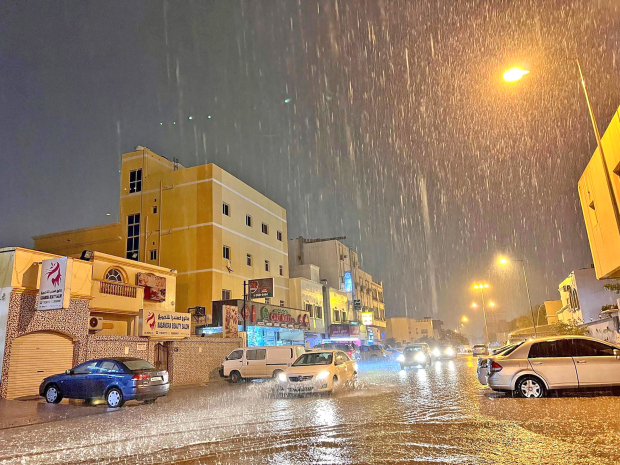
Preparations have been stepped up ahead of the rainy season, with a special focus on addressing long-standing flooding problems in the Muharraq Governorate, according to officials.
An extraordinary meeting between Muharraq Municipal Council members and senior Works Ministry officials reviewed the progress in resolving water drainage issues across key areas prone to water accumulation.
It was revealed that 13 of the 50 regular flooding locations in Muharraq have now been completely cleared, three are in the tendering stage and nine are under “active construction”.
Acting council chairman Saleh Buhazaa said the ministry had made “remarkable strides” in addressing flooding challenges, particularly in newly-developed housing areas such as Galali and East Hidd.
“These areas demonstrate the right approach to infrastructure planning and should be the model we follow moving forward,” said Mr Buhazaa.
However, he noted that most of the governorate’s persistent flooding issues were due to older housing areas built around two decades ago, many of which lacked proper drainage infrastructure when constructed.
“Most of the flooding problems are with residential areas built 20 years ago without adequate infrastructure,” he explained. “Re-engineering these neighbourhoods is either extremely difficult or very costly.
“Also, there is an issue with Old Muharraq, where narrow alleys make it hard for tankers and equipment to enter.”
He also confirmed that rainwater drainage channels are being cleaned and maintained as part of the country’s preventive measures, while both the Works Ministry and the Municipalities Affairs and Agriculture Ministry will jointly handle rain-related responsibilities – with the former overseeing main highways and streets, and the latter focusing on inner residential areas.

Mr Buhazaa
Mr Buhazaa acknowledged that similar problems persist in other parts of the country, citing Wadi Al Sail and Hunninyah Valley in the Southern Governorate as examples.
“These issues are not unique to Muharraq, other governorates face the same difficulties,” he said.
“But we are confident that with proper co-ordination, these problems can be managed and gradually resolved.”
Meanwhile, the council’s services and public utilities committee chairman Abdulqader Al Sayed praised the Works Ministry’s proactive approach, saying the government was better prepared this year to deal with rainfall.
“Flooding will happen, but it will be limited,” he said.
“There’s no magic wand to fix everything overnight, but problems are being solved one by one.”

Mr Al Sayed
Mr Al Sayed emphasised that new housing projects, designed with advanced drainage and infrastructure systems, have largely been free of flooding issues – a result of the government’s ongoing commitment to improving public services and urban resilience.
“The government has already addressed concerns in new housing areas such as East Hidd, East Sitra and Salman Town,” he said.
“These areas no longer experience flooding, and we want to see the same level of development in Old Muharraq – a historic area protected by Unesco and now undergoing modernisation under royal directives.”
Both officials reiterated their confidence in the national rain response plan and expressed optimism that Bahrain’s preparations this year would significantly minimise disruptions during the rainy season.
mohammed@gdnmedia.bh