

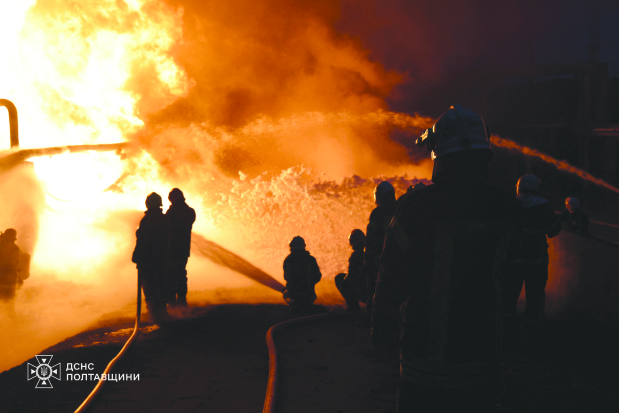
Russia’s air defences destroyed 77 Ukrainian drones launched, Russia’s defence ministry said yesterday, as both sides continued cross-border air attacks in the nearly four-year-old war.
The drones were downed over seven regions in southern and central Russia and over Russian-annexed Crimea, the ministry said in a statement on the Telegram messaging app.
A power transmission tower was damaged in the Rostov region bordering Ukraine, about 1,000km south of Moscow, leaving about 250 residents without electricity, Rostov Governor Yuri Slyusar said on Telegram, adding that no one was injured.
Forty-two drones were destroyed over the Saratov region in southwestern Russia and 12 over the Rostov region, the defence ministry said.
Russian authorities rarely disclose the extent of damage from Ukrainian air attacks and almost never confirm hits on military infrastructure.
The war has increasingly featured long-range drone and missile strikes far from the front lines, as each side seeks to hit military, logistics and energy assets deep in the other’s territory.
Moscow has carried out missile and drone attacks on Ukraine’s power grid and cities in past winters and ahead of this winter, causing blackouts and putting pressure on repair crews as cold weather sets in.
Kyiv has stepped up drone attacks on oil depots, airfields and other targets inside Russia, often casting them as a legitimate response to Moscow’s campaign against Ukraine’s cities and energy system.
US President Donald Trump’s outgoing Ukraine envoy said a deal to end the Ukraine war was ‘really close’ and now depended on resolving two main outstanding issues: the future of Ukraine’s Donbas region and the Zaporizhzhia nuclear power plant.
Russia invaded Ukraine in February 2022 after eight years of fighting between Russian-backed separatists and Ukrainian troops in the Donbas, which is made up of the Donetsk and Luhansk regions.
The Ukraine war is the deadliest European conflict since the Second World War and has triggered the biggest confrontation between Russia and the West since the depths of the Cold War.
US Special Envoy for Ukraine Keith Kellogg, who is due to step down in January, told the Reagan National Defence Forum that efforts to resolve the conflict were in ‘the last 10 metres’ which he said was always the hardest.
The two main outstanding issues, Kellogg said, were on territory – primarily the future of the Donbas – and the future of Ukraine’s Zaporizhzhia nuclear power plant, Europe’s largest, which is under Russian control.
“If we get those two issues settled, I think the rest of the things will work out fairly well,” Kellogg said on at the Ronald Reagan Presidential Library and Museum in Simi Valley, California. “We’re almost there.”
&uuid=(email))