

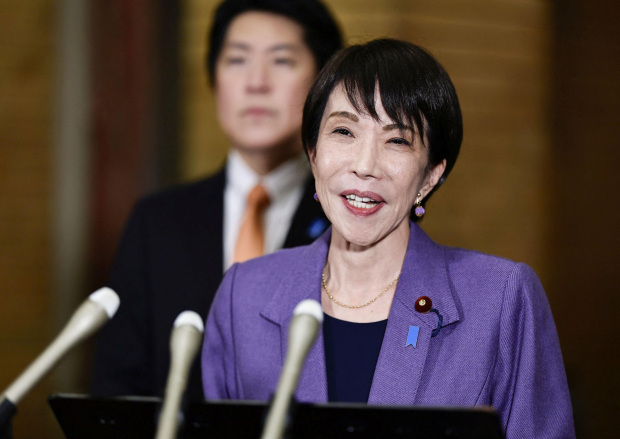
Japan’s Prime Minister Sanae Takaichi is among some 60 female legislators petitioning for more women’s toilets in the parliament building to match their growing representation in the legislature.
A record 73 women were elected into the 465-seat Lower House in October 2024, exceeding the previous high of 54 in 2009.
One opposition legislator, Yasuko Komiyama, said there were often ‘long queues in front of the restroom... before plenary sessions start’, and quoted another MP who said she had ‘given up’ going to the toilet before a session began, reported BBC News.
There is one female toilet with two cubicles near the plenary chamber, though the entire building itself has nine female toilets with 22 cubicles.
There are a total of 12 men’s toilets with 67 stalls and urinals across the building, according to local media reports.
The current situation is ‘often inconvenient’ because female staff and visitors also share the toilets, said Komiyama from the opposition Constitutional Democratic Party.
“I want to raise my voice and prepare myself for the day when women hold more than 30 per cent of (parliamentary seats) in the future,” she wrote in a post on Facebook.
Japan’s parliament building was built in 1936, a decade before women were given the right to vote in 1945. The first women were appointed to parliament in 1946. The parliament building is a sprawling three-storey structure, with a central portion that is nine storeys high. The building occupies 13,356sqm, the equivalent of about two football pitches, with a total floor area of 53,464sqm.
“If the administration is serious about promoting women’s empowerment, I believe we can count on their understanding and co-operation,” Komiyama said, according to Japanese media.
Chair of the Lower House committee Yasukazu Hamada has ‘expressed a willingness’ to consider the proposal for more women’s toilets, said an Asahi Shimbun report.
The Japanese government earlier set a target of having 30pc of leadership roles across all sectors of society held by women by 2020, but at the end of that year the timeframe was quietly pushed back by a decade.
Women currently hold nearly 16pc of the seats in the Lower House and about a third – or 42 out of 125 seats – in the Upper House.
Takaichi had pledged to raise female representation in her cabinet to levels comparable to Nordic countries, which hold the top spots in terms of female leadership. But she has appointed just two other women to her 19-member cabinet.
&uuid=(email))