

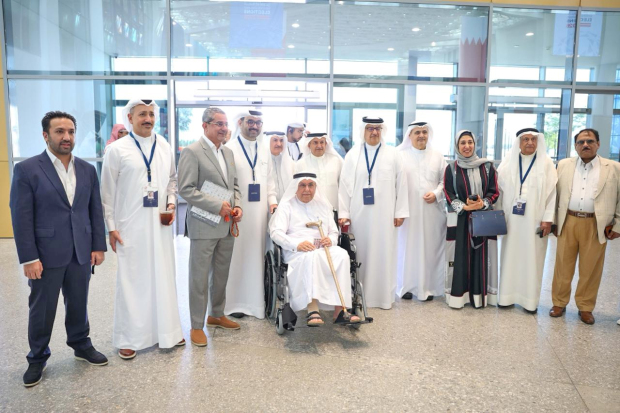
A high-stakes atmosphere gripped Exhibition World Bahrain in Sakhir yesterday as the kingdom’s business community cast their votes in the landmark 31st board of directors elections for the Bahrain Chamber.
The polls officially closed at 10pm and the counting process entered into its final stages of counting to choose the 18-member body that will steer Bahrain’s private sector for the next four years.
This year’s proceedings were lauded for their efficiency, utilising a high-speed electronic system capable of processing more than 300,000 votes.
The atmosphere remained professional yet charged with anticipation.
The kingdom’s ‘Merchant Class’ participants were seen throughout the day casting their votes, underscoring the high importance placed on this session’s mandate.
The race featured 27 candidates vying for the coveted 18 seats.
One candidate unofficially withdrew from the race over an unannounced issue, observers were told.
An 18-member bloc Estidamah (Sustainability), led by Nabeel Kanoo, featured a blend of veteran business leaders and emerging talent such as Mohamed Alkoheji, Nawaf Alzayani, Yousuf Salahuddin, Sonya Janahi, Sawsan Abulhassan, Abeer Almoayyed, Ahmed Al Salloom, Jameel Al Ghanah, Professor Waheeb Al Khaja, Abdulwahab Al Hawaj, Mohammed Adel Fakhro, Shaker Al Helli, Rashad Zainal, Mohammed Diwani, Hassan Bader Kaiksow, Khalid Abdulrahman Juma and Khalid Engineer.
Mr Kanoo, who ran solely for the chairman’s post, emphasised that the bloc’s vision was centred on stability and sustainable growth.
“We in the Estidamah Bloc recognise that the current phase presents several challenges for the commercial sector, particularly in light of regional circumstances and economic shifts,” he said.
“This makes it increasingly important to strengthen co-operation between the Bahrain Chamber and the government to ensure the continued stability of the national economy.”
Many incumbents have campaigned on their track record of navigating the private sector through global economic shifts and their strong consultative relationship with the government.
Several independent candidates and younger entrepreneurs voiced the need for more ‘agile support’ for small and medium enterprises (SMEs) and a deeper focus on digital economy legislation.
Business leaders liked the new location for the big vote in Sakhir.
“Moving to this larger space was a significant improvement. It offered the breathing room needed for effective networking..
“While it was further from the city centre, the trade-off was worth it; we were able to manage the logistics as long as the environment supported the business community,” said independent candidate Ebrahim Aldaaysi.
“With 27 candidates in the running, the real winner is the Chamber. This is a healthy race to reach the decision-making tables, and I hope the outcome serves the greater economy.”
On leadership and integrity, Mr Aldaaysi added: “I had two pieces of advice. To the electors: choose those truly capable of delivering results. To the candidates: you must respect the fine line between public interest and private interest. We are here to serve the collective, not ourselves.
“Given the regional challenges we face, we need extraordinary people at the helm who can manage these circumstances with vision.”
“The chamber remains the primary voice of the merchant,” one voter told the GDN outside the hall.
“We need a board that can bridge the gap between traditional commerce and the rapid digitalisation we are seeing across the GCC.”
Estidamah Bloc member Yousuf Salahuddin underlined the Bahrain Chamber’s long history, having been established in 1939, describing it as one of the oldest economic institutions in the region.
“Over the years, the Chamber has been essential in organising commercial activities, championing merchants, supporting economic legislation, and improving the business climate, thereby securing its place as a vital partner in Bahrain’s development,” he added.
Commenting on the election turnout, independent candidate Bob Thaker told the GDN he was encouraged by the turn out amidst the circumstances the country finds itself in as Iranian aggression continues.
“These are undoubtedly challenging times for the economy, and I wish the incoming board well. Their primary focus must be to tackle the pressing issues currently facing our markets, established businesses, and specifically our SME sector.”
He added: “I must congratulate the Bahrain Chamber on organising such a smooth and efficient election.
“The entire process was exceptionally well-thought-out and professionally executed. It is a commendable job by the entire team involved.”
According to the initial data announced by Elections Committee chairman Abbas Radhi, around 37,000 commercial registrations were eligible to take part in the elections, while 2,613 commercial registrations actually participated in the voting process.
A total of 1,028 traders attended and cast their votes.
The total number of votes available to eligible voters stands at 307,176 votes, under the adopted voting system which grants varying voting weights based on the size of the commercial registration.
These figures indicate a participation rate of approximately seven per cent of the total registrations.
While this may appear relatively low numerically, it carries qualitative significance given the nature of chamber elections, which depend more on the weight and representation of companies than on the number of participants, in addition to the presence of a number of inactive registrations.
Currently, undisclosed capital gets two votes, BD1 to BD19,999 four votes, BD20,000 to BD49,999 eight votes, BD50,000 to BD99,999 16 votes, BD100,000 to BD499,999 32 votes, BD500,000 to BD999,999 64 votes, BD1m to BD4.999m 128 votes, and BD5m and above gets 256 votes.
avinash@gdnmedia.bh
mohammed@gdnmedia.bh
&uuid=(email))