

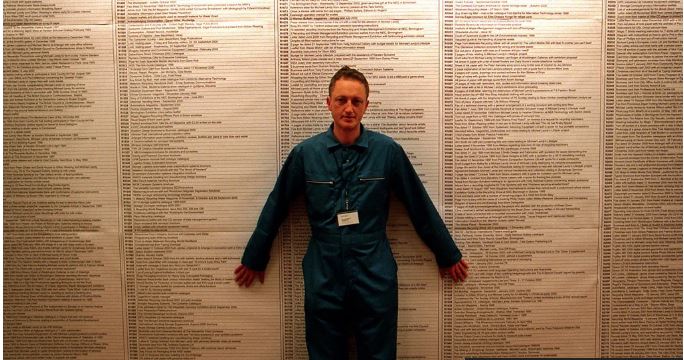
In February 2001, artist Michael Landy did something people still talk about today. He counted everything he owned. Landy compiled a complete list of every object he possessed – clothes, books, paintings, tools, gifts, and small items that people often forget about. He even included items with deep personal meaning, such as love letters and family photos. Listing every item was the first step towards a larger, bolder idea. He has a list of 7,227 possessions.
After the counting, a plan emerged that shocked many. Landy set up a temporary factory in the middle of London’s busiest shopping area, near Oxford Street. This place is always full of people going into stores and looking at shop windows. It is a place where the city shows itself at its most consumer-friendly side. Landy chose that spot for a reason. He wanted his work to stand right beside the world that buys and sells so much.
Landy called the project Breakdown. He and a team built a long, noisy machine in a glass-fronted space. The machine had belts, crushers, and shredders. It looked like a real industrial site. However, instead of making cars or furniture, this factory made destruction. The public could look through the windows and watch what happened inside. People passing by stopped to look. Some took pictures. Some stood in silence. Others laughed nervously or walked away.
Landy’s possessions went through the machine one by one. A shirt went on the belt. A painting slid forward. A handwritten note moved along and met a grinder. Even his car was there! Each object was broken down, crushed, or shredded until nothing remained to recognise. The parts were collected and, in the end, removed. The performance was careful and organised. Nothing was burned or scattered on the street. Everything Landy owned was reduced to simple materials. The destruction was public and controlled.
Watching these private and ordinary things being destroyed made many people uncomfortable. Love letters, in particular, seemed to disturb viewers. These items contained memories and feelings. Seeing them fed into a machine felt like watching their private lives being erased. For some, the act seemed wasteful. Others felt brave and honest. Landy himself said that the work was an experiment. He wanted to ask: Who are we without our possessions?
That is a sharp and simple question. Many people use objects to define themselves. Clothing reflects fashion choices and social status. Art and books can express taste and personality. Cars can signal success. Houses and furniture suggest comfort and stability. When identity is tied to objects, losing them might feel like losing part of oneself. Landy’s work prompted people to consider this. By removing all his objects, he attempted to determine what remained of the self that was not material.
The timing and place of the Breakdown mattered. In the early 2000s, shopping culture was strong, and Oxford Street was a symbol of it. Landy’s factory sat in the heart of that commerce, like a mirror reflecting the city. Shoppers moved past, often without stopping. Their lives continued—bags in hand—while Landy’s possessions disappeared behind glass. This contrast made the performance even more powerful. It suggested that people can live side-by-side with loss and never notice it. It also hinted that building identity on purchases might be fragile.
Critics have different views. Some called it ‘Breakdown – an important piece of contemporary art. They saw this as a daring statement about consumer culture. Others found it too extreme or theatrical. They worried that this was simply a way to gain attention. However, many agreed that it made people think. The work created a space for public conversations about value, meaning, and memory.
Landy viewed the work as personally meaningful. By listing everything he owned and then destroying it, he displayed his own life. The act showed discipline and risk. He gave up the convenience of possessions and the comfort of familiar objects. At the same time, he maintained his sense of identity. He did not destroy himself. He walked away from the factory without his belongings but remained himself. This outcome helped answer the question he had raised. He showed that a person can continue after giving up objects. However, the performance also showed that people attach significant emotional importance to things, and that discarding them can be painful.
Breakdown left a lasting impression on London and on the art world. It forced people to look at the link between self and possessions. It raised questions about consumption, waste, and meaning that remain important today. As stores and advertisements push for more buying, Landy’s work reminds us that possessions do not automatically equal identity or happiness. The factory in Oxford Street was loud and industrial for a few weeks. Yet, the idea behind it continues, quietly asking anyone who thinks about it: Who are we without our possessions?
Dr Aloma Jayasundera
&uuid=(email))