

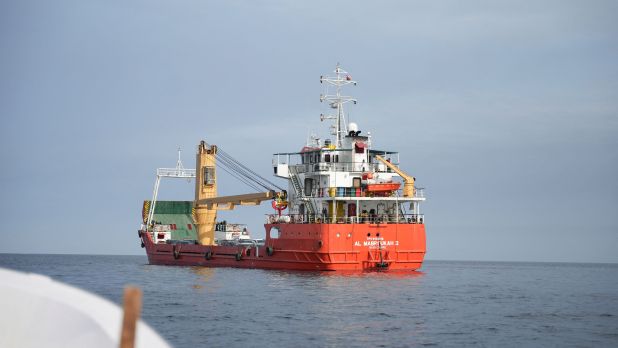
President Donald Trump said yesterday the US Navy would start blockading the Strait of Hormuz, raising the stakes after marathon talks with Iran failed to reach a deal to end the war, jeopardising a fragile two-week ceasefire.
The US Central Command said US forces would begin implementing the blockade of all maritime traffic entering and exiting Iranian ports at 10am ET (1400 GMT) today.
It would be ‘enforced impartially against vessels of all nations entering or departing Iranian ports and coastal areas, including all Iranian ports on the Arabian Gulf and Gulf of Oman’, a CENTCOM statement on X said.
US forces would not impede freedom of navigation for vessels transiting the Strait of Hormuz to and from non-Iranian ports, and additional information would be provided to commercial mariners through a formal notice prior to the start of the blockade, it said.
Trump also said in a post on Truth Social that the US would take action against every vessel in international waters that had paid a toll to Iran, and begin destroying mines that he said the Iranians had dropped in the strait, a choke point for about 20 per cent of global energy supplies that Iran has blocked.
“No one who pays an illegal toll will have safe passage on the high seas,” Trump wrote, adding: “Any Iranian who fires at us, or at peaceful vessels, will be BLOWN TO HELL!”
Iran’s Parliamentary Speaker Mohammad Baqer Qalibaf, who led his country’s delegation to the talks along with Foreign Minister Abbas Araqchi, said Trump’s new threats would have no effect on Iran.
“If you fight, we will fight, and if you come forward with logic, we will deal with logic,” he said, in comments carried by state media.
Six weeks of fighting has killed thousands, roiled the global economy and sent oil prices soaring as Iran prevented traffic through the strait.
Trump said yesterday that the price of oil and gas may remain high through November’s midterm elections, a rare acknowledgement of the potential political fallout from the war.
The dollar jumped against other major currencies yesterday, as investors sought the relative safety of the currency after the talks failed to yield a deal, plunging markets into a seventh week of uncertainty.
The weekend talks in Islamabad, which followed the announcement of a ceasefire last Tuesday, were the first direct US-Iranian meeting in more than a decade and the highest-level discussions since the 1979 Islamic Revolution.
“The bad news is that we have not reached an agreement, and I think that’s bad news for Iran much more than it’s bad news for the United States of America,” Vice President JD Vance, who headed the US delegation, said afterwards.
In an interview with Fox News after his post about the strait, Trump nevertheless said he believed Iran would continue to negotiate and called the discussions “very friendly”.
&uuid=(email))