

A new, faster government mechanism to install, fix and upgrade street lighting across Bahrain has been officially revealed, promising clearer responsibilities between ministries and quicker responses to municipal requests.
The system was outlined to the Muharraq Municipal Council following a recommendation to install lighting poles along Road 607 in Muharraq’s Block 206. The response, issued through the Municipalities Affairs and Agriculture Ministry, details a streamlined process agreed with the Works Ministry alongside the Electricity and Water Affairs Ministry.
Municipal Affairs Under-Secretary Shaikh Mohammed bin Ahmed Al Khalifa confirmed that roles have now been clearly defined to eliminate delays that previously arose from overlapping jurisdictions.
“The ministry has completed co-ordination with both the ministries of Electricity and Water Affairs and Works, specifying the responsibilities and jurisdictions related to the installation of lighting poles.”
Under the new arrangement, installation of the poles on internal roads constructed by the Works Ministry will fall directly under its responsibility. Roads recently constructed by the Works Ministry and bearing the code (IUWR) – Inter Utility Work Request – will also be handled by the Works Ministry.
Meanwhile, maintenance of streetlights in all areas of Bahrain will be the responsibility of the Electricity and Water Affairs Ministry, creating a single point of accountability for repairs and upkeep.
However, the background to this reform reveals why municipal councils have repeatedly raised the issue over the years.
Across Bahrain, and particularly in older residential blocks in Muharraq, parts of neighbourhoods have frequently plunged into darkness for long periods – not because of a lack of willingness to fix the issue, but because no single authority could decisively say it was responsible.
In many cases, a road would have been constructed years ago under one project, later modified under another, with utilities installed at different stages. When lighting poles failed or when additional poles were needed, municipal councils would send requests that moved around in circles between ministries.
Some roads were not clearly classified as ‘new works’, others were not formally handed over after completion, and some fell into grey areas between infrastructure responsibility and service maintenance. The result was familiar to residents: dark streets, safety concerns and months of correspondence without action.
Councillors in Muharraq and other municipalities have often complained that they would receive complaints from residents, raise them officially, only to be told the matter fell under another entity’s jurisdiction – a process that could repeat several times before any work was carried out.
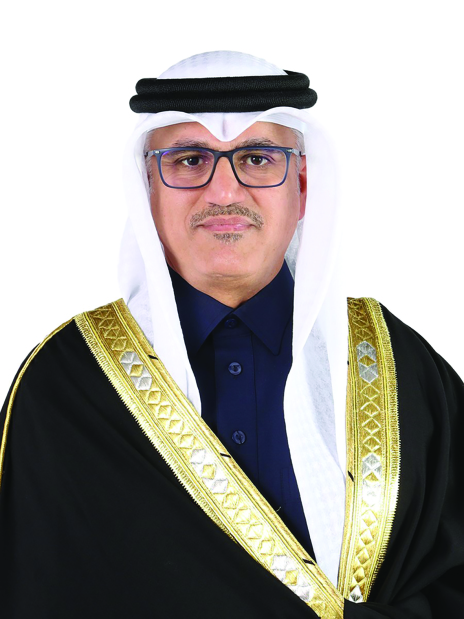
Shaikh Mohammed
Shaikh Mohammed acknowledged that the new system was designed precisely to end this pattern of perplexity. “This co-ordination ensures that responsibilities are clear, funding is identified, and requests from municipal councils can be addressed through an organised and efficient mechanism,” he said.
The most significant development lies in how new lighting requests to strengthen power in older areas will be financed and prioritised. “Co-ordination has been completed with the relevant parties at the Finance and National Economy Ministry to allocate a budget for this purpose within the Municipalities Affairs budget to cover these works,” he added. “Co-ordination with the municipal councils regarding the mechanism for receiving requests and setting priorities will take place once the general budget is approved and adopted.”
This means that for the first time, there will be a dedicated, pre-approved funding channel for lighting improvements in older neighbourhoods – areas that previously fell into administrative gaps.
For fast-developing areas and new road projects, lighting will now be incorporated as part of the Works Ministry responsibility from the outset, particularly for roads tagged under the IUWR classification, which co-ordinates utility works alongside infrastructure development.
Maintenance, which has also been a source of confusion in the past, is now fully assigned to the Electricity and Water Affairs Ministry across Bahrain, removing uncertainty over who responds when lights stop working.
Municipal officials say this clarity is warmly welcomed although long overdue.
In many parts of Muharraq’s older blocks, residents had grown used to poorly lit roads where lighting poles were either insufficient or non-functional, while requests moved between departments without resolution. The new mechanism is expected to significantly reduce the time between a council recommendation and actual installation on the ground.
The Muharraq case is now being seen as a model for how future municipal service proposals will be processed under the new system, potentially transforming how street lighting issues are handled nationwide.
What began as a request for lighting poles on a single road has now resulted in a nationwide procedural reform – one aimed at ensuring that no part of Bahrain is left in the dark simply because no authority could say, with certainty, ‘this is our responsibility’.
mohammed@gdnmedia.bh
&uuid=(email))