

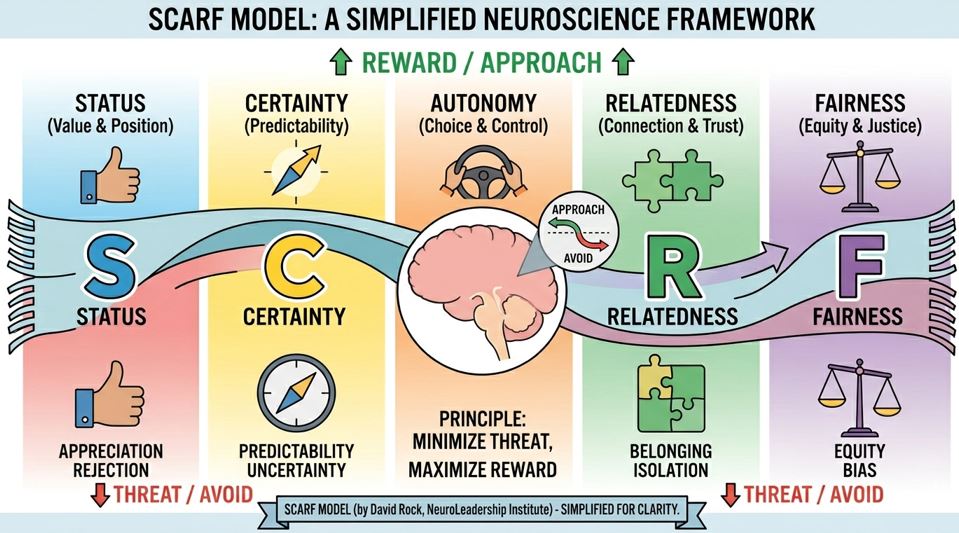
People do not react solely to facts. They also react based on how safe, respected, and in control they feel in the situation. This is the main idea behind the SCARF Model, created by psychologist Dr David Rock in 2008.
SCARF is a simple way to understand what drives stress and motivation at work, school, and in everyday life. The model looks at five areas: Scarf, Certainty, Autonomy, Relatedness, and Fairness. Each answer provides a key insight into how individuals experience change.
First, SCARF asks, Do I matter here? Am I respected?
When people feel respected, they are more likely to listen, participate, and remain calm. When they feel ignored, they may become quiet, defensive, or angry. For example, imagine a team meeting where a manager listens only to one person and cuts off everyone else. Even if the project is going well, the rest of the team may feel that they do not matter.
Another example is in classrooms. If a teacher never calls on certain students and only praises the same few, those students may begin feeling invisible. On the other hand, a teacher who says, “I want to hear from everyone” and responds to students’ answers respectfully helps students feel valued. Respect is not just about manners; it affects how safe people feel.
Next is Certainty, which asks, Do I know what is happening next?
Humans often feel anxious when their plans are unclear. If people do not know the timeline or what will happen after a decision, their minds may fill in the gaps with fear. For instance, a store may change its schedule without informing employees in advance. In contrast, a manager who shares a clear schedule and explains what changes mean gives people certainty. Certainty can be shared even when a full plan is not perfect. For example, a school may announce, “We are switching to a new system next month. You will receive training on Tuesday and Wednesday. After that, you will use it in class.” Such messages reduce confusion and help people prepare.
The third is Autonomy, which asks, Do I have control or choice?
Autonomy means people can influence what happens to them. Consider a worker who is instructed to perform tasks the same way every day, with no option to change their approach. Such individuals may feel powerless, even if the job is manageable. However, if the worker can choose the order of tasks or pick between two approved methods, they often feel more motivated. Group work is another example. If students are assigned random roles and told that they cannot change anything, they may dislike the project. However, if they can choose a role that matches their strengths, such as research, design, or presentation, they are more likely to take ownership and try harder.
The fourth is relatedness, which asks, Am I safe with you? Same team?
Relatedness involves trust and belonging. If people think someone will attack, humiliate, or ignore them, they may stop cooperating. For example, in a workplace, if mistakes are publicly punished, employees may hide problems rather than solve them. However, if leaders respond with teamwork and respect – ‘Let’s fix it together’ – people feel safer. Another example is a sports team. If a new player is welcomed and included, they are more likely to practice and learn the game. If they are ignored or mocked, they may feel unsafe and withdraw from the conversation.
Fifth is Fairness, which asks: Is this equitable and consistent?
People closely observe how decisions are made. They want to know whether the rules apply to everyone and whether the choices are consistent over time. For example, in a company, overtime may be assigned to the same person repeatedly without clear reasons. Other employees may feel the system is unfair and lose trust in it. In contrast, a fair system explains this process. A manager might say, “Overtime is offered by rotation based on availability,” or “Assignments are based on clear criteria.” When fairness is visible, people are more likely to accept the outcomes and continue working together.
The SCARF Model can also help explain why small events can feel like big problems. A change that seems minor— such as a new schedule, rule, or boss—can suddenly feel stressful because it affects one or more SCARF areas. For instance, when a company announces layoffs or major restructuring, people often worry about their respect, plans, and whether they have any control over the situation. They also wonder whether they are still part of the same team and whether the process is fair enough.
In everyday life, SCARF can be used as a quick checklist. When leading a meeting, ask yourself: Do people feel respected? Do they know what will happen next? Do they have a choice? Do they feel safe in the group? Are the rules consistent? When you answer these questions, communication improves, and conflict often decreases.
Dr Aloma Jayasundera
&uuid=(email))