

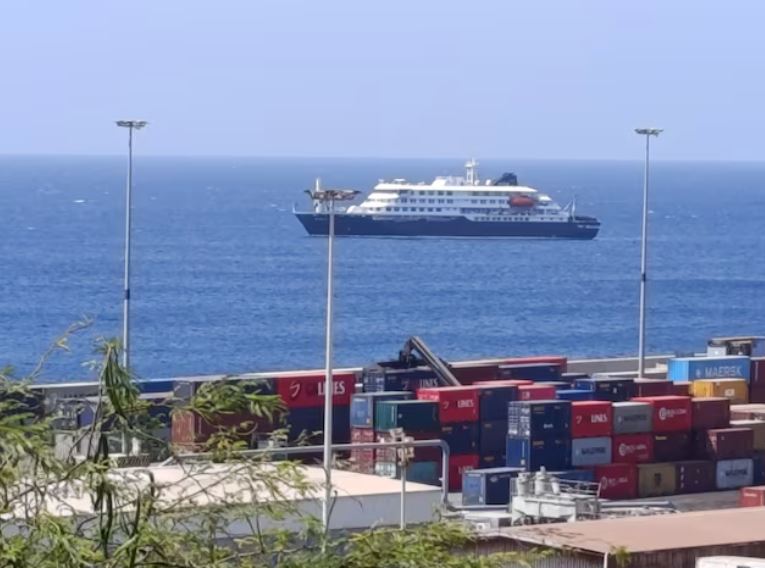
The World Health Organisation said yesterday that it suspects some rare human to human transmission of the deadly hantavirus took place between very close contacts on board a luxury cruise ship hit by seven confirmed or suspected cases.
Human to human transmission is not common, and the UN health agency reiterated that the risk to the wider public was low from a disease typically spread from contact with infected rodents.
A Dutch couple and a German national have died, while a British national was evacuated from the ship and is in intensive care in South Africa, officials said.
Two crew members require urgent medical care, the Dutch-flagged MV Hondius ship’s operator, Oceanwide Expeditions, said. Another person on board with a suspected case has only reported a mild fever.
The Dutch foreign ministry said it was preparing the medical evacuation of three people to the Netherlands from the ship currently moored off Cape Verde. The island nation in the Atlantic off West Africa was meant to be its final destination but it has not allowed the vessel to put passengers ashore because of the outbreak.
Oceanwide Expeditions said yesterday two specialised medical planes are en route to Cape Verde for the evacuation, adding it did not have an exact timeline.
It was not yet clear when or where the nearly 150 other people still onboard would disembark, though the company said it was in talks with Gran Canaria and Tenerife authorities to moor there. The two Canary Islands are located three days of sailing away from Cape Verde, it said.
Spain’s health ministry has said earlier it saw no need for the ship to make a stop in the Canary Islands if everyone who was sick was evacuated in Cape Verde, unless new cases emerged. A ministry spokesperson declined to comment and the head of Canary Islands’ regional government said the most sensible course of action was for the ship to return to the Netherlands.
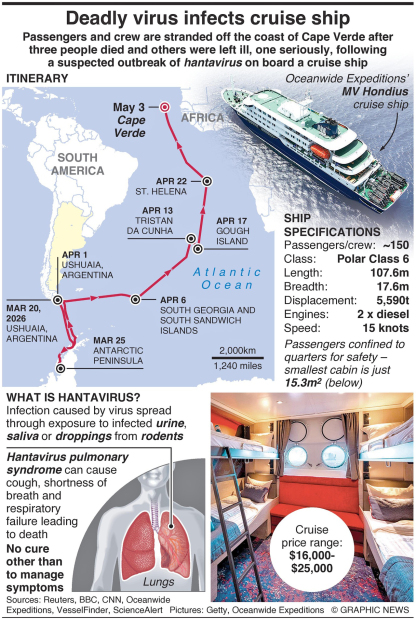
People are usually infected by hantavirus through contact with infected rodents or their urine, their droppings or their saliva.
However, a limited spread among close contacts has been observed in some previous outbreaks with the Andes strain, which spreads in South America, including Argentina, and which the WHO believes could be involved in this instance. Testing is under way. The Hondius left Ushuaia in southern Argentina in March.
The WHO said it had been told there were no rats on board.
The Hondius is carrying mostly British, American and Spanish passengers on a luxury cruise that set off from the southern tip of Argentina in late March. The cruise visited the Antarctic peninsula and South Georgia and Tristan da Cunha - some of the remotest islands on the planet.
Argentina continues to have the most cases in the Americas region, the WHO said in December, with a lethality rate of around 32 per cent, higher than average and than for other strains of the virus.
&uuid=(email))