

Massive multi-million dinar infrastructure projects transforming Muharraq Governorate into a vibrant destination were outlined by Works Minister Ibrahim Al Hawaj.
He highlighted decades of investment in roads, bridges, airport access and sewage networks, as well as ongoing and planned schemes aimed at preserving heritage, easing congestion and modernising services across Muharraq.
The minister was responding to a question by Strategic Thinking Bloc spokesman MP Khalid Bu Onk.
“The ministry pays great attention to projects that directly benefit citizens and residents,” said Mr Al Hawaj. “We are continuing to develop infrastructure in Muharraq through projects under implementation as well as those in the tendering and procedural stages.”
Mr Al Hawaj revealed that from 2006 to 2023, the ministry completed 27 road projects in Muharraq at a total cost of BD60.023 million.
He added that three additional road projects are currently under implementation.
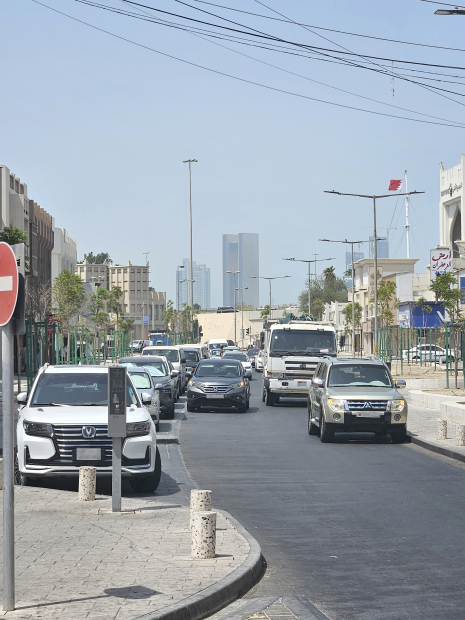
The old Muharraq Suq (Shaikh Hamad Avenue) ... parking problems
Among the landmark schemes is the Shaikh Abdulla Avenue and Shaikh Isa Avenue development project, designed to upgrade roads leading to historic sites in keeping with Muharraq’s cultural identity.
“The project reflects a balance between preserving Bahraini authenticity and meeting modern urban development needs,” Mr Al Hawaj said.
“Works extended over 1.2 kilometres linking major historic corridors and intersections, with the project expected to be complete by the end of the year as 90pc of it is ready.”
He said plans are also underway for the Shaikh Hamad Avenue development project aimed at revitalising the historic commercial spine and improving access for residents and visitors to traditional markets.
A major highlight is the fourth Muharraq bridge project, forming part of the Muharraq Ring Road expansion linking the island to Manama from the north.
The multi-phase project includes:
- An 8km dual carriageway from Muharraq to Al Sayah
- Links to Busaiteen, Al Dair and Samaheej
- A 482-metre causeway with five lanes in each direction
- A 150-metre architectural arch 11 metres above sea level
“The suspension bridge will be a distinctive architectural icon upon completion,” the minister noted. The project is currently in the tendering phase.
Other completed traffic projects include upgrades to Dry Dock Highway, Shaikh Daij Avenue, and a new overpass connecting traffic from Shaikh Isa bin Salman Causeway directly to the Muharraq Ring Road via Busaiteen.
Significant works around Bahrain International Airport were also completed to ensure smooth access to the new passenger terminal.
Phases included:
- Converting Route 2403 into an overpass to the terminal
- Widening approaches to Airport Road.
- Replacing roundabouts with signalised intersections
- Constructing new bridges for traffic flow from Khalifa Al Kabeer Avenue nearby the Falcon Monument.
Also, access roads to East Hidd Housing Town were expanded with dual carriageways, new roundabouts and widened entry points to distribute traffic across multiple access routes.
On the sanitation front, Mr Al Hawaj said 14 sewage projects worth BD21.26m were completed in the past four years, with three more worth BD9.1m underway.
Key ongoing projects include:
- Reactivating the sewage link between Muharraq and Manama via B1 Pumping Station. It’s expected to be completed by the last quarter of this year.
- Construction of a primary treatment plant in Hidd Industrial Area. It’s likely to be completed by the third quarter of next year (2027).
Addressing persistent flooding concerns, the minister said five new stormwater pumping stations were built in Muharraq, alongside upgrades to existing stations.
“Specialised teams conduct continuous cleaning of drainage networks and culverts, especially before the rainy season,” he said. “Comprehensive emergency plans are also in place with tankers and round-the-clock station readiness.”
Mr Al Hawaj acknowledged that one of the biggest challenges facing the ministry is the presence of utility lines and infrastructure within road corridors.
“This requires projects to be implemented in successive phases to maintain traffic flow and uninterrupted services,” he explained. “In some cases, service lines must be relocated to suit project needs.”
He stressed that all works are carried out in co-ordination with municipal councillors to ensure integrated planning.
“The ministry remains fully committed to co-operate with Parliament and delivering infrastructure that supports sustainable urban development,” Mr Al Hawaj added.
mohammed@gdnmedia.bh
&uuid=(email))