

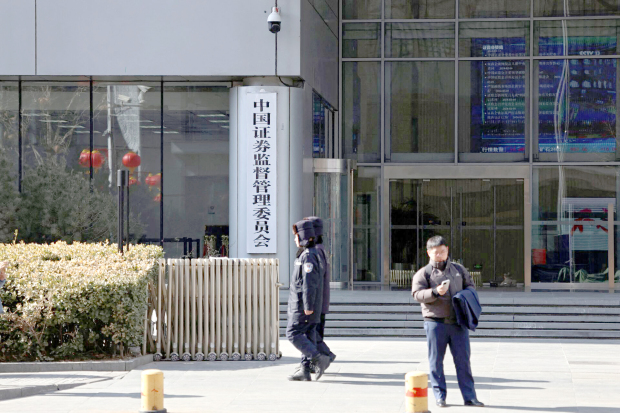
China announced a major crackdown on cross-border investment yesterday and said it would punish brokers it accused of illegally moving money to foreign markets, sending their shares plunging.
Online brokers Tiger, Futu and Longbridge would be penalised for soliciting business in China without an onshore licence, the securities regulator said.
Shares in Futu and Tiger parent UP Fintech Holding fell more than 30 per cent in US premarket trade.
The move intensifies scrutiny of capital outflows – which are strictly controlled by China – and also sent shares of popular Chinese companies listed abroad lower because the brokers’ clients will be limited to selling shares, not buying.
The China Securities Regulatory Commission, which launched the crackdown with seven other government agencies including the central bank, said in a statement it was targeting overseas firms and their local partners operating without approval.
It said illegal gains would be forfeited.
Futu said it had high compliance standards, had previously stopped adding accounts for mainland applicants and rejected tens of thousands of applications that did not meet requirements. At the end of the first quarter, mainland investors accounted for 13pc of its customer base.
The firm disclosed later in a filing that it faced a 1.85 billion yuan ($271 million) proposed penalty from the CSRC.
A Tiger spokesperson said the company “has always placed compliance as a top priority”.
It noted the CSRC statement, said it would cooperate and “all business operations remain normal.”
Its parent, UP Fintech, said the CSRC Beijing bureau had imposed administrative penalties of 308.1m yuan and confiscation of illegal income of 103.1m yuan over illegal activities by its subsidiaries, a filing showed.
Longbridge did not disclose details of the penalties it faced, but said it would strictly implement the rectification measures in full accordance with regulatory requirements, while emphasising that the safety of client funds remains unaffected.
“The government wants to ensure that any outbound capital flows are under its scrutiny,” said Gary Ng, senior economist for Asia Pacific at Natixis.
The firms would be given a two-year grace period to wind down illegal activities, the regulator said, during which time customers would only be allowed to sell existing holdings and withdraw funds, with no new investments allowed.
US-listed shares of Chinese companies popular with investors fell sharply in pre-market trade with online marketplace operators PDD Holdings, Alibaba and JD.com down between 3.5pc and 6pc. KraneShares ETF of China internet companies fell 4.3pc.
The regulators’ announcement came after markets closed on the mainland and in Hong Kong on Friday. Hang Seng futures fell 1.5pc.
“In the short term, these actions may cool down some trading and speculative activities in Hong Kong,” said Steven Leung, director of institutional sales for UOB-Kay Hian in Hong Kong.
Yesterday’s crackdown widens years of scrutiny, which stepped up late in 2022 when the CSRC banned overseas institutions from opening accounts for mainland investors.
It coincided with a crackdown on speculation in onshore markets and was aimed, regulators said, at protecting “healthy development of the capital market, channel outbound investments via legal channels, and protect investors.”
&uuid=(email))