

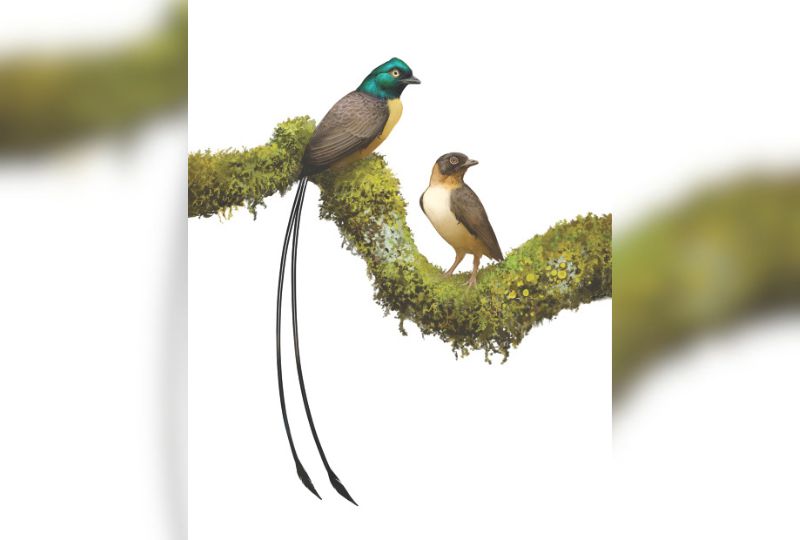
New Guinea’s tropical rainforests are home to one of the animal kingdom’s most spectacular courtship rituals, with male birds of paradise prancing about and showing off their plumage, hoping to attract a female.
But, as a new fossil from China indicates, such behaviour in birds may date back to the age of dinosaurs.
Researchers said the fossil discovered in northeastern China of a newly identified pigeon-sized bird species called Plumadraco bankoorum that lived about 121 million years ago preserved nearly its entire plumage including tail feathers that were two times as long as its body.
They believe the specimen was male because long ornamental tail feathers today typically belong to male birds.
Based on the length and structure of these feathers and the anatomy of a skeletal structure called a pygostyle that anchored the muscles controlling them, the researchers hypothesise that a male Plumadraco would have moved its tail feathers up and down in a display to get the attention of a mate.
“With this specimen, we have a pretty strong argument that not only did males probably try to attract females with feather ornamentation, but they also did so with ridiculous lengths and probably displays,” said Alex Clark, a doctoral candidate in evolutionary biology at the University of Chicago and the Field Museum in Chicago, lead author of the research published on Wednesday in the journal PLOS One.
“It means that 121m years ago, this male Plumadraco was dragging along a train of tail feathers twice its body length, just to impress potential mates – something we see today in modern birds as well. Pretty cool if you ask me,” Clark said.
The pygostyle’s structure suggests big muscles for up-and-down movements and an absence of muscles for tail spreading, said Field Museum paleontologist and study co-author Jingmai O’Connor.
Plumadraco’s hypothesized mating dance showing off its tail feathers may have featured an up-and-down bobbing of the tail or holding the feathers up in a raised posture, Clark said.
The fossil’s chemical makeup indicated that the feathers were dark brown or black, the researchers said, but there may have been some eye-catching colours at the tips of the tail feathers – perhaps iridescence or blue or purple.
Birds evolved from small feathered dinosaurs during the Jurassic Period.
The earliest-known bird, Archaeopteryx, dates to about 150m years ago.
Plumadraco – meaning “feathered dragon”- lived almost 30m years later during the subsequent Cretaceous Period, but shared some traits with the earlier Archaeopteryx such as a mouthful of teeth.
&uuid=(email))