

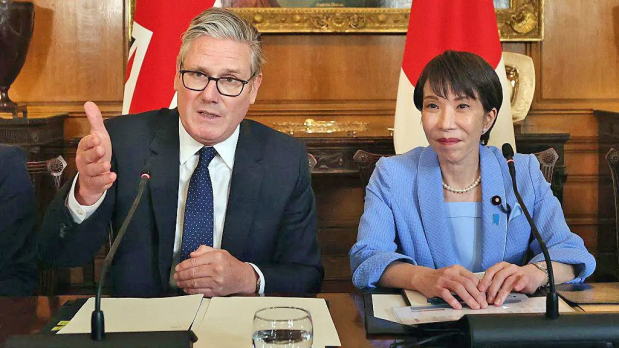
The UK and Japan have agreed a multi-billion pound investment deal which UK Prime Minister Keir Starmer said will build a “new era of co-operation” between the two nations.
Alongside announcements totalling £18 billion ($24bn) on infrastructure, financial services and wind power, Japanese Prime Minister Sanae Takaichi said deep security ties were at the foundation of the countries’ relationship.
Japanese firms will spend more than £9bn on UK infrastructure and financial services and up to £9bn on UK offshore wind, creating tens of thousands of jobs, Downing Street said as Starmer met his Japanese counterpart in London.
The deal comes as the UK’s economy struggles to grow, with experts predicting the US-Israel war with Iran will hit the UK particularly hard.
It is not clear how much of the investment listed by Downing Street represents new money or previously announced plans.
Starmer and Takaichi met Japanese business leaders at Downing Street yesterday, with Starmer describing the talks as “very productive”.
Separately, the UK premier said he was “really pleased” the two countries had reaffirmed their commitment to the Gcap fighter jet programme being developed alongside Italy.
Meanwhile, it was announced Rolls-Royce would work with Japan’s Atomic Energy Agency to develop next generation nuclear technologies and a technology agreement would link up UK research and development and software expertise with Japanese manufacturing.
Speaking through a translator, Japan’s prime minister said the UK is “an extremely important partner”.
Mitsubishi Estate, Mitsui Fudosan, Nomura Real Estate were some of the Japanese firms which Downing Street said had agreed to spend billions over the next five years on infrastructure and real estate projects.
The Conservative’s shadow business and trade secretary Andrew Griffith said his party welcomed “any deal that brings investment” to the UK.
However, he added that Labours “tax hikes and employer red tape are doing huge damage, destroying jobs and putting more and more people onto welfare”.
Though Downing Street has said the deal will boost jobs and long-term growth, experts expect economic pain in the near term.
The UK economy grew by 0.6 per cent during the first three months of the year, but analysts think growth will to be sluggish in the months ahead.
The US-Israel with Iran war will hit the UK the hardest of the world’s advanced economies, the International Monetary Fund (IMF) said last month.
Meanwhile, the Bank of England has warned that it expects UK inflation to increase as a result of the war, possibly reaching 6pc in the worst-case scenario.
&uuid=(email))