

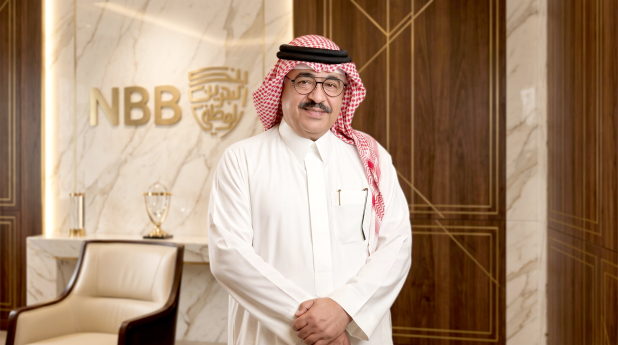
In most strategic client relationships, the dynamic runs in one direction: a bank offers services and a client decides whether to accept them. At the National Bank of Bahrain (NBB), the picture is considerably more layered than that.
Many of the clients managed by the team of Abdul Aziz Al Ahmed, NBB’s Chief Executive – Strategic Accounts, are also the bank’s shareholders. Some are families that have held both positions for decades, their financial relationships with the bank spanning generations.
“When you are both a shareholder and a major depositor, the responsibility is massive,” Mr Al Ahmed says. That sentence describes something genuinely distinctive in Bahraini banking, and it shapes everything about how his department operates.
Trust before terms
Price is often one of the clearest points of competition in banking. Rate, fee, yield are what institutions use to attract and retain large depositors, particularly at the top end of the market where clients have the widest choice of institutions. Mr Al Ahmed’s version of how this segment is served runs in a different order.
“Trust, Confidentiality, Service, and then Price,” he says, naming his department’s guiding priorities in sequence. He is also precise about the weighting. “The first 20 per cent goes entirely to trust, followed by confidentiality. These two come before everything else, then comes service, and finally, price.”
For most institutions, inverting the hierarchy this way would carry a cost. At the level of clientele Mr Al Ahmed works with, it is likely the only credible position. A depositor who also holds shares in the bank has their confidence in the institution at stake before any transaction takes place. Earning that confidence is the relationship itself, not a prerequisite for opening one.
The responsibility of a dual role
Mr Al Ahmed describes NBB’s most significant clients as participants in a specific commercial history. “This bank is an extension of a prestigious history, involving large, well-established merchant families who hold accounts and, at the same time, are shareholders who own parts of the bank,” he says.
That overlap creates a unique sense of partnership. Clients are not only depositors but also shareholders who have a direct stake in the bank’s future. As a result, every interaction carries added significance. “We must be very careful in our dealings and service delivery, because any deterioration in the relationship might lead a customer to reconsider the shares they hold in the bank,” Mr Al Ahmed stresses. For his team, delivering exceptional service is about strengthening the confidence and loyalty of stakeholders whose interests are closely aligned with the bank’s own.
The commercial logic follows naturally. Clients who are both depositors and shareholders have a deeper connection to the institution, making every relationship particularly valuable. Their continued confidence reflects not only satisfaction with the services they receive but also belief in the bank’s long-term direction. This is precisely why these accounts are managed separately and with exceptional care, ensuring that every interaction reinforces a partnership built on trust, commitment and shared success.
A department built for a specific clientele
The team Mr Al Ahmed leads handles high-net-worth individuals, corporate entities of significance, and families with generations of connection to the bank. He describes it as a structure distinct from other Bahraini banks, a characterisation that reflects a genuine specificity in how his department operates.
The model begins with who delivers the service. “My team consists of trained people who were hand-picked and are well-known in the market,” Mr Al Ahmed says. “We focused on the quality of these individuals because you must know who you are dealing with before you place all your trust and all your money with them.” A team member’s first task, in his description, is not to present a product but to first establish credibility with a client who has chosen to place substantial financial interest in the same institution that employs the person sitting across from them.
What availability means at this level
Mr Al Ahmed is direct about what around-the-clock availability communicates to Strategic Accounts clients. “Our clients know that we are available 24 hours a day, seven days a week, even during holidays and at midnight,” he says. The example he reaches for makes the point cleanly. “When a customer comes to you during an Eid holiday and requests something and you fulfil it, that builds immense loyalty. They realise that no one else would provide that service at that time.”
The recent geopolitical crisis, when banking operations across the region moved to remote working conditions, tested this commitment. Mr Al Ahmed says client loyalty increased during that period. “Even in cases where we worked from home, we ensured all services were delivered.” For a client who’s financial and ownership interests are both held in the same institution, continuity during uncertain conditions is what sustains the relationship.
Service that spans generations
The defining characteristic of how Mr Al Ahmed’s team works is that it serves families. “In the Strategic Accounts department, we do not serve the individual alone. We provide a package for the entire family, ensuring the same quality of service reaches the grandfather, the father, and the grandson.”
The language he uses with clients reflects how that relationship is framed. “We tell them, ‘This is your bank; you own it.’ We acknowledge their history of holding shares for many years, and we are here to continue what those before us started.” A Strategic Accounts relationship, therefore, is a continuation of something already in place, assumed on both sides from the first contact to be ongoing across the full span of a family’s financial life.
NBB has been operating in Bahrain since 1957. The families Mr Al Ahmed describes have been alongside it for much of that time, either as shareholders in its growth, clients of its services, or both. The Strategic Accounts function is where that shared history is most deliberately maintained, with relationships built to continue across generations.
&uuid=(email))