

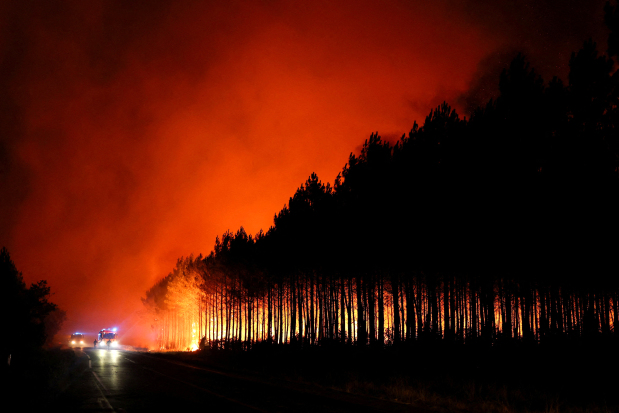
A FAST-MOVING wildfire has forced more than 10,000 people from homes and campsites near France’s Atlantic coast, as extreme heat and deepening drought fuelled fires across Europe and scientists warned that climate change was worsening the continent’s water shortages.
Across Europe, three heatwaves in succession this season have intensified drought, strained water supplies and left vegetation tinder-dry, helping wildfires scorch more land already this year than the annual average of the past two decades on the world’s fastest-warming continent. The heat has also been blamed for thousands of deaths.
More than 10,000 people were evacuated overnight in southwestern France as a rapidly spreading wildfire ripped through at least 2,400 hectares of land west of the city of Bordeaux, officials said yesterday.
Five hundred firefighters are battling to control the blaze, the prefecture said, adding that no one had been injured so far.
The wildfire is located near the Arcachon Bay area, a tourist hotspot, and many of those evacuated are visitors staying in camping sites. “Overnight, the fire spread more quickly than we had imagined,” said Philippe de Gonneville, the mayor of Lège-Cap Ferret.
In neighbouring Spain, authorities were still working to put out fires which have raged for several days, while in Italy, a 59-year-old firefighter died after falling ill while battling a large wildfire near San Cataldo in Sicily.
The Cap Ferret peninsula, often likened to the upscale Hamptons in the United States, is home to some expensive properties where wealthy Parisians and Bordelais come to sip white wine and feast on oysters.
Lège is the only one of the peninsula’s 11 villages that is currently threatened by the fire, but Gonneville said authorities had evacuated 5,200 people overnight. He said access was completely closed, and contingency plans were in place to evacuate the entire peninsula by both road and sea if necessary.
The fire later reached the edge of Lège, forcing the evacuation of several campgrounds and neighborhoods close to the forest.
“We moved here two and a half years ago because it’s a lovely place, and we don’t know what we’ll return to,” said Jeanine Clarke, 46, evacuated to a nearby evacuation centre with her family and dog.
Camper Elizabeth Carron said she was having dinner when she saw the flames. “The sky turned red. Black and red. Then little by little, we could smell it. There were ashes on the car, on the caravan, on my grandchildren’s little tent. Then two hours later, they advised us to leave.”
Wildfires remained a major challenge across Spain yesterday, with authorities tackling several significant blazes.
Train traffic on Spain’s Madrid-Barcelona high-speed rail line resumed yesterday after a wildfire near the tracks prompted the suspension of services between Mejorada del Campo and Alcalá de Henares, east of Madrid. Railway infrastructure operator ADIF said the fire was unrelated to railway operations and that services on one of the country’s busiest transport corridors were gradually returning to normal after the incident was resolved.
Across central Spain, firefighters, emergency personnel and military units remained deployed as authorities monitored multiple active fires, including blazes in Guadalajara, Toledo, Ciudad Real and Albacete. More than 100,000 hectares have burned nationwide so far this year. Over 10,000 excess deaths were recorded across Europe and Britain in the last two record-breaking heatwaves in May and late June, with scientists saying the only credible reason for the unusually high toll was heat-related.
Belgium yesterday said June 27 – during its heatwave last month – was the country’s second deadliest day of the 21st century, with 650 deaths. Europe is bearing the brunt of a rapidly warming climate, with temperatures rising more than twice as fast as the global average.
&uuid=(email))