

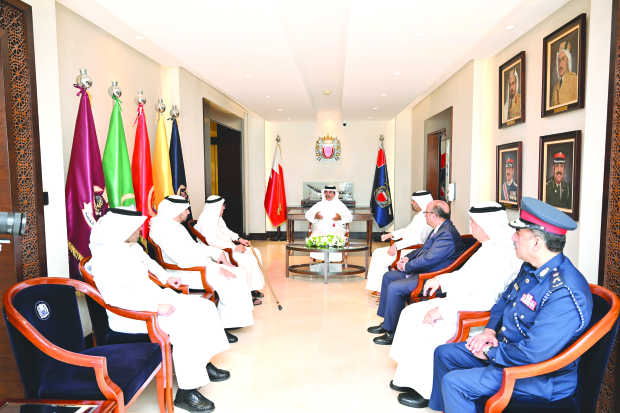
Interior Minister General Shaikh Rashid bin Abdulla Al Khalifa met the editors-in-chief of local newspapers, during which he discussed a number of security and national issues, including the dangers posed by the ideology of Wilayat Al Faqih, the repercussions of Iranian attempts to undermine Bahrain’s stability, and the ministry’s efforts to promote national awareness and strengthen community security. Following is the text of interview he gave to the editors-in-chief.
Q: The heinous Iranian aggression continues, directing its missiles and drones towards Bahrain, committing war crimes against citizens and residents, and targeting civilian infrastructure without regard for the rights of neighbourliness. What is your view about the issue?
Bahrain is a country committed to peace and has never attacked Iran. It is geographically limited. Therefore, these Iranian terrorist attacks are not merely a border war but rather cover all of Bahrain without exception. With this heinous targeting, Iran has violated the principles of good neighbourliness. How can there be any co-operative relationship with a regime that has violated our security and sovereignty, threatened our present and future, and targeted our national unity and social fabric? We have dealt with Iran’s proxies, thwarted their ideology and plans, and rallied the patriotism and loyalty of the people of Bahrain in the face of these heinous attacks.
Q: Security measures under these exceptional circumstances are extremely delicate and complex, with fundamental security principles. What are the most significant challenges facing security operations at this critical phase?
First and foremost, the wisdom and leadership of His Majesty King Hamad represent the unifying national framework around which the people, in all their diversity, rally and upon which they operate, working to strengthen the state and preserve its status.
The King’s directives have enabled Bahrain to solidify its position, strength, and capabilities to deal efficiently and professionally with these exceptional circumstances by building a sophisticated strategic system over the past years. The security, sovereignty, and stability of the nation are non-negotiable pillars, and anyone who transgresses these boundaries places themselves in direct confrontation with the law and the state.
I would also like to commend the measures taken by the esteemed government, headed by His Royal Highness Prince Salman bin Hamad Al Khalifa, Crown Prince and Prime Minister, and its role in addressing the challenges of this difficult period through a sophisticated and decisive system and vision. This vision relies on strengthening national preparedness and co-ordinating governmental and national efforts to confront various challenges and emerging issues with a high level of readiness.
Here, I would like to address a specific issue, by way of example – one that underscores the increased complexity of current challenges. Previously, we dealt with terrorist organisations as ‘overt entities’.
Still, now we are dealing with clandestine organisations that focus on raising funds through covert means and using them to support those working to destabilise the country. They engage in activities hostile to states and work to control religious institutions, removing them from the oversight and control of official bodies. Simultaneously, they work to control citizens’ attitudes, thoughts, and feelings through extremist and inflammatory rhetoric.
Based on security experience, I can say that sustainable security cannot be achieved through temporary reactions. Rather, it requires a long-term strategic vision rooted in moderation, the rule of law, and the understanding that security is a shared responsibility involving institutions, legislation, society, and public awareness. True security is achieved by building strong institutions that strengthen societal trust and support stability.
Q: You described ‘parallel patriotism’ as one of the outcomes of the Wilayat Al Faqih. How can official and societal institutions protect young people from transnational ideological loyalties?
Thanks to God, Bahrain has been able to expose the intentions and dangers of this extremist ideology, which by its very nature has created negative and unacceptable concepts, including what is called “parallel patriotism”.
This concept has no place within the framework of genuine loyalty and national belonging.
Confronting it requires regulating religious discourse, fostering intellectual fortification, and co-operation between families, schools, and the media, in addition to security and legal measures.
The family represents the starting point for nurturing a sense of belonging; the school reinforces the concept of sovereignty; the places of worship deliver a sound and enlightening message; and the media conveys the truth credibly. When these roles are fulfilled, belonging becomes a deeply rooted behaviour rather than merely a slogan.
In this context, I praise the Education Ministry’s role in shaping national generations through a well-thought-out educational approach. I also commend the role of the Information Ministry in promoting national unity and loyalty, as well as that of the Justice, Islamic Affairs and Endowments Ministry, especially in regulating religious discourse.
Q: Given the ongoing attempts by some external parties to undermine countries’ stability through transnational ideological projects, what is the ministry’s strategy to prevent the export of extremist ideology linked to Iran?
The Wilayat Al Faqih, in its transnational political dimension, represents an approach that transcends jurisprudential or doctrinal interpretations. Its danger lies in its endeavour to create entities outside the state’s framework. It has worked to distance religious and civil institutions from state authority and has exploited the collection of funds through illicit means to reward opponents of the state.
Q: The so-called Ulema (Scholars) Council had a negative influence on some young people, and the Interior Ministry’s measures thwarted this scheme. Would you shed light on the measures taken?
The Interior Ministry’s strategy in this regard is based on three pillars: monitoring extremist ideas in their early stages, drying up their funding sources, and protecting society from them. The so-called ‘Ulema Council, which was dissolved by court order several years ago, was an unofficial organisation that overstepped its declared religious framework to become a front providing religious cover for a chaotic, transnational political project. This project aimed to weaken national unity. It was dealt with within the framework of the law to protect society and the Shi’ite community in Bahrain from attempts at political manipulation and exploitation.
Q: Is Bahrain facing a form of soft warfare targeting minds and national loyalty, and what role is required of the state, families, schools, majlises, and religious figures to protect young people?
Data indicates attempts to shape the awareness and loyalty of young people through indirect means, including educational content, publications, and speeches presented as advice but carrying a different underlying message.
Confronting this pattern requires co-operation among the state, families, schools, majlises, and religious figures. In addressing those influenced by such discourse, the state distinguishes between individuals who have been misled and need to correct their understanding, and those who have knowingly chosen this path – tailoring its response to the nature of each case. Those who persist in such actions will be held accountable in accordance with the law.
Q: To what extent do intellectuals, thinkers, and academics bear a national responsibility in defending Bahraini identity against attempts to impose foreign agendas?
Intellectuals, thinkers, and academics play a direct role in confronting projects of subservience, recognising them as battles over concepts, identity, and national memory, rather than merely security battles. Indeed, this is the positive role of the intellectual: a commitment to their homeland. This responsibility requires clarifying the facts and countering misconceptions with reasoned arguments and knowledge, thereby helping establish a positive understanding of patriotism as a steadfast commitment. Bahrain cherishes its thinkers and intellectuals and relies on them to promote awareness and enlightenment.
Q: You mentioned the infiltration of Wilayat Al Faqih into mosques and religious centres, with some of them having been transformed into recruitment centres. What measures and controls are in place to prevent this from happening again?
Mosques and community centres (Ma’atams) hold a significant religious and social position, and the state is committed to preserving their rituals without restriction. However, under the law, it is not permissible to convert places of worship or other venues into platforms for political mobilisation, ideological recruitment, or the dissemination of foreign agendas within society.
The measures are based on organisation, monitoring, co-ordination, and accountability, with those in charge of these sites responsible for protecting them from infiltration. The Supreme Council for Islamic Affairs and the Council for Islamic Endowments play a key role in this regard.
Q: Some are trying to portray the security measures as being directed against a specific sect or social group. How do you respond to this claim, and how is a balance struck between national security and the protection of rights and freedoms?
This claim is inaccurate. The security measures are directed at political organisations linked to foreign entities, with the aim of preserving social cohesion and national unity. The Shi’ite community in Bahrain is an integral part of the national fabric, predating these organisations historically, and far broader than can be reduced to them.
In reality, we distinguish between opinion and incitement, between religious practice and politicisation, and between individual transgressions and generalisations about social groups. This distinction is essential to maintaining a balance between safeguarding security and protecting constitutionally guaranteed rights and freedoms. Attempts to undermine public confidence and construct a propaganda narrative against these security measures – which are fundamentally intended to protect Bahraini society – fail to recognise that Bahrain has moved beyond such sectarian debates and that its citizens possess a high level of awareness and understanding.
Q: How do you deal with Iran’s policy aimed at achieving sectarian isolation?
In short, our approach to countering this movement is based on a firm policy of national integration among all citizens, without discrimination. The Interior Ministry is vigilant in monitoring any external attempts to promote sectarian isolation and addresses them at an early stage, preventing such efforts from having any real impact on the cohesion of Bahraini society. Furthermore, the deep-rooted national awareness among citizens constitutes the first line of defence that thwarts such attempts. A complementary objective of the policy of sectarian isolation is to address attempts to undermine national confidence through dealing with these schemes, which, in reality, have only strengthened and solidified loyalty to the King.
Q: You mentioned that members of the Wilayat Al Faqih group have tried to infiltrate education, media, and social media. Will any entities or platforms that are being exploited to spread this ideology be announced soon?
Any educational institution, media organisation or platform found to be promoting or exploiting the Wilayat Al Faqih ideology will be subject to investigation and the necessary legal procedures, based on verified evidence. Once the investigation is complete and responsibilities are established, the law will take its course, ensuring a balance between protecting societal security and safeguarding individual rights.
Q: The Interior Ministry announced the arrest of 41 individuals belonging to a main group linked to the Wilayat Al Faqih and Iranian Revolutionary Guard Corps (IRGC). Later, there was talk about their operational roles. Are we dealing with a hierarchical, organised group, and what does this case reveal about its danger?
The security operation constituted a proactive step to thwart these terrorist plots. The arrests targeted members of the main group linked to the Wilayat Al Faqih of Iran and the IRGC. These individuals – Iran’s agents in Bahrain – worked covertly to promote the ideology of the Wilayat Al Faqih through a plan aimed at destabilising the state and forming an opposition front loyal to foreign powers. They also sought to influence citizens, especially youth and adolescents, to engage in illegal activities, using methods such as social infiltration and the establishment of cells to advance the agendas of illegitimate entities. They worked to collect large sums of money and hide them in their homes to use in financing terrorist acts and sending them abroad for terrorist purposes. They exaggerated social and economic issues, built networks loyal to the IRGC and arranged training in camps on the use of weapons and explosives, which facilitated smuggling operations. Furthermore, they sought to infiltrate educational institutions, media outlets and social media platforms to spread the Wilayat Al Faqih ideology, while conducting disinformation campaigns and fuelling sectarian divisions within Bahraini society.
Q: The Interior Ministry has achieved remarkable successes, having apprehended terrorist groups operating on behalf of the Iranian Revolutionary Guard. Would you like to shed light on these successes?
These measures are the result of accumulated security expertise and continuous monitoring. These security efforts were proactive, not reactive, in anticipation of potential attacks. These operations have helped protect lives and property and secure vital installations, confirming that Bahrain deals with any attempt to compromise its security with constant readiness and vigilance, using a proactive and highly professional approach.
Q: We would like to shed light on the legal and security measures imposed on any person or entity that expresses support for or promotes the Wilayat Al Faqih ideology or groups affiliated with the IRGC?
The law is clear on this matter. All actions that go beyond expressing an opinion and constitute incitement or promotion of banned organisations, support for hostile entities, unlicensed collection of funds, or communication and recruitment on their behalf are subject to legal accountability.
No one is held accountable for their religious beliefs. However, anyone who uses their religious beliefs to serve a foreign political agenda or promotes groups affiliated with the IRGC, or any other entity, is subject to legal accountability.
Q: You mentioned that investing in education, awareness, and digital literacy is a key line of defence. What programmes does the Interior Ministry implement to enhance security and digital awareness among young people?
The sources of danger facing young people have shifted from the physical to the digital world, through anonymous platforms and accounts, and targeted content that employs indirect persuasion techniques. Therefore, digital literacy constitutes a fundamental component of national security. The ministry’s programmes in this area focus on raising awareness, promoting legal culture, and clarifying methods of recruitment, disinformation, and online funding, in partnership with educational, media, and civil society institutions. The aim is to empower young people to distinguish between news and rumours, and between opinion and incitement. The ministry has experience in this field, and this issue receives significant attention from the relevant directorates within the ministry.
Q: How has the Interior Ministry’s role in cybersecurity evolved?
Cybersecurity has become a fundamental aspect of national sovereignty, given the vastness of threats, including digital networks and accounts, electronic financial transactions, and information campaigns. The Interior Ministry’s role in this area has expanded to cover monitoring, analysis, combating cybercrime, and protecting society from online exploitation.
Addressing cybercrime relies on early detection, technical analysis, rapid response (which I would describe as ‘instantaneous’) and co-ordination among relevant authorities, based on the principle of early prevention.
Q: How are attempts to exert external influence over Bahraini domestic affairs addressed?
Attempts at external influence may take indirect forms through media, funding, organisations, religious discourse, or digital platforms. Security agencies address these attempts using a comprehensive methodology, paving the way for appropriate legal action.
Q: The Interior Ministry has banned travel to Iran and Iraq. Is there a plan to add other countries, and what are the reasons behind this decision?
The decision to ban travel to certain regions was made as a precautionary measure to protect citizens, especially young people, and to prevent the exploitation of travel for training, financing, recruitment, or communication with hostile entities. The addition of any other countries is subject to the discretion of the relevant authorities, based on security data.
Q: In light of escalating cross-border threats, do you see a need to elevate joint Gulf security co-operation beyond its current state?
These exceptional circumstances and the challenges we have faced necessitate that the GCC states move from co-operation and co-ordination to security integration. The evolving nature of threats demands the continuous development of this system, rather than being content with its current level. Shared threats, from illicit financing to cross-border recruitment networks, and recent developments, require deeper integration in information exchange and the unification of response mechanisms among Gulf security agencies. The Interior Ministry is continuously working with its counterparts in the GCC states to enhance this integration through joint monitoring and analysis mechanisms, keeping pace with the rapid evolution of threat tools and achieving the highest levels of collective readiness. The GCC states have learned, through history and lived experience, that our resilience stems from our ability to co-ordinate our stances and visions.
Q: In light of your recent visit to Syria, how do you assess the outcomes of the visit and its impact on bilateral security co-operation?
This visit was part of Bahrain’s keenness to strengthen co-operation with Syria in a way that serves common interests and supports efforts to promote regional stability. During the visit, I conveyed a fraternal message from the King to his brother, Syrian President Ahmed Al Sharaa, emphasising Syria’s role in the Arab world and in maintaining regional security and stability. There was also an opportunity to meet the Syrian Interior Minister and the Emergency and Disaster Management Minister. We discussed ways to enhance security co-operation and the latest security developments in the region. We agreed to activate security co-operation and to continue consultations, communication, co-ordination, and the exchange of expertise. A joint memorandum of understanding was also signed regarding co-operation in disaster risk reduction and civil protection.
Q: You affirmed that security and development are two sides of the same coin. How does this vision reflect on the Interior Ministry’s plans?
Security is a fundamental pillar of development, providing the stability necessary for the growth of the economy, education, and society. It directly impacts investor confidence, community activity, and the continuity of the development process. Accordingly, the Interior Ministry’s plans focus on prevention before intervention, capacity building before risks occur, modernising security systems, and strengthening community partnerships.
The indicators of security and stability in Bahrain reflect a strategic vision established by the King. This vision is based on placing the Bahraini citizen at the heart of development, citizenship as the foundation of the state, and the rule of law as the guarantee of justice. The directives of HRH the Crown Prince and Prime Minister have further strengthened this approach by integrating institutional performance with development planning. This contributes to the cohesion of the national work system and the integration of the responsibilities of state institutions.
Q: With the development of media and the rapid spread of information, what is the ministry’s plan for crisis management, and what role does police media play in countering disinformation campaigns in light of the advancements in artificial intelligence technologies?
Dealing with crises requires a swift and clear media presence, as any delay in official information creates fertile ground for rumours and misinformation. The ministry’s plan in this regard is based on the principles of initiative and accuracy, without haste. National media is a key partner in crisis management and in protecting society from its repercussions, especially given the growing risks posed by misleading content resulting from the irresponsible use of artificial intelligence technologies. The ministry aims to strengthen the role of police media in clarifying facts and building societal resilience against these risks.
Q: Bahrain is characterised by a cohesive social fabric based on coexistence, tolerance, and pluralism. What is the importance of preserving this heritage?
Bahrain’s legacy of coexistence, historically rooted in pluralism and diversity, is a cornerstone of national stability. The Interior Ministry contributes to protecting this heritage through the firm application of the law, the strengthening of community partnerships, and the prevention of any discourse that turns differences into hostility or diversity into division. Preserving national unity is regarded as an ongoing responsibility.
Q: What is your vision for the future of community security in Bahrain amid evolving regional challenges?
The future of community security in Bahrain hinges on a shift from immediate response to continuous prevention and from sporadic engagement to lasting partnership, within a comprehensive security framework that covers awareness, media, education, the digital sphere, the family, and civil society. The Interior Ministry views security as a shared responsibility between the state and society. It forms the framework through which national identity is preserved, societal stability and citizens’ interests are protected, and future generations are safeguarded from attempts at intellectual polarisation and external allegiances that could undermine the social fabric Bahrain has cultivated over decades of coexistence and harmony. While the tools for addressing security challenges evolve to keep pace with regional changes, loyalty to the King, allegiance to Bahrain and its leadership, respect for the law, and the preservation of national unity remain unwavering principles.
Q: In light of recent events, the importance of national unity as a first line of defence has become evident. How do you assess the level of national awareness today, and what factors have contributed to strengthening this cohesion?
Recent events have demonstrated a firm level of national awareness among the majority of Bahraini society. This cohesion stems from the convergence of several factors, most notably the wisdom of leadership, the strength of national institutions, and a long historical experience that has promoted the values of civil peace and national unity within society. Perhaps the most splendid example of national unity was recently witnessed with the renewal of the pledge of allegiance to the King and the signing of the Pledge of Allegiance document by all individuals in Bahrain.
KEY POINTS
- Iranian terrorist attacks are not a border war but cover all areas of Bahrain.
- How can there be co-operation with a regime that has violated our security and sovereignty and threatened our present and future?
- Bahrain has succeeded in exposing the intentions and dangers of the extremist ideology of the Wilayat Al Faqih, which has created unacceptable negative concepts, and in thwarting its destructive plans.
- There is no place for “parallel patriotism” in a country of authenticity, loyalty, and national belonging.
- The Wilayat Al Faqih is a transnational political project that focuses on distancing religious and civil institutions from state authority and exploiting the collection of funds illegally to reward opponents of the state.
- The wisdom and leadership of HM the King represent the unifying national framework around which the people, in all their diversity, rally.
- The security, sovereignty, and stability of the nation are non-negotiable pillars, and anyone who crosses these boundaries places themselves in direct confrontation with the law and the state.
- The comprehensive measures taken by the government, headed by HRH the Crown Prince and Prime Minister, have contributed to addressing the challenges of this difficult period through a comprehensive and advanced system and vision.
- The Shi’ite component in Bahrain is an integral part of the national fabric, historically predating these organisations and far broader than can be reduced to them.
- The Ulema Council was a religious front for an Iranian project, and it was dealt with within the framework of the law.
- The arrest of the Wilayat Al Faqih group revealed a plot to destabilise the state and form an opposing front that pledges allegiance to foreign powers.
- These exceptional circumstances and heinous attacks require the GCC countries to move from co-operation and co-ordination to a state of security integration.
- Community security is a fundamental pillar for preserving national unity and the values of coexistence in Bahrain.
&uuid=(email))