

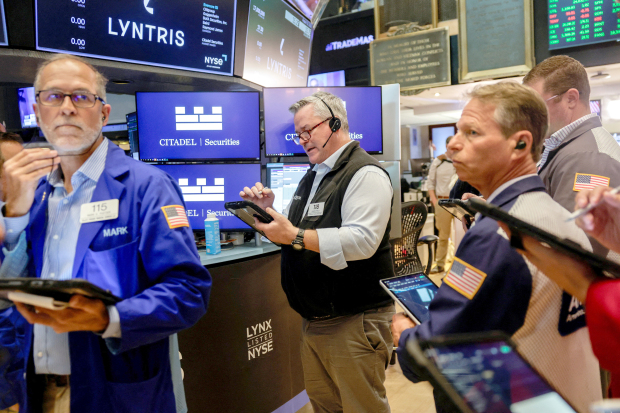
US government bonds sold off following a brief reprieve yesterday, pushing yields higher again and keeping stocks under pressure as investors questioned whether US Treasury support measures would provide lasting relief.
Yields on the 30-year US government bond rose 4 basis points to 5.225 per cent after falling to 5.1765pc earlier, a day after the Treasury’s pledge to buy back more longer-dated debt. Yields move inversely to prices.
The moves were being closely watched to gauge markets’ faith in the US Treasury’s ability to stem a rout that has sent shockwaves across multiple asset classes.
Stocks were mixed, with the MSCI index of global stocks up 0.3pc after falling for four consecutive sessions, its longest losing streak since March, and US major indexes lower in morning trading. The Nasdaq was down 0.7pc and the S&P 500 was off 0.3pc.
“The buyback announcement is more of a band-aid than a panacea. But it is a reminder that the Treasury Department is paying attention and will do whatever it can to keep yields from getting too high too quickly,” said Lawrence Gillum, chief fixed-income strategist at LPL Financial.
The benchmark 10-year yield rose 3.5 bps to 4.688pc, following a 5 bps fall on Wednesday. Yields on government bonds in Germany and Japan, however, eased.
The pan-European STOXX 600 slipped 0.17pc. Higher bond yields typically pressure stocks.
Elevated oil prices also hit sentiment. Brent crude futures rose 1.8pc to $93.23 a barrel as disruption in the Strait of Hormuz showed few signs of easing.
“You’re hitting a point where inventories can become a problem,” said Tom Samuelson, chief investment officer at Vineyard Global Advisors. US stockpiles of distillate fuel, including diesel and heating oil, have fallen for three consecutive weeks. Still, crude and gasoline inventories rose last week.
Enthusiasm about AI investment remains strong and semiconductor stocks rose on Thursday following declines earlier in the week.
“It’s penny-wise, pound-foolish for tech companies to worry about where the yield curve is. The fundamental story for AI charges ahead regardless,” said Marta Norton, chief investment strategist at retirement and wealth services provider Empower.
Tech firms cannot afford to stop their AI spending given the potential hit to their businesses if they fall behind, a dynamic that may limit the impact of bond market turbulence on AI stocks, she added.
In currency markets, the euro rose 0.16pc to $1.1695, hitting its highest since May. The yen weakened 0.3pc to 158.71.
The dollar index, which measures the US currency against six major peers, was down 0.03pc at 98.81. Minutes of the Federal Reserve’s latest policy meeting released on Wednesday showed that concern about inflation deepened, with “several” policymakers appearing ready to raise interest rates and “many” saying a hike in borrowing costs would be needed if inflation does not decline to the central bank’s 2pc target.
Meanwhile, major Gulf stock markets ended mixed yesterday as uncertainty over US-Iran peace talks kept investors cautious, although firmer oil prices provided some support.
Saudi Arabia’s benchmark index closed 0.3pc higher, with all sectors advancing. Saudi Arabian Mining Co gained 2pc, while National Shipping Company of Saudi Arabia rose 3.2pc.
Abu Dhabi’s benchmark index added 0.7pc, with most sectors ending higher. International Holding Company gained 1.9pc, while Aldar Properties rose 0.4pc.
Dubai’s benchmark index ended marginally lower, as gains in materials, financials and real estate stocks were offset by losses in other sectors. Toll operator Salik Company declined 1.1pc, while Dubai Islamic Bank gained 0.9pc.
Qatar’s benchmark index fell 0.9pc, extending losses for a fourth consecutive session and closing at 9,683 points, its lowest level in more than two years. Qatar Islamic Bank lost 1.9pc, while Industries Qatar declined 1.4pc.
Outside the Gulf, Egypt’s blue-chip index snapped a three-session losing streak to close 0.4pc higher, with most shares ending in positive territory.
&uuid=(email))