

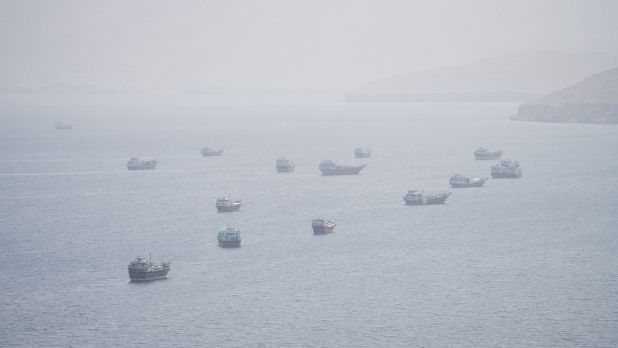
New strikes on Saudi Arabia and on ships in the Gulf tested nerves in the Middle East yesterday, after an attack on a Saudi oil pipeline and an advance by Yemen’s Houthis threatened to worsen the wartime disruption to global energy supplies.
Oil traders were expecting prices to rise again when markets reopen today, following the weekend developments that jeopardise supplies from the world’s biggest exporter, Saudi Arabia.
The British maritime security agency UKMTO said that a vessel had been struck by a projectile as it moved through the Strait of Hormuz, causing a fire and forcing the crew to be evacuated. Iran, for its part, said one person was killed and four crew wounded aboard an Iranian commercial vessel struck off its coast.
In Saudi Arabia, state media released video of damage to homes and a mosque from the purported latest cross-border attack by the Houthis, in Jazan province in the south.
Oil prices surged above $100 last week for the first time since July. The politically sensitive retail price of diesel fuel in the United States rose to another all-time high above $6.20 a gallon.
Traders and Saudi oil buyers told Reuters that Riyadh has enough oil stored at its Red Sea port of Yanbu to maintain exports for just five to seven days if the pipeline struck on Friday remains shut.
After that, as much as four per cent of global oil supply could be jeopardised, on top of the millions of barrels a day already lost to the disruption to traffic through the Strait of Hormuz.
After a quiet August when flows of Middle East oil trickled back up, the past two weeks have seen a steady escalation in the war that the United States and Israel launched six months ago. No peace talks have been held since an interim agreement in June collapsed after a few weeks.
In an interview with London-based pan-Arab news outlet Al Arabi Al Jadeed, Iran’s Foreign Minister Abbas Araqchi said despite any agreement with Oman, Iran would not reopen the strait until the United States satisfies Tehran’s demands.
The US has so far failed to achieve the objectives President Donald Trump set out when he launched ‘Operation Epic Fury’ in February: to end Iran’s nuclear programme, prevent it from being able to attack its neighbours and create conditions for its people to topple their rulers.
Iran, having withstood the superpower onslaught despite military and economic losses, hopes to emerge stronger than before the war, including with the newfound power to collect fees from ships that use the strait.
The attacks in Yemen pose a new dilemma for Washington, which wants to support its allies and protect shipping but is wary of joining war on another front.
The Houthis had mostly kept out of the wider Middle East war until recent weeks. Their advance along the Red Sea coast is part of the biggest eruption of fighting in Yemen for years.
The United States bombed the Houthis for two months in 2025, but Trump halted that campaign after announcing the group had lifted a threat to attack Red Sea shipping.
Related report – Page 16
&uuid=(email))