

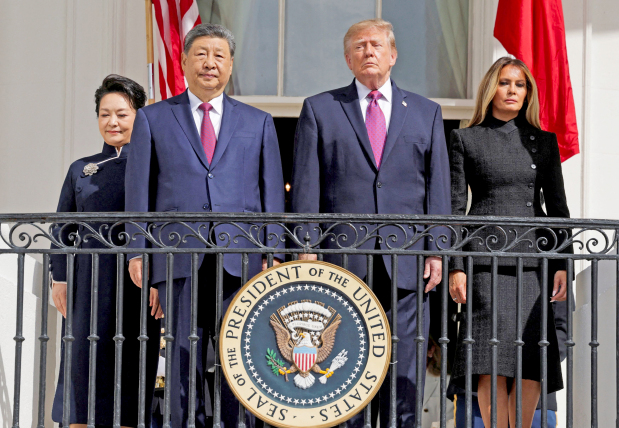
US President Donald Trump welcomed Chinese President Xi Jinping to the White House yesterday for a lavish state summit that was heavy on symbolism but light on substance, with no sign that a closed-door meeting yielded breakthroughs on thorny issues such as AI, trade, Taiwan and the war with Iran.
During a bilateral discussion in the afternoon, Xi urged the US to oppose ‘Taiwan independence’, according to a readout from the official Chinese news agency Xinhua shortly after it concluded. The White House did not immediately provide its own summary of the talks.
Xi had been expected to press Trump this week to halt arms sales to Taiwan. Following his visit to China in May, Trump said he was holding in abeyance an arms package to Taiwan worth some $14 billion and called it a “very good negotiating chip.”
That move left some US allies in Asia and even some of Trump’s fellow Republicans concerned that he may be tempted to soften Washington’s support for Taipei in exchange for economic wins. China claims democratically governed Taiwan as its own territory and has not ruled out using force to gain control over the island.
In remarks after Xi’s arrival, Trump emphasised his “truly great friendship” with Xi, rather than focusing on policy differences, and said the two powers had made strides on trade since his trip to China in May.
“During this visit, we will also discuss pressing issues concerning security, technology, and ‘super intelligence’,” Trump said, using his alternative name for artificial intelligence.
In somewhat more pointed remarks, Xi said the two countries’ interests were deeply intertwined and that competition between them should be a ‘healthy one’. US companies were welcome in China, he said, adding that he hopes “Chinese companies are treated fairly here in the United States.”
Xi also said both militaries should maintain regular dialogue to improve crisis prevention.
Edgard Kagan, a former senior White House official for East Asia, said the contrasting rhetoric demonstrates the different strategy of each leader.
“The president is casting it very much as about his personal relationship with Xi,” said Kagan, now with the Centre for Strategic and International Studies. “What I found interesting was Xi is being much more cautious and suggesting that it’s less about the personal relationship than the national relationship.”
The summit, Xi’s first visit to Washington in more than a decade, is the second meeting this year between the leaders of the world’s two biggest economies.
For Trump, who relishes ceremony and prizes his ties with powerful leaders, the visit is as much a matter of national prestige as an opportunity for high-stakes diplomacy.
But Trump and Xi’s remarks were not carried live by any US television networks, which refused to provide footage in protest of the White House’s ban of CNN, MS Now and Politico.
Trump’s embrace of Xi could complicate his campaign message at home ahead of November’s midterm elections, when Republicans’ narrow congressional majorities are at stake as voters fret about inflation and the war on Iran.
The president for months has labeled Democrats ‘communists’ in an effort to paint them as too extreme, but he welcomed Xi, the head of the Chinese Communist Party, as a dear personal friend, with Chinese flags adorning the roof above the Oval Office alongside US flags.
Despite the fanfare, major breakthroughs appeared unlikely, analysts said.
US Treasury Secretary Scott Bessent told Fox News after talks with Chinese Vice Premier He Lifeng that they had agreed to extend until January 10 an agreement pausing their trade war.
&uuid=(email))