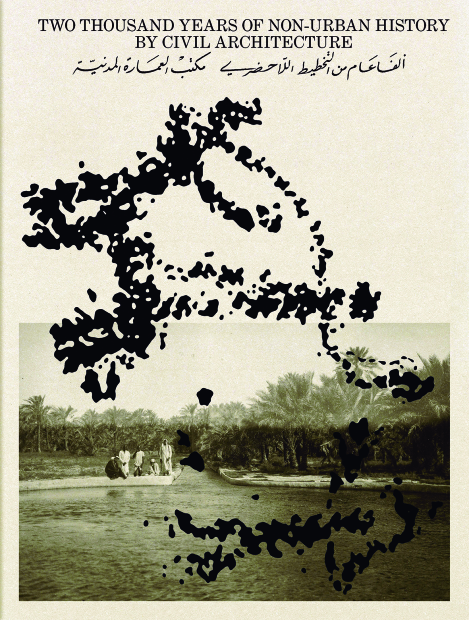
A bilingual book about the pre-oil architecture of the Gulf, exploring the desert, sea and land has been published, intended as a much-needed primer on the topic for students and architecture lovers.
Two Thousand Years of Non-Urban History documents overlooked structures in the region like natural springs, fisheries and date palm fields and how people interacted with the environment in the not-so-distant past.
Both an art piece and a history book, its pages are filled with painstakingly-crafted illustrations, archival images and stunning documentary photography. Remarkably, most of the Arabic text in the book was hand-written by a calligrapher.
The book was authored by Bahraini-Kuwaiti design firm Civil Architecture, run by duo Ali Karimi and Hamed Bukhamseen, who aimed to fill a gap in literature: practices in the Gulf that were neglected and ‘overwritten’ after the oil boom.

A constellation chart with key zodiacs, based on Al-Sufi’s book
“The idea was that every architecture student can read this book and gain an idea about the Gulf outside of Dubai, Muharraq and Manama,” Mr Karimi told the GDN.
“Hamed and I wanted to make this publication as an accompaniment, to complete part of the students’ education that we felt they did not get,” he said, referencing his and Mr Bukhamseen’s experience of teaching in university.

From a photo series about the construction of fish traps in Nabih Saleh – by Hussain Almosawi and Mariam Al Arab
“Students study about foreign architecture from Europe and America, as well as modern and Islamic, but there is nothing about the relationship of the people with the natural world.
“It is also a set of lessons for non-Khaleejis of how architecture can be used in desert, sea, farmland, and the relationship between architecture and the environment.”

Aerial view of farmland in Al Safriyah, by Mr Almosawi and Ms Al Arab
Since the duo both taught architecture in university, they noticed a trend of students submitting ‘surface-level’ research work about natural springs, all containing similar information. So, they set out to create a source that can be used as a springboard to conduct further, more unique research.
Mr Karimi stated that the desert, the sea and agricultural spaces are often overlooked, especially in books about the Gulf, despite their importance in architectural history.

Figure of lunar phases, based on an 11th-century manuscript by Muslim polymath Al-Biruni
“The desert isn’t just an empty space outside of cities, it has its own features and architecture,” he said.
Chapters
Two Thousand Years of Non-Urban History is divided into four sections covering fish traps, farms, desert kites, and the seasons.
Every chapter begins with a photo essay – a collaboration with different photographers – while the bilingual text provides historical insights and compiles references for further exploration of each topic.
A chapter covered hudhoor (plural of hadhra), traditional fish traps placed all along the shores of the Gulf, and are used to this day by Bahrainis.
Mr Karimi went to Nabih Saleh to document the process of building a hadhra, along with documentary photography duo Mariam Al Arab and Hussain Almosawi, who is also a GDN photographer and videographer.

Mr Karimi
Another chapter highlighted the desert kites of Arabia, millennia-old hunting structures that once aided desert-dwelling peoples to catch gazelles and antelopes.
Saudi photographer Moath Alofi was charged with photographing the ancient traps, located in the formerly volcanic Harrat Khaybar in Hejaz, Saudi Arabia.
Consisting of long walls leading to an enclosure with a pit in it, ancient peoples chased herds of animals into these traps to use for meat and hides.
A chapter about freshwater springs, underground channels and farms documented ever-shrinking green spaces, and the infrastructure supporting them.

Mr Bukahmseen
Through the lens of photographer Camille Zakharia, a total of 35 springs were documented, with 12 appearing in the book, some being published for the very first time.
The final chapter presents the overarching idea that ties the book together: the relationship between seasons, the environment and the people.
Multiple types of timekeeping used in the region were presented and compared, such as the Gregorian and Hijri calendars, as well as celestial calendars and the zodiac, known as ‘al-anwaa’.
“The people of the past had a different mentality when it comes to time,” Mr Karimi said. “They had a different approach towards the environment and the climate; thinking was seasonal.
“It forced you to see how the universe works, and closely observe the movement of the sun, moon and stars.
“Life wasn’t the same all year round, and architecture was designed with the seasons in mind.”
Detailed illustrations made in-house by Civil Architecture show the different types of desert kites and their construction, the process of building and installing a hadhra, irrigation systems and more.
“We wanted the book to be handwritten, as a way of celebrating the Arabic language, to show that it isn’t an afterthought,” Mr Karimi said. Kuwaiti calligrapher Hasan Albardisi was commissioned to be a scribe, writing out the whole text by hand.
“The English part of the book fits very much within contemporary architectural discourse, but the Arabic part relates to a long heritage of books by figures by Al-Idrisi, Al-Biruni, Ibn Battuta and Al-Sufi.
“All these books, from the 1400s to the 1600s, came from the Islamic world, talking about farming and climate prediction, and we wanted our work to fit within that.
“It connects it to a visual continuity of Islamic scientific books, which began 1,000 years ago and lives on to the current day.”
Although it was an enjoyable process, the team faced challenges along the way, including a substantial increase in the cost of shipping the books from the press in Europe because of the conflict.
“It’s hard to access archives, and there aren’t many avenues to request information for research, as the system isn’t prepared for them,” Mr Karimi said.
Collaboration
An ensemble of architects, photographers, designers, artists and writers have collaborated to make Two Thousand Years of Non-Urban History possible, with a research team that was nearly all Bahraini.
It was published by Kaph Books, a Lebanon-based publishing house that specialises in art books from the Arab world, and was printed in Italy on artisanal recycled paper.
The text was translated into Arabic by Ghadeer Alkhenaizi and Jumana Alqassab, with a foreword written by architecture professor Rania Ghosn, and an afterword by geographer Ahmad Makia.
Funding began with a grant from US-based Graham Foundation for Advanced Studies in the Fine Arts and Tamkeen, with further support provided by the Bahrain Authority for Culture and Antiquities.
In September, the book was launched in Printed Matter, New York City and MIT in Boston, with inauguration events scheduled this month in Sharjah, and in November in London.
As for Bahrain, it is set to be launched in Muharraq Nights in December, while an event in Kuwait City is set for March next year.
The authors made the book affordable and accessible – at a price of just BD15 – and is available for purchase online on Kaph Books’ website or Amazon. In Bahrain, the book is sold in the Bahrain National Museum and Qal’at Al Bahrain Site Museum’s gift shops, as well as Al Riwaq Art Space.
zainab@gdnmedia.bh