

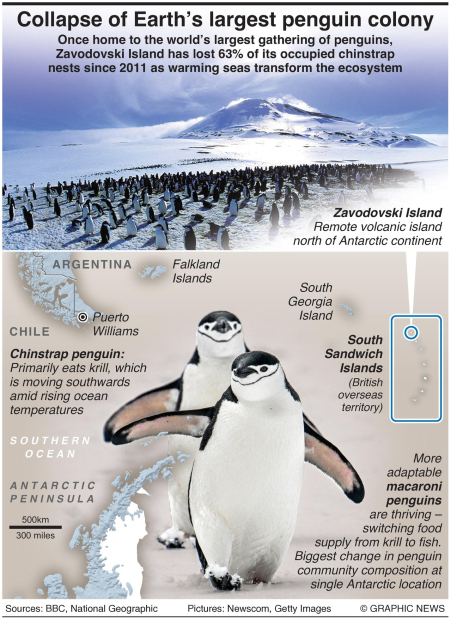
The population of a penguin colony that was previously the largest in the world has fallen by almost two-thirds, a new study has revealed – with climate change thought to be a major reason for the decline.
The number of chinstrap penguins on the remote volcanic island of Zavodovski in Antarctica has decreased from approximately 550,000 in 2011 to just over 200,000, according to scientists from the British Antarctic Survey (BAS).
It also found a 63 per cent decline in occupied chinstrap nests from 2011 to 2025.
Professor Norman Ratcliffe, a BAS ecologist and the lead author of the study, described the decline as ‘a huge collapse’ and said the drop in numbers was ‘alarming.’
Prof Ratcliffe said: “When we actually arrived on the islands and saw these very alarming decreases, you could see how the populations had contracted.
“Even in the field you can see the big areas where there’s just empty nests where birds used to nest that are now just completely empty.”
Prof Ratcliffe said the chinstrap penguin population had not been affected by one singular event, but their numbers had declined steadily over decades.
However, he said the drop had been expedited by the warming climate that has led to krill – the food source chinstrap penguins almost solely rely on - to navigate away in search of colder waters.
The BAS said that, by contrast, there were ‘a lot more’ macaroni penguins – which also inhabit the island and have a more flexible diet – than the 90,000 reported in 2011.
Prof Ratcliffe called the difference in population shifts between the penguin species ‘the biggest change in community composition ever observed at a single location in Antarctica,’ and said it provided ‘further evidence of how rapid warming in the Antarctic is impacting unique and sensitive ecosystems.’
The researchers ruled out other possible explanations for the change, such as competition for nesting space between the two penguin species, or krill fisheries in the region.
They also suggested that the island’s volcanic eruption in March 2016, which deposited smoke and ash over the lower slopes of the volcano, is not to blame.
&uuid=(email))