

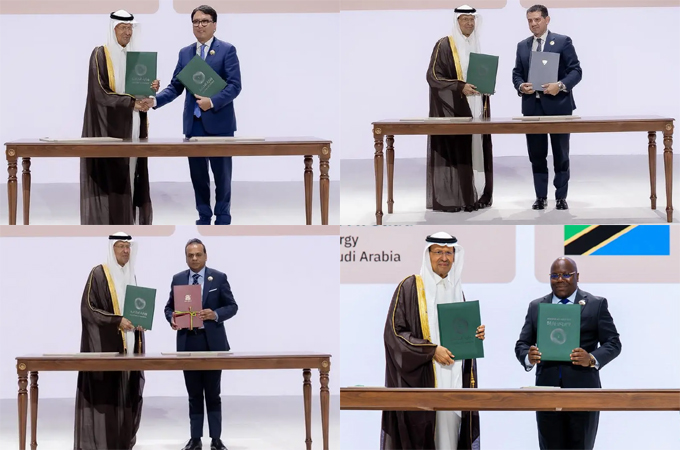
Saudi Arabia has signed four memoranda of understanding (MoUs) with Mongolia, Tanzania, Cyprus and Mauritius to strengthen cooperation across the energy sector, including oil and gas, renewable energy, electricity, petrochemicals and clean hydrogen.
Saudi Minister of Energy and Minister of Industry and
Mineral Resources Prince Abdulaziz bin Salman bin Abdulaziz signed the
agreements with senior officials from the four countries in Riyadh on the
sidelines of the 25th WPC Energy Congress, hosted by the Kingdom through
October 15 under the theme “Pathways to an Energy Future for All.”
The agreements aim to expand bilateral cooperation,
encourage investment opportunities, promote technological innovation and
strengthen collaboration on energy security and climate change mitigation.
Prince Abdulaziz signed the agreement with Mongolia’s Deputy
Prime Minister Togmid Dorjkhand, establishing a framework for cooperation in
oil and gas, refining, petrochemicals, electricity, power interconnection,
renewable energy, energy efficiency and storage.
The agreement also covers climate change mitigation
technologies, including Circular Carbon Economy solutions, as well as digital
transformation, artificial intelligence, innovation and cybersecurity
applications in the energy sector.
The two countries will seek to develop strategic
partnerships to secure materials, products, services and technologies across
energy supply chains.
The MoU also aims to promote sustainable petrochemical
materials in construction and other industries, strengthen cooperation between
energy companies and support large-scale electricity projects and renewable
energy development.
A separate agreement was signed with Tanzania’s Minister for
Energy Juma Zuberi Homera to strengthen cooperation in refined petroleum
product supplies and explore opportunities related to supporting
infrastructure.
The agreement also provides for assessing opportunities in
liquefied natural gas, exchanging technical expertise in oil and gas
exploration, and exploring potential cooperation in petrochemical production.
Additional areas include electricity, renewable energy,
energy efficiency and climate change mitigation technologies, including clean
cooking solutions and Circular Carbon Economy initiatives.
The two countries will also explore opportunities linked to
the Oil Sustainability Program and transport and fuel infrastructure, alongside
cooperation in digital transformation, artificial intelligence, innovation and
cybersecurity.
Prince Abdulaziz also signed an MoU with Cyprus’s Minister
of Energy, Commerce and Industry Michael Damianos covering oil and gas,
refining, petrochemicals, electricity, clean hydrogen and its derivatives,
renewable energy, energy efficiency and storage.
The agreement includes cooperation on climate change
mitigation, digital transformation and cybersecurity, as well as efforts to
advance shared international policy priorities through multilateral
negotiations.
These include discussions under the United Nations Framework
Convention on Climate Change, the Paris Agreement and the international legally
binding instrument on plastic pollution.
The MoU also supports the development and use of sustainable
petrochemical materials, the expansion of energy access through appropriate
infrastructure and stronger collaboration among companies operating in
energy-related fields.
The fourth agreement, signed with Mauritius’s Minister of
Foreign Affairs, Regional Integration and International Trade Dhananjay Ramful,
covers a broad range of energy areas, including oil and gas, refining,
petrochemicals, electricity, clean hydrogen, renewable energy, energy
efficiency and storage.
It also includes cooperation on climate change mitigation,
Circular Carbon Economy technologies, digital transformation and cybersecurity
applications in the energy sector.
Like the agreement with Cyprus, the Mauritius MoU provides
for coordination on shared international policy priorities through relevant
multilateral negotiations, including those related to climate change and
plastic pollution.
It also promotes sustainable petrochemical materials and
infrastructure development to expand access to energy.
The four agreements underscore Saudi Arabia’s efforts to broaden international energy partnerships and strengthen cooperation across conventional and emerging energy technologies, while supporting energy security, innovation and sustainability. -OGN/TradeArabia News Service
&uuid=(email))