

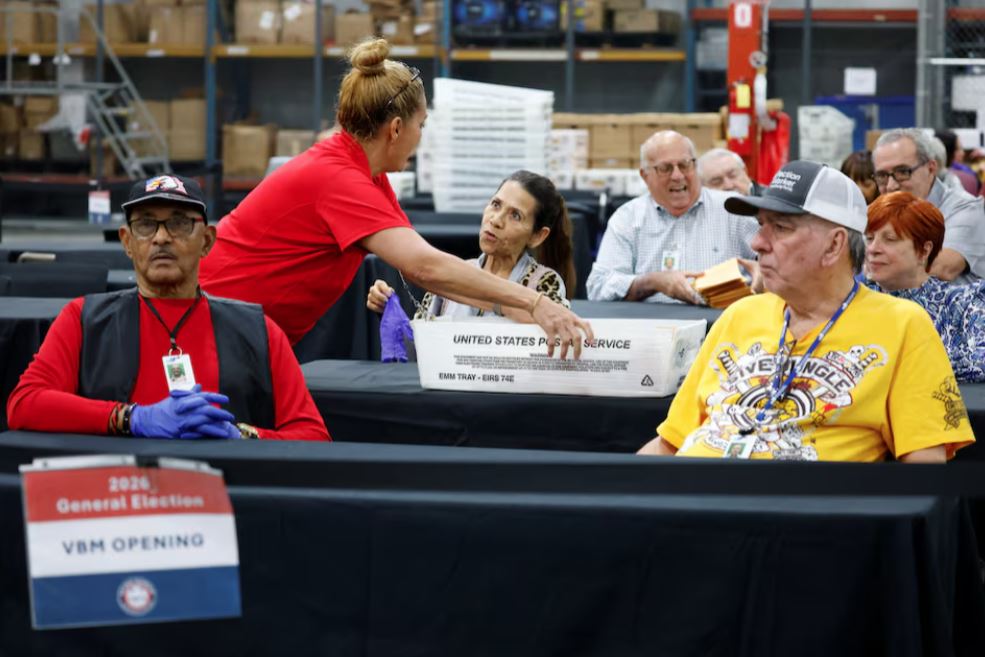
Americans headed to the polls yesterday in midterm elections that will deliver a verdict on President Donald Trump’s second term, with surveys and nonpartisan analysts favouring Democrats to capture the House of Representatives from Republicans while control of the Senate remains uncertain.
The battle for the Senate is unfolding across nearly 10 closely contested statewide races, most in Republican strongholds.
History is against Trump’s Republicans: The sitting president’s party has lost ground in Congress in all but two midterm elections since the Second World War. Trump’s approval rating is hovering near his all-time lows, dragged down by deep voter frustration over the war with Iran and the resulting rise in fuel prices.
The close US-Israel alliance has been a particular focus in Michigan, where progressive Democrat Abdul El-Sayed is running a closely watched campaign for Senate.
The president has sought to energise his base with more than two dozen campaign rallies since the start of October, most in states he easily won in 2024. He also offered the novel inducement of a proposed $5,000 cheque to each US adult if Republicans retain control of Congress, which would have to approve the costly payout.
Led by Trump, Republicans have portrayed Democratic candidates as radical, un-American and even communist.
But opinion polls show voters are most concerned about affordability, and disapprove of Trump’s handling of the issue. His sweeping tariffs on imports, many of which were thrown out as illegal by the courts, and his decision to attack Iran in February raised prices for consumers. Republican candidates, meanwhile, have struggled to distance themselves from a president who demands fealty and rarely acknowledges mistakes.
At a voting centre in a predominantly Black neighbourhood in northwest Detroit, Natalia Towns, 34, said she did not find efforts by Mike Rogers, the Republican Senate candidate, to court Black voters sincere, and felt El-Sayed would do more to bring down costs. “I do feel like health matters, petrol prices are high, food is too high,” she said.
Problems with voting equipment were reported in various parts of the country, including counties in Georgia, Iowa, New York, North Carolina, Oklahoma and Wisconsin, potentially causing local delays in voting and ballot-counting.
Isolated voting machine malfunctions are not unusual for US elections, but election experts say that backup systems and other safeguards mean these rarely affect results.
Legal observers and Democrats have warned that Trump, who has long falsely claimed that US elections are rigged, may attempt to challenge yesterday’s results if Republicans lose.
The US Justice Department said it was deploying 1,000 election monitors and observers to all 50 states in what it called the largest election day monitoring effort in history.
Democrats have criticised the plan as potential voter intimidation. In roughly two-thirds of the jurisdictions the department listed, voters supported Democrat Kamala Harris over Trump in the 2024 presidential election, a Reuters analysis found.
All 435 seats in the US House of Representatives are up for election, along with 35 of the Senate’s 100 seats, though most contests are not considered competitive. Democrats must flip at least three House seats and four Senate seats to win a majority in each chamber.
Democrats have little margin for error. The party must defend all of its current seats while winning at least two states that voted for Trump by a double-digit margin two years ago: Alaska, Iowa, Kansas, Nebraska, Ohio, South Carolina and Texas.
Opinion polls show Democrats either narrowly leading or within striking distance in all of those states.
The Michigan Senate contest between El-Sayed, 42, and Rogers, 63, represents a high-profile test of whether Republicans’ identity-based attacks – El-Sayed would be the nation’s first Muslim senator — prove effective in a battleground state.
A win for El-Sayed, who has faced millions of dollars in opposition spending from Israel-linked groups and supports policies such as universal healthcare, would also be seen as a boost for the Democratic Party’s left wing ahead of the 2028 presidential election.
