

Bahrain: Soaring temperatures will make Gulf countries uninhabitable before the end of this century if greenhouse gas emissions are not curbed, according to a new report.
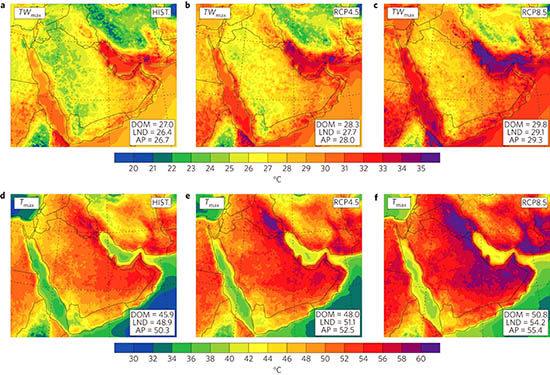
The study, which was published in the scientific journal Nature Climate Change earlier this week, projects heatwaves by 2070 that will be more severe than anything previously experienced.
Even young, healthy people will be unable to maintain a safe body temperature in such conditions, while the elderly and very young will be even more at risk.
Authored by professor Elfatih Eltahir of Massachusetts Institute of Technology and professor Jeremy Pal of Loyola Marymount University in Los Angeles, the study predicts that the hottest days of summer today will become a near-daily occurrence in future.
“Like all living species, human survival is partially a function of the environmental temperature,” said the authors, who drew a distinction between so-called “dry-bulb” and “wet-bulb” temperature – the latter being a combined measure of temperature and humidity.
“A human body may be able to adapt to extremes of dry-bulb temperature through perspiration and associated evaporative cooling, provided that the wet-bulb temperature remains below a threshold of 35C.”
The limit of “survivability” for a fit person under well-ventilated outdoor conditions is 35C at 100 per cent humidity.
This threshold can also be crossed with a higher temperature and lower humidity level – 46C at 50pc humidity, for example.
Without air conditioning, humans can only last for about six hours under such conditions before their bodies begin to shut down, according
to the authors.
“We project, using an ensemble of high-resolution regional climate model simulations, that extremes of wet-bulb temperature in the region around the Arabian Gulf are likely to approach and exceed this critical threshold under the business-as-usual scenario of future greenhouse gas concentrations,” they said.
Hotspot
“Our results expose a specific regional hotspot where climate change, in the absence of significant mitigation, is likely to severely impact human habitability in the future.”
Currently, wet-bulb temperatures rarely exceed 31C in the Gulf, but if it were to climb higher the authors predict several knock-on effects for vital infrastructure and transport.
“When temperature approaches such extremes, much machinery designed for the current climate may malfunction. For example, aircraft may not operate properly during take-off and landing, and rail lines can buckle at extreme temperatures, even at temperatures around 40C.”
The report postulates that by the end of the century, the present-day hottest summers will become “approximately a normal summer day”.
Temperatures on the Red Sea are expected to be
milder, but still “fairly severe”, with Jeddah and Mecca being impacted. “These extreme conditions are of severe consequence to the Muslim rituals of Haj, when pilgrims (approximately two million) pray outdoors from dawn to dusk near Mecca,” said the report.
“This necessary outdoor Muslim ritual is likely to become hazardous to human health, especially for the many elderly pilgrims, when the Haj occurs during the boreal (Northern Hemisphere)
summer.”
The end result will be that life in the region becomes unsustainable – especially to those most vulnerable, the authors said.
“Under such conditions, climate change would possibly lead to premature death of the weakest – namely children and elderly,” they said.
“A plausible analogy of future climate for many locations in Southwest Asia is the current climate of the desert of Northern Afar on the African side of the Red Sea, a region with no permanent human settlements owing to its extreme climate.”
laala@gdn.com.bh
&uuid=(email))