

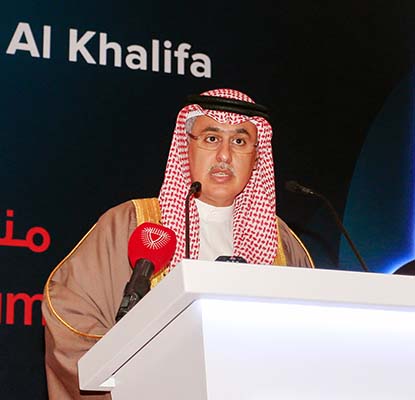
Manama: Economic growth in Bahrain’s non-oil sector has remained robust in the first half of this year and is consistent with the overall projection of 4.6 per cent for the year as a whole, Industry, Commerce and Tourism Minister Zayed Al Zayani has said.
In a presentation at the 10th consecutive edition of the Invest in Bahrain forum at Bahrain International Exhibition and Convention Centre (BIECC) yesterday, the minister said foreign trade data also showed strong non-oil growth; the increase in non-oil exports is particularly evident with a jump from BD186 million in May to BD292.6m in June and the aggregate value of non-oil merchandise exports during the first eight months of the year reaching BD1.72 billion.
The day-long forum and exhibition was held under the patronage of His Royal Highness Prime Minister Prince Khalifa bin Salman Al Khalifa, who deputised Deputy Premier Shaikh Khalid bin Abdulla Al Khalifa to preside over the opening.
Mr Al Zayani said Bahrain has long recognised the importance of a diversified economy and an enabling commercial and manufacturing environment with world-class infrastructure.
“In this era of global slowdown and high volatility in the oil prices, we are, more than ever before, conscious of the need to diversify the economy and boost our exports,” he said.
The ministry has carried out a study on the potential for economic diversification and new export opportunities in co-operation with Gulf Organisation for Industrial Consulting (GOIC) and the World Bank Group.
Experts from World Bank have identified several attractive investment opportunities in sectors ranging from machinery, transportation, metals, electrical and electronics to chemicals and plastics, Mr Al Zayani added.
According to him, investment opportunities identified do not just aim to promote Bahrain as a suitable destination for investment, but also represent a sincere call to businesses to explore areas of interest and partnerships supported by a pro-business environment and infrastructure.
Basic and higher education, technical training, health services, electronic services and communications are potential high growth prospects for business owners, he said.
The manufacturing sector is considered the third largest sector of Bahrain’s economy after oil and financial service. As part of the economic diversification process, Bahrain has focussed on value-added industries such as aluminium, petrochemicals, metal products and iron.
The minister, who has recently seen the addition of tourism to his portfolio, said the sector achieved 13.5pc average growth in revenues over the past five years.
There has also been a 31pc increase in occupancy rates in hotel facilities over the same time frame, he said.
“The ministry is seeking to build potential in this sector, which allows for 100pc foreign ownership, and looking at developing sports tourism as well as the meetings, incentives, conferences, and exhibitions (MICE) business.”
He said Manama, being named the Capital of Gulf Tourism 2016 by GCC Tourism Ministers, should also have a “great impact in supporting tourism.”
On other initiatives by the ministry, Mr Al Zayani said the launch of the Business Licensing Integrated System (BLIS) in May, which converted all commercial licensing operations from paper to electronic and integrated relevant governmental bodies in one system, has considerably shortened the time required to obtain business licences, while doing away with the need to visit the Investors Centre and other government agencies.
“The system communicates automatically with applicants through e-mails to inform them about stages of issuing licences and with the required information and explains all conditions, procedures, laws and regulations.
“More than 1,800 business activities and services such as change of company name, addition of partners or change of address are offered under BLIS.”
The minister said the Cabinet has also accepted in principle a move to International Standard Industrial Classification (ISIC) 4, which should be done soon.
ISIC is a United Nations system for classifying economic data according to kind of economic activity in the fields of production, employment, gross domestic product and other statistical areas.
According to the UN, as a basic tool for studying economic phenomena, it fosters international comparability of data, providing guidance for the development of national classifications and for promoting the development of sound national statistical systems.
Federation of Chambers of the GCC chairman Shaikh Khalifa bin Jassim bin Mohammed Al Thani, who also spoke at the forum, said events such as the Invest in Bahrain forum were essential to activate partnership between the private and public sectors to develop national industries, enhance their international competitiveness and open new marketing channels for products.
In his address, Bahrain Chamber of Commerce and Industry chairman Khalid Almoayed said according to the World Investment Report 2015, foreign direct investment (FDI) flowing into Bahrain reached $957m last year, while the ratio of Bahrain’s total FDI inflows relative to the GDP for last year was 55.4pc.
avinash@gdn.com.bh
&uuid=(email))