

A year-round strategy is being rolled out to tackle some of the Capital Governorate’s most persistent rainwater trouble spots, with authorities promising faster responses, better co-ordination and long-term engineering solutions.
The plan was highlighted during a presentation on the Capital Municipality’s efforts during the 2026 rainy season, where officials detailed measures taken to reduce flooding and water accumulation across vulnerable neighbourhoods.
Capital Trustees Board chairman Saleh Tarradah said the issue remained a top priority for municipal and government authorities.
“Rainwater accumulation is a challenge that requires continuous monitoring and long-term planning rather than seasonal responses,” he said. “We’re giving special attention to areas that are repeatedly affected by heavy rainfall. The Works Ministry is studying solutions based on available funding, technical feasibility and new engineering approaches that can provide lasting results.”
Mr Tarradah stressed that efforts were focused on gradually reducing the number of flood-prone locations through infrastructure upgrades and preventative measures.
“We are committed to improving conditions for residents and ensuring that road networks and residential areas are better prepared whenever rainfall occurs,” he added.
During the presentation, Capital Trustees Authority (Municipality) cleaning section representative Yousif Al Banna outlined the extensive preparations undertaken before and during the rainy season.
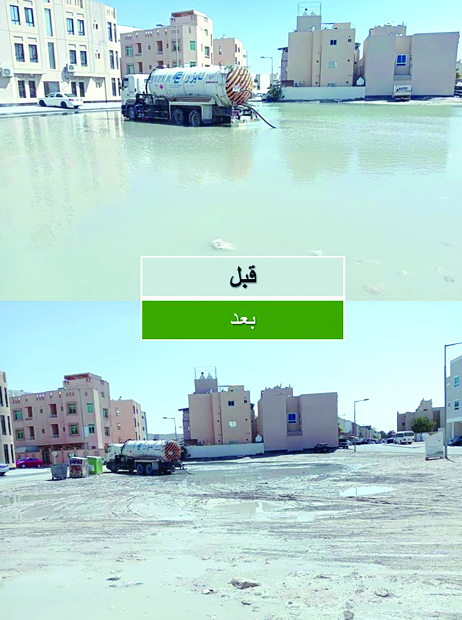
Work before and after within residential areas
A dedicated operational plan was developed to distribute inspectors across different areas, allowing continuous field monitoring of water tankers, pumps and drainage operations.
Mr Al Banna revealed the municipality had identified the 10 locations most vulnerable to rainwater accumulation, including parts of Sitra, Wadiyan, Al Daih, Tuwaili and Jid Ali.
“Knowing where the challenges are allows us to respond more effectively,” he said.
“Our teams monitor these locations closely and mobilise equipment immediately when rainfall is forecast or water begins to accumulate.”
He added that municipality crews were also engaged in cleaning open areas, removing weeds and clearing potential obstructions that could hinder drainage.
“Preventive work is just as important as emergency response,” said Mr Al Banna.
“Keeping drainage paths clear and maintaining public spaces significantly improves our ability to manage rainwater when storms arrive.”
Capital Trustees Authority director-general Alya Yousif said co-operation between government agencies had dramatically improved response times and operational efficiency.
“Rainwater removal is now being carried out more quickly and efficiently thanks to close co-ordination between the Works Ministry and the Municipalities Affairs and Agriculture Ministry,” she said.
“Joint planning and real-time communication have strengthened our ability to deploy resources where they are needed most.”
Ms Yousif noted that the integrated approach had enabled teams to address incidents faster while minimising disruption to residents and road users.
“Our objective is not only to respond to rainfall events but to continuously improve readiness levels throughout the year,” she said.
“The lessons learned from each rainy season help us refine procedures and enhance future performance.”
She said the municipality has also increased public awareness efforts through social media, showcasing pumping operations, maintenance work and field activities aimed at reducing the impact of adverse weather.
With climate patterns becoming increasingly unpredictable, officials say the capital’s flood management strategy is evolving from a seasonal operation into a permanent programme focused on prevention, rapid intervention and long-term resilience.
mohammed@gdnmedia.bh
&uuid=(email))