

OBESITY in Bahrain has increased, according to preliminary data of a national survey revealed to the GDN by an expert.
Specific details of the National Health Survey conducted in 2018 is not yet ready for official release, said King Hamad University Hospital (KHUH) consultant endocrinologist, Dr Dalal Alromaihi.
She also fears that the pandemic will have added to the burden, in a country where more than 70 per cent of the adult population is obese.
Survey
“We are currently waiting for the final release of the National Health Survey that was conducted in 2018,” Dr Alromaihi told the GDN.
“From the preliminary data of this survey that I have reviewed, the statistics of obesity has gone higher than it used to be in the past.
“This is alarming for the health of the current and future generation and has several implications on the quality of life, cost of healthcare and overall productivity of individuals.”
The most recent official statistics in Bahrain, which date back to 2007, revealed that 72.6pc of the adult population was obese and 65.9pc overweight. Obese women accounted for 40.3pc compared with 32.3pc men, while more men were overweight, accounting to 34.8pc against 31.1pc women.
Among children the data dated back to 2005 and reflected 15.5pc as obese, with 26.9pc overweight. Girls accounted for 14.3pc of the overweight population, while boys were 12.6pc, with 8.1pc girls and 7.4pc boys registered as obese.
Dr Alromaihi was speaking to the GDN on the sidelines of a three-day virtual conference addressing the theme of ‘Obesity across the Lifespan’.
The GDN yesterday reported that the forum of around 1,000 healthcare clinicians and professionals was focusing on the findings of a report launched by the World Obesity Federation, which underlined the ‘critical need’ for early diagnosis in treating and managing obesity.
Dr Alromaihi, who was part of the team which developed the practical recommendations, said the report was important for Bahrain.
“We have to recognise it as a medical condition in order to provide the needed preventive measures and implement appropriate treatment plans to those affected by obesity,” she explained.
“Obesity is one of the leading risk factors for several chronic conditions including diabetes, hypertension, high cholesterol, cancer, sleep apnea and others.”
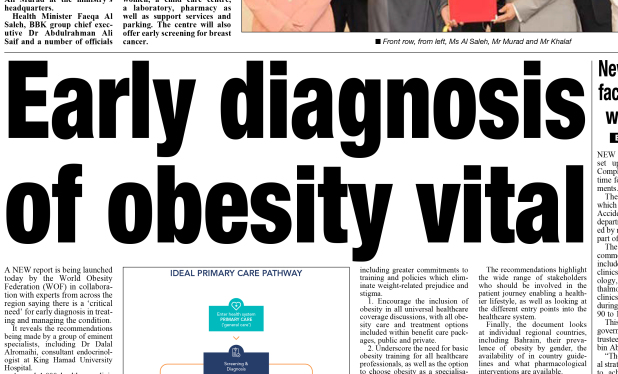
The report in yesterday’s GDN
Dr Alromaihi pointed out on the need for more awareness programmes for the public to train them to make better health choices, adopting better dietary habits and to engage regularly in physical activities.
“We also need to consider regulations regarding food marketing and advertisement and to mandate food labelling by restaurants,” she added.
“Adding more tax to unhealthy meals can help and the environment needs to be welcoming to more exercise, such as creating more safe paths for cycling, for example.
“We also need the health sector to deal with obesity as a chronic disease and designate specialised clinics for obesity diagnosis and management.
“Additionally, the cost of obesity management should be covered as it is a way to improve the health of the individual and cut cost on the healthcare in the long term by virtue of avoiding several additional chronic diseases.”
Experts across the world have cautioned that a lack of physical exercise during the pandemic could contribute to a rise in non-communicable diseases.
The GDN reported last month Health Ministry nutrition section chief Dr Marwa Hussain highlighting the need for a balanced lifestyle alongside physical activity and a healthy diet to ensure obesity and diabetes rates in the country do not increase.
“We don’t have solid statistics yet on the changes post-Covid-19, but the need for social distancing and closing of the gyms at the beginning of the pandemic, forced many people to stay indoors more and some may have succumbed to indulging in more food at the same time as reducing their engagement in regular exercise,” said Dr Alromaihi.
“Furthermore, this time has been stressful and could lead to ‘stress eating’ in both adults and children.
“My expectation is that obesity rates have increased but we will wait for more data to support this conclusion.”
Non-communicable diseases account for 75pc of global fatalities, with a prevalence of obesity in GCC countries among children and adolescents in recent years.
raji@gdn.com.bh
&uuid=(email))