

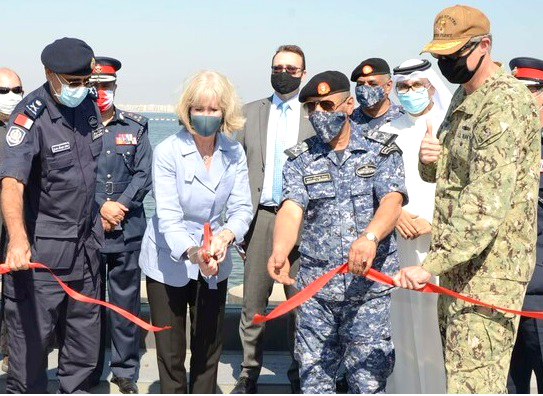
MANAMA: A first-of-its-kind waterside security barrier has been installed by the US Navy in Bahrain to protect ships at the port.
The 3,810-metre-long Coalition Force Waterfront Security Barrier is the longest sea wall the US Navy has built overseas.
It is designed to absorb kinetic energy (energy that an object has because of its motion) and has the power to defend, deter or delay a vessel intending to harm navy ships moored on the waterfront at Mina Salman Port.
“The purpose of the Coalition Force Waterside Security Barrier is to provide protection against maritime security threats to coalition naval forces while they are in port,” Fifth Fleet deputy public affairs office Lieutenant Commander Pete Pagano told the GDN.
“Bahrain, the US and other coalition ships regularly use the berths and will therefore benefit from the added security of the barrier.”
He said the barrier was designed to improve the ability of Bahrain and US security forces to control access to berths at the port.
The increased security will help defend US Navy, BDF, commercial and UK Military Component Command ships berthed at the Naval Support Activity Bahrain’s Mina Salman Port.
“The project is part of an ongoing effort to continuously enhance mutual defensive capabilities alongside our coalition partners, and was completed in record time due to effective co-ordination and teamwork between Bahrain and the US Navy,” said Lieutenant Commander Pagano.
The new installation follows a series of threats by Iran in the past few years targeting the US Navy and commercial vessels.
Construction of the more than two-mile barrier was completed in about nine months, all the while working with the challenges and restrictions caused by Covid-19.
The Naval Facilities Engineering and Expeditionary Warfare Centre and Naval Facilities Engineering Command Europe Africa Central co-ordinated with multiple contracting companies to oversee the design and construction of the project.
The Fifth Fleet area of operations encompasses about 2.5 million square miles of water area and includes the Arabian Gulf, Gulf of Oman, Red Sea and parts of the Indian Ocean.
This includes three critical choke-points at the Strait of Hormuz, the Suez Canal and the Strait of Bab Al Mandeb at the southern tip of Yemen.
&uuid=(email))