

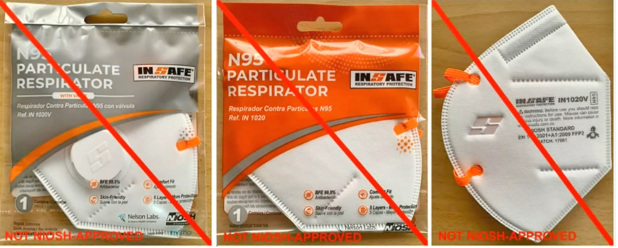
COUNTERFEIT face masks and thermometers were seized by inspectors from the local market, revealed a senior official, in a crackdown to help avoid a major headache for the health authorities tackling the Covid-19 pandemic.
The substandard face coverings could have spread the virus to unwitting members of the public trying their best to keep safe and not spread the illness and keeping a temperature check was another means of making sure they had not caught it.
Inspectors at the National Health Regulatory Authority (NHRA) also encountered the prevalence of devices sold with the promise of disinfecting the air around a person alongside unsubstantiated anti-coronavirus claims last year.
NHRA medical equipment engineer Omar Mohamed revealed that the authority seized at least five types of face masks that were falsely marketed as certified by US federal agency NIOSH (National Institute for Occupational Safety and Health).
Mr Mohamed was speaking at the virtual GCC MedTech Summit which concluded yesterday. The three-day forum addressed medical device and technology regulation, registration, market access and compliance in the Gulf region.
“We found at least five types of counterfeit face masks in the market during the Covid-19 pandemic,” Mr Mohamed told the GDN on the side-lines of the forum.
“They were sold after being claimed to be approved by NIOSH, and signs were forged to look like they were.
“During inspections in the market we also found some thermometers that were marketed which unfortunately did not comply with international requirements and they had to be recalled.
“Another counterfeit device that was seized had falsified claims of offering Covid-19 prevention.”
The NHRA in March last year recalled a device from the market citing its claims were ‘scientifically unfounded’, while it also cautioned on using infrared thermometers accurately, as they became widespread during the height of the pandemic.
The US Environment Protection Agency in August last year banned selling a device which described itself as a ‘personal air sanitiser’.
It directed users to hang the badge-like gadget from their shirts or backpacks as it releases chlorine dioxide gas to purportedly sanitise the air of pathogens.
Furthermore, in his keynote address at the summit on ‘Counterfeit – Covid Impact’, Mr Mohamed said the prevalence of fake devices in Bahrain had fortunately declined.

Mr Mohamed
“The hike in 2019 was because of the enforcement of medical device importation protocols that year following which NHRA organised training sessions which led to the decrease of counterfeit devices in the market,” he added.
The GDN reported that among other unregistered medical devices confiscated by the NHRA in the first nine months of that year were high frequency body contouring machines, non-surgical weight reduction gear and facial equipment imported by salons.
Inspectors also seized a number of crude surgical instruments manufactured in workshops in Bahrain that were being supplied to local clinics.
Mr Mohamed pointed out that usually counterfeit medical devices are encountered during planned inspection visits, surprise checks and follow up investigations to public complaints.
“Once we open the case, we conduct an inspection visit to verify and then contact the manufacturer to get more information on the quality,” he explained.
“Once the product is confirmed to be a counterfeit, a recall notification is issued and we will ensure that all are recalled.
“In case of a patient harm caused by a device, the case will be transferred to NHRA’s legal committee in order to take legal action according to Bahrain law.”
The problems are global. Seizures of hundreds of thousands of counterfeit N95 respirators have been reported in the UAE and South Africa amidst the pandemic.
Nearly 20 factories selling substandard face masks, disinfectants and hand sanitisers have been uncovered in the UAE since the outbreak of the virus.
raji@gdn.com.bh
&uuid=(email))