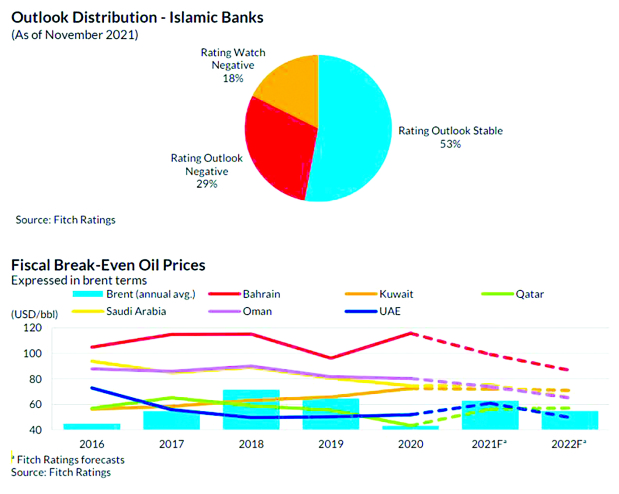
MANAMA: Islamic banks in Qatar and Kuwait have a negative outlook for 2022, due to the former’s increasing reliance on external funding and the latter’s negative sovereign outlook, according to Fitch Ratings.
The agency said yesterday that the ‘Rating Watch Negative’ on all rated Qatari Islamic banks reflects their increasing reliance on external funding and rapid asset growth, which may have moderately weakened the sovereign’s ability to support the banking system, if needed.
It also said the negative outlook on all Kuwaiti Islamic banks reflects the negative outlook on the sovereign, in turn driven by near-term liquidity risk given the depletion of liquid assets in the absence of a debt law.
For the rest of the GCC and the sector as a whole, Fitch said the 2022 sector outlook is neutral, reflecting a modest economic recovery and higher oil prices.
The agency however expects continued profitability pressures across the region.
On the other hand, asset quality is not expected to deteriorate sharply following the end of forbearance measures, while capital buffers and liquidity are expected to remain stable and adequate for the risks.
“We expect further M&A activity in 2022 as many Islamic banks have weak franchises lacking strong competitive advantages, particularly in pricing, cost of funding and growth opportunities,” said Redmond Ramsdale, head of Middle East Bank Ratings and Islamic Banking at Fitch.
“Asset quality, profitability and, potentially, capital pressures on these banks could lead to more tie-ups. M&A may also create new Islamic national or regional champions.”
Looking at potential disrupting factors, Fitch said the Higher Sharia Authority (HSA), housed under the UAE central bank, continues to push for compliance with Bahrain-based Accounting and Auditing Organisation for Islamic Financial Institutions (AAOIFI) Sharia standards.
HSA’s initiatives affect various aspects of Islamic banks’ daily operations.
According to the agency, supervision and regulation of GCC Islamic banks differ by country and will increase in 2022.
This is mainly through the set-up of centralised Sharia boards by country; they are already in place in Bahrain, Kuwait and the UAE and one is being implemented in Qatar.
The Saudi Central Bank has also issued a Sharia corporate governance framework for banks engaging in Islamic banking, aiming to establish standards for Sharia governance practices.
There is a push towards the standardisation of Sharia-compliant products but challenges remain with the adoption of Islamic standards and the realignment of existing products, it said.
avinash@gdn.com.bh