

Fewer cats and dogs have found their ‘fur-ever’ homes in Bahrain despite an apparent global spike in pet adoptions during the pandemic.
According to local shelter executives, cat and dog adoptions have declined over the past two years, much to their dismay.
“We have gone from more than 200 animals being adopted in 2019 down to 130 in 2020 and just 110 in 2021,” said Bahrain Society for the Prevention of Cruelty to Animals (BSPCA) deputy chairman Yasmin Alhilli. “On average, at any one time, we hold more than 200-plus animals, including more than 100 dogs and more than 50 cats, all awaiting adoption.”
BSPCA animals are fully vaccinated, wormed, tick treated and, if old enough, neutered before they are adopted by the public.
But, it’s not all bad news.
“Over the last two years we have found homes for many different types of animals such as rabbits, Guinea pigs, goats and donkeys to name but a few of the creatures that have come into our care,” added Ms Alhilli. “We have also successfully rescued, rehabilitated and released many critically-endangered sea turtles too.”
Meanwhile, only 43 dogs and six cats were adopted last year from the Bahrain Animal Rescue Centre (BARC) in Hamala.
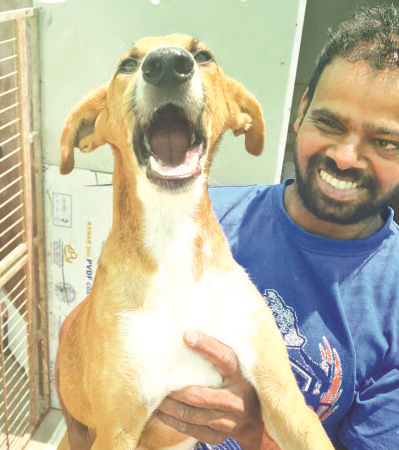
A BARC resident with Chula, the oldest animal care worker at the centre
“The whole idea that so many pets got adopted during the pandemic is not true as far as we are concerned,” said BARC’s volunteer team leader Muna Aldaaysi.
“The whole pandemic puppy or kitten trend may have happened in other countries where the idea of having cats and dogs inside the house is not frowned upon by the majority.
“The stigma of many local families not accepting dogs as pets inside the house still persists. Unfortunately, this is the reality in Bahrain. This is also, why the majority of our adoptions are now international.”
BARC has been working with the Wild Heart Foundation in the UK and Loved At Last Dog Rescue in Canada to facilitate the travel and adoption process. There is even a Flight Buddies programme in which people can sign up to accompany dogs on their journey to their new homes.
Unfortunately, due to the pandemic, flights became limited and so expensive and not many were travelling, causing a decline in adoptions internationally too.
“The Flight Buddy programme was discontinued and only started up again in July 2021,” added Ms Aldaaysi. “We only had the option of unaccompanied cargo which costs approximately BD1,000 per dog and, as a charity relying solely on donations, that hit us really hard.”
The centre is home to 359 dogs and 180 cats born on the streets of Bahrain, abandoned or found injured and afraid.
BARC’s wish for 2022 is to increase both local and international adoptions, sustain the shelters residents’ well-being and rally more community support.
“All animals deserve loving homes,” added Ms Aldaaysi. “The benefit here is two-fold; our animals find loving homes and, with that, will make space for the next animal in need that would otherwise remain on the street.
“We would like to resume our rescue and rehabilitation efforts but given how congested the shelter is at the moment we do not have the space to accommodate any newcomers.
“We have been blessed with wonderful veterinarians who have donated their time regularly to tend to our residents’ health and medical needs and we are forever indebted to them. We are also blessed with caring volunteers that come out to spend time with the animals, take our dogs out for walks and cuddle our cats.”
However, more needs to be done and BARC still hopes that people will change the way they view stray animals in the kingdom.
“We need to collectively pursue humane solutions to resolve the stray crisis in the kingdom,” added Ms Aldaaysi. “The Catch, Neuter and Release (CNR) programme is the only viable solution and stepping stone to stop the exponential growth in the stray population.”
In terms of CNR, the BSCPA on average has sponsored more than 260 animals through their free programme each year for the last 10 years.
The one troubling issue is they can’t track down all the hundreds of much-loved missing pets recorded.
“There are less than 50 per cent of missing pets ever reunited with their owners,” added Ms Alhilli, citing this as another important reason to increase animal awareness in the community.
“This is a plea to all animal lovers in the kingdom and beyond, please do not forget that these animals rely on you for their food, their water, their shelter, their warmth in winter, their urgent and preventative care and so much more,” she said.
The American Pet Products Association reported in its latest ‘Covid-19 Pulse Study’ that 11.38 million US households have taken in a new pet during the pandemic. Three out of four pet owners said spending time with a dog, cat or another animal species helped reduce their stress and increased their sense of well-being during the crisis.
However, new reports have suggested shelters and rescues will soon be overwhelmed once pandemic-related restrictions are lifted and lifestyles shift yet again.
mai.alkhatib.gulfweekly@gmail.com
&uuid=(email))