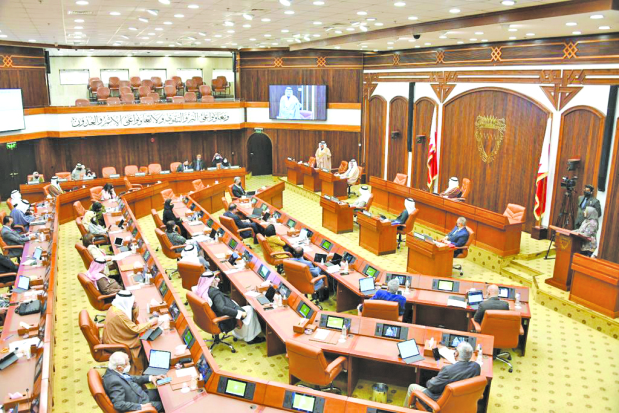
Members of Bahrain’s upper legislative chamber are set to reject amendments that would have made it mandatory for senior unionists and labour union federation leaders to declare their finances like other public representatives.
The Shura Council will debate the 2010 Financial Integrity Law on Sunday. It was rejected by Parliament last month.
Justice, Islamic Affairs and Endowments Minister Shaikh Khalid bin Ali Al Khalifa previously told MPs that the move could ignite disputes between senior and junior unionists and allow unjust corruption allegations to be voiced.
According to council documents, the Justice, Islamic Affairs and Endowments Ministry has stated that declaring financial integrity – in accordance to the law – applies to the public sector while senior unionists and labour union federation leaders fall under the private sector.
“The funds that the draft law seeks to protect are considered private funds which contradicts the clauses of the 2010 Law regarding financial disclosure which is concerned with the protection of public money,” said an official response from the Justice, Islamic Affairs and Endowments Ministry.
“Restricting the inclusion of heads and members of trade union councils within the categories that disclose their financial liabilities, while excluding others in the private sector, isn’t legally justified.
“Violations committed in the private sector are regulated by the Penal Code as well as the provisions contained in the 2012 Private Sector Employment Law.”
The General Federation of Bahrain Trade Union (GFBTU) voiced its opposition, suggesting that the proposed amendments were a breach of privacy and an infringement of personal freedom.
According to the GFBTU, the draft law aimed to combat corruption in the private sector and protect private funds which is separate from the objectives of the 2010 Financial Integrity Law that protects public funds.
The Shura Council’s legislative and legal affairs committee, which recommended rejection of the proposed amendments, reaffirmed its appreciation of trade union work in Bahrain.
“The committee commends the efforts of representatives of unions, organisations and trade union federations which are primarily devoted to serving the citizens and union work,” said the committee in its official report.
“Union funds and union work should be free from any form of corruption and for this the committee supports the objectives of the draft law. However, it considers that the correct place to oblige representatives of unions, organisations and labour unions is the Trade Unions Law promulgated by Decree Law (33) of 2002.”
Meanwhile, the Shura Council is also set to approve amendments to the 1996 Occupancy of Public Roads Law with hefty fines imposed on violators.
The GDN previously reported that fines of up to BD500 could be imposed for occupying public roads illegally. Under the current law violators are charged BD20.
The amendments propose increasing the fine to between BD50 to BD500 and failure to remove structures, material or items on the road would also see an additional daily fine double of the original fee amount charged for the road occupation service.
If the deadline given by municipal inspectors is not met then the municipality would remove the violation with the violator being made to foot the bill. However, if the violator agrees to remove the violation within a set deadline then the fine will be limited to BD50.
Under the proposed amendments, people will also be able to apply for temporary permits to use the road.
Legislators are also set to vote on amendments to the 2015 Infrastructure Cost and Development Law.
reem@gdn.com.bh