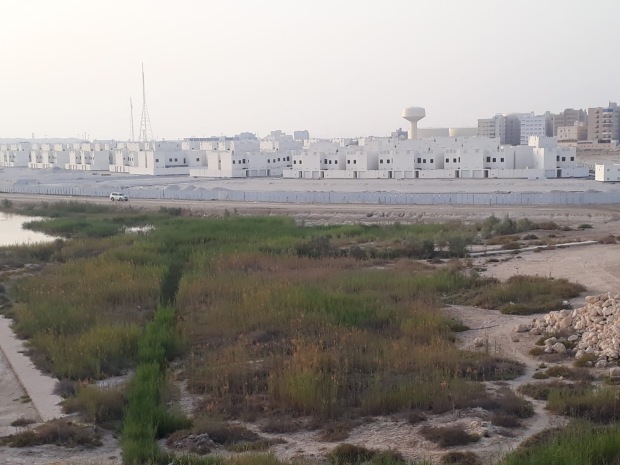
The government has been urged to fast-track measures to protect ecological areas in Buhair Valley and crack down on illegal dumping.
The Southern Municipal Council stressed the need to map out protected areas and fence them off to stop people from trespassing or destroying the historic site.
His Royal Highness Prince Salman bin Hamad Al Khalifa, Crown Prince and Prime Minister, had declared in July this year that the ecological areas in Buhair Valley that contain terrain and rocky hills be considered a ‘nature reserve’.
He called on the relevant authorities to take ministerial measures to preserve the zone.
HRH Prince Salman further directed officials to continue infrastructure development in Buhair Valley while taking into account its ecological significance. He affirmed the kingdom’s commitment to preserve and develop areas of natural and historic value to support the country’s role as a tourism attraction.
The council has now sent an official request to the Cabinet seeking an explanation on why it is taking long for necessary measures to be taken by the relevant ministries and government bodies to safeguard the valley.
“The leadership’s intervention clearly reveals the importance of the area, but it has been three months since the official declaration and nothing has been done yet to protect the valley or even fence it off in an eco-friendly manner,” said the council’s services and public utilities committee chairman and area councillor Abdulla Abdullatif.
“Tankers and trucks continue to dump waste and sewage water in the valley,” he added.
“There is no monitoring by environmental inspectors and we fear the area could be irreparably damaged if neglected for longer.
“Residents have witnessed several migratory bird carcasses. A few were spotted with plastic bottles in their beaks or bills, a few others were found trapped inside plastic bags, or dead after drinking sewage water.
“There have also been reports of wildlife animals like weasels found dead or injured with severed limbs.”
Buhair Valley dates back to prehistoric times as it contains fossils of creatures indicating that the place was once underwater.
However, decades of illegal dumping has turned it into a toxic wasteland.
Residents complained of unhygienic conditions and pungent gases when waste was dug to lay the foundations for a government housing complex in 2013.
A major clean-up operation was immediately launched to empty the valley of waste, but on several occasions the rubbish combusted when oxygen was exposed to methane gas that had built up over the years.
Around 3,700 people in Bahrain signed an online petition earlier this year, calling for a halt to the destruction in the valley, while others trekked down the valley seeking the most picturesque spots to paint, photograph and draw.
Buhair Valley has many examples of geological phenomena completely unique to Bahrain. Geologists have claimed that it contains 45-million-year-old fossils that cannot be found anywhere else.
Known in Arabic as Wadi Al Buhair – ‘wadi’ meaning valley and ‘buhair’ meaning ‘little sea’ – it contains rock formations belonging to the middle Eocene epoch, between 40 and 48 million years ago.
The fossils are shells left behind by single-celled organisms known as foraminifera, which would bore holes into the limestone and leave behind empty spaces after they decompose.
mohammed@gdnmedia.bh