

THE International Monetary Fund (IMF) cut its growth outlook yesterday due to Middle East war-driven energy price spikes but said the world was already drifting towards a more adverse scenario with much-weaker growth as Strait of Hormuz shipping disruptions continue.
With massive uncertainty over the Middle East conflict gripping finance officials gathered for IMF and World Bank spring meetings in Washington, the IMF presented three growth scenarios: weaker, worse and severe, depending on how the war unfolds.
Under the IMF’s worst-case outlook, the global economy teeters on the brink of recession, with oil prices averaging $110 a barrel in 2026 and $125 in 2027.
The IMF chose the most benign scenario for its World Economic Outlook ‘reference forecast,’ which assumes a short-lived conflict and oil prices normalising in the second half of 2026, with an $82 per-barrel average for the year – well below yesterday’s benchmark Brent crude futures price of around $96.00.
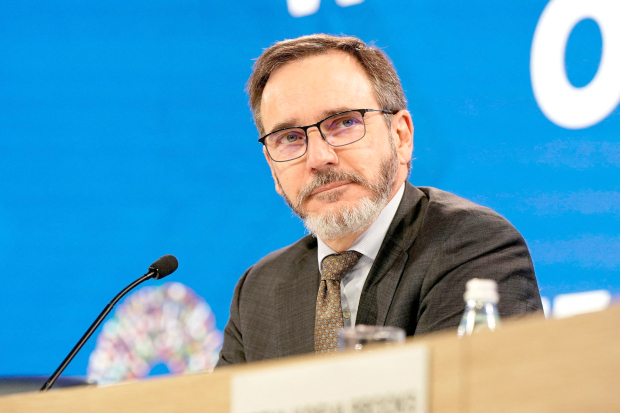
Just minutes after releasing the outlook, IMF chief economist Pierre-Olivier Gourinchas said it may be already outdated. He told reporters that with continued energy disruptions and no clear path to end the conflict, the IMF’s ‘adverse scenario’ looks increasingly likely.
That middle path envisions a longer conflict that keeps oil prices around $100 per barrel this year and $75 in 2027, with global growth falling to 2.5 per cent this year from 3.4pc in 2025.
“I would say that we are somewhere in between the reference scenario and the adverse scenario,” Gourinchas said. “And of course, every day that passes and every day that we have more disruption in energy, we are drifting closer towards the adverse scenario.”
Absent the Middle East conflict, the IMF said it would have upgraded its growth outlook by 0.1 percentage point to 3.4pc, due to a continued technology investment boom, lower interest rates, less-severe US tariffs and fiscal support in some countries.
The IMF in January had forecast that oil would decline to about $62 in 2026.
The IMF’s worst-case “severe scenario” assumes an extended and deepening conflict and much higher oil prices that prompt major financial market dislocations and tighter financial conditions, slashing global growth to 2.0pc.
“This would mean a close call for a global recession,” the IMF said, adding that growth has been below that level only four times since 1980 – with the last two severe recessions in 2009, following the financial crisis, and in 2020 as the Covid-19 pandemic raged.
Gourinchas said that a number of countries would be in outright recessions under this scenario, with oil prices averaging $110 per barrel in 2026 and $125 in 2027. Prices at this level for an extended time would also increase expectations “that inflation is here to stay,” prompting wider price increases and wage hike demands.
“That change in inflation expectations is going to require central banks to step on the brakes and try to bring inflation back down,” he said, adding that this may require more pain than in 2022.
The IMF said, however, that central banks may be able to “look through” a short-lived energy price surge and hold rates steady amid weaker activity, which would be a de facto monetary easing, but only if inflation expectations remain anchored.
Global inflation for 2026 would top 6pc in the severe scenario, compared to 4.4pc in the most-optimistic reference scenario, which is the assumption for the IMF’s country and regional growth forecasts.
The IMF shaved its US growth outlook for this year to 2.3pc, down just a tenth of a percentage point from January, reflecting the positive effect of tax cuts, the lagged effect of interest rate cuts and continued AI data centre investment partly offsetting the higher energy costs. These effects are expected to continue in 2027, with growth now forecast at 2.1pc, up a tenth of a point from January.
&uuid=(email))