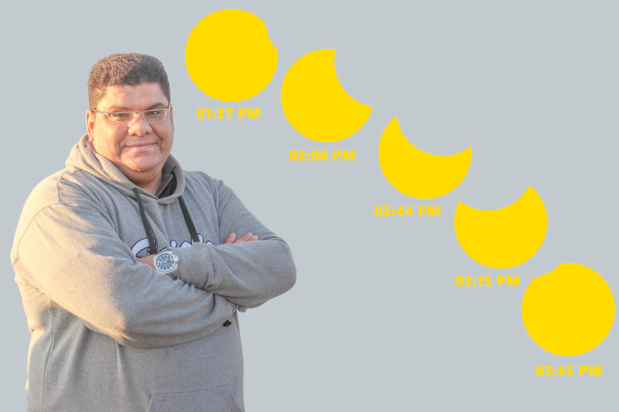
ECLIPSE prayers will be observed in most mosques in the country, confirmed officials from both the Sunni and Jaffari Waqf (Endowment) Directorates.
The solar eclipse will take place today, when the Moon blocks the rays of the sun when it passes between the Sun and the Earth.
The partial eclipse, which will cover a maximum of 39 per cent of the sun when seen from Bahrain, will last for more than two hours from 1.32pm to 3.50pm.
All mosques that fall under the Sunni Waqf Directorate have been instructed to hold communal eclipse prayers, ‘as soon as the eclipse is observed.’
“While salat al-kusuf (solar eclipse prayer) is not wajib (mandatory), it is highly-recommended for every Muslim man and woman to perform it,” Shaikh Dr Saleh Abdulkareem told the GDN.
“All mosques will hold salat al-jama’ah (congregational prayers) on this occasion, including Al Fateh Grand Mosque.
“It is up to individual workplaces whether or not to allow employees to attend the salat al-jama’ah but employees can perform the prayer alone at work.
“Stay-at-home mothers can also perform the prayer from their homes,” he added, explaining that the prayer can be performed at any point during the two-hour celestial phenomenon.
However, he stated that the prayer cannot be done retroactively, as the window to perform it ends once the eclipse is over.
As asr (afternoon) prayers will occur within the duration of the eclipse, Shaikh Dr Abdulkareem said that regular prayers take precedence over the former.
Step-by-step instructions on how to perform eclipse prayers were posted on the Sunni Waqf Directorate’s social media channels.
Warning
The Jaffari Waqf Directorate has not directed imams of mosques in the directorate’s jurisdiction to hold the prayers.
“The directorate did not order mosques to open for eclipse prayers because all mosques typically observe the prayers on their own accord,” explained directorate official Baqer Zainuddin. “It is a rather a routine occurrence, so no special instructions need to be issued.”
Solar and lunar eclipse prayers are mandatory for all observers of the Jaffari faith, along with other natural phenomena like earthquakes and cyclones.
As in the case with all eclipses, health experts and astronomers have cautioned people not to look at the sun directly during the event as it can cause serious damage to the retinas.
“To view the solar eclipse safely, one must wear protective gear like eclipse glasses,” prominent astronomer Ali Al Hajari told the GDN.
“One can even observe it through indirect methods like the Internet too,” said the Bahraini, adding that sun glasses do not protect the eyes.
“The eclipse will last for two hours and 18 minutes – reaching its maximum coverage at 2.44 pm.”
It is never safe to look directly at the sun’s rays – even if the sun is partly-obscured. When watching a partial eclipse you must wear eclipse glasses at all times if you want to face the sun, or use an alternate indirect method.
Mr Al Hajari will lead an eclipse viewing at the Isa Town Secondary Boys’ School from 1pm to 4pm.
Special ‘eclipse glasses’ will be distributed and attendees will also have the opportunity of observing the phenomenon using a special telescope.
Filters for direct viewing of the sun are typically sold in the form of wearable certified safe ‘eclipse shades’ or as solar viewing cards that you hold in your hand. What makes them special is that they reduce sunlight to safe levels so that you don’t injure eyes.
The GDN has learned that some private schools have switched to online learning only for one day, while all schools in Kuwait are closed.
zainab@gdnmedia.bh