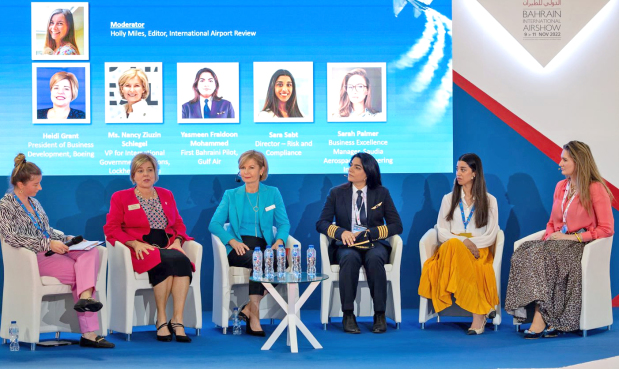
Modern women are breaking the ‘brass ceiling’ to embrace a range of daring careers in aerospace, with many of them even willing to take up key leadership roles, a forum heard yesterday.
Women leaders in aerospace are ‘no longer rare like unicorns’, said Lockheed Martin International government relations vice-president Nancy Ziuzin Schlegel, while speaking at a forum on women breaking barriers in the field.
The meeting, held on the sidelines of the Bahrain International Air Show (BIAS) 2022, also hosted Boeing Business Development president Heidi Grant, first Bahrani Gulf Air pilot Captain Yasmeen Fraidon Mohammed, Bahrain Airport Company Risk and Compliance director Sara Sabt and Saudi Aerospace Engineering Industries Corporate Affairs director Sarah Palmer.
Ms Schlegel recounted her experiences in the aerospace and defence industry, which were in the past dominated by men.
“I liked the challenge,” she said, adding that her early mentors were all men who gave her opportunities to rise up the ladder.
What struck her when she joined Lockheed Martin was that ‘a lot of the basic-level work was done by young women’.
“However, finding a woman in a leadership role was like finding a white tiger or a unicorn, they were really rare,” recalled Ms Schlegel, who has almost three decades of experience in the industry.
“It took a while for them (men) to understand that it is important to reach back,” she said. “Today we have a significantly higher level of women leaders and it provides that support and safe space to talk about the issues that are either holding us back, or the lessons learned that we can take forward in growing our careers.”
Ms Grant also highlighted the welcoming environment for women in the industry today, reflecting on the “brass ceiling” that she had to break amongst her male military colleagues.
“I walked into the Pentagon forum meetings where I had engagements with mostly men in uniform,” said the former US Defence Security Co-operation Agency director.
“Instead of a glass ceiling which many of us know of, which we need to punch through, I would call this a brass ceiling as it’s the military environment.”
The men wore their badges and medals, while she had none.
“When I came to the table, nobody had any idea of my education, experience or background and it took a while to prove my credibility,” she said.
Ms Grant asserted that one had ‘to be a continuous learner’ and ‘come to the table and build that trust’.
Capt Mohammed said global pilots’ shortage could be addressed if more women are encouraged to take up the role.
“I’m looking at the pool, only 50pc of my population is on board, having more women would solve this shortage,” she said.
Highlighting India’s example of having 12pc female pilots in every airline as against the global norm of 4pc, she called for better opportunities for women in terms of talent acquisition, scholarships and short-term educational opportunities in the industry.
Ms Sabt said men were now “accepting women and they now see the values that we give to the industry”.
“We just need to collaborate together and will definitely open more opportunities for women,” she added.
Ms Palmer also endorsed the increasing role for women in the industry while cautioning of complacency.
She outlined a recent survey that said that 10pc of women in companies assumed leadership positions.
“They generally say women are very well represented in leadership roles – but one in 10 is not enough,” she pointed out.
“I think it’s easy to become complacent when you feel like there is progress. We have to address this.”
The forum was moderated by International Airport Review editor Holly Miles.
raji@gdnmedia.bh