

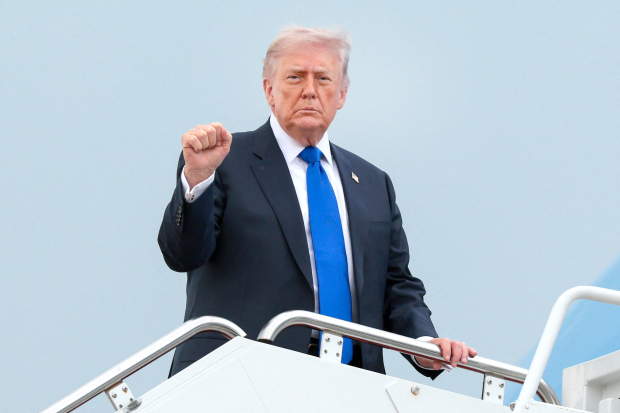
WITH his approval ratings falling, US President Donald Trump faces domestic pressure to end the unpopular war. Iran’s leaders, though weakened militarily, have found leverage in negotiations with their ability to stop shipping in the economically vital Strait of Hormuz, which normally carries a fifth of global oil shipments.
President Trump said yesterday Iran could telephone if it wants to negotiate an end to their two-month war, stressing that Tehran can never have a nuclear weapon.
Tehran has largely closed the strait while Washington has imposed a blockade of Iran’s ports.
Iranian Foreign Minister Abbas Araqchi returned to Islamabad after holding talks yesterday in Oman, another mediator in the war.
Iranian state media said Araqchi discussed security in the strait with Omani leader Haitham bin Tariq Al Said and called for a regional security framework free of outside interference.
Pakistani government sources said Araqchi would hold talks with Pakistan’s leadership before heading to Moscow.
Iran’s semi-official Tasnim news agency reported that Araqchi’s talks with Pakistani officials would include “implementing a new legal regime over the Strait of Hormuz, receiving compensation, guaranteeing no renewed military aggression by warmongers, and lifting the naval blockade.”
The talks would not be related to Iran’s nuclear programme, the report said.
Speaking in Florida on Saturday, Trump said he cancelled his envoys’ visit due to too much travel and expense for what he considered an inadequate Iranian offer. Iran “offered a lot, but not enough,” he said. The comments were made before a White House Press dinner in Washington later that day, where Trump was rushed off the stage by security officers after a man opened fire in the hotel venue.
Iranian President Masoud Pezeshkian told Pakistani Prime Minister Shehbaz Sharif by phone that Tehran would not enter “imposed negotiations” under threats or blockade, according to a statement from the Iranian government.
He said the US should first remove obstacles, including its maritime blockade, before negotiators could begin laying the groundwork for a settlement.
The disagreements between the US and Iran extend beyond Tehran’s nuclear programme and control of the strait.
Trump wants to limit Iran’s support for its regional proxies, including Hizbollah in Lebanon and Hamas in Gaza, and curb its ability to strike US allies with ballistic missiles. Iran wants a lifting of sanctions and an end to Israeli attacks on Hizbollah.
In talks in Islamabad earlier in April, US Vice President JD Vance led the US delegation opposite Iran’s parliamentary speaker Mohammad Baqer Qalibaf. They ended without agreement.
After the latest diplomatic trip was called off, two US Air Force C-17s carrying security staff, equipment and vehicles used to protect US officials flew out of Pakistan, two Pakistani government sources said yesterday.
Writing on Truth Social before the shooting at the White House Correspondents’ Dinner, Trump said there was “tremendous infighting and confusion” within Iran’s leadership.
Pezeshkian said last week there were “no hardliners or moderates” in Tehran and that the country stood united behind its supreme leader.
&uuid=(email))