

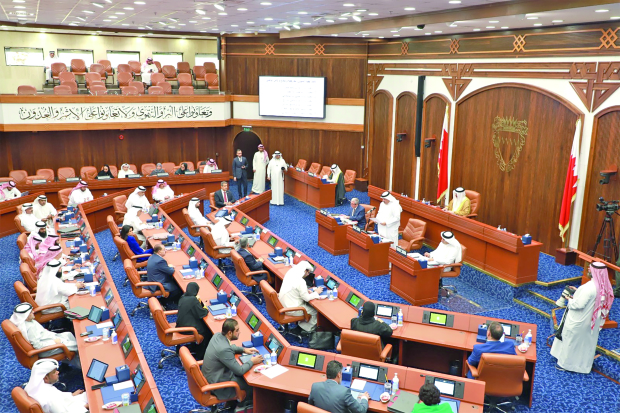
A RETHINK has been urged on a proposed parliamentary legislation to cap government borrowing at 60 per cent of the gross domestic product (GDP).
The proposal by five MPs, led by second deputy speaker Ahmed Qarata, aims to control Bahrain’s borrowing which had reached BD16.7 billion by the end of last year.
His Majesty King Hamad had issued a Royal Decree in September amending the 1977 Development Bonds Law to set the cap at BD16bn.
The Finance and National Economy Ministry warned the move would prevent the government from covering existing deficits in the budget.
“Borrowing has already exceeded 60pc and making it obligatory by law to respect the cap will just paralyse the government’s treasury,” the ministry said.
The Central Bank of Bahrain (CBB) also said that the proposal would hamper the functioning of the government.
“Public debt stands at 101pc of the GDP and just bringing it down to 60pc will put the government in legal and financial trouble with holders of bonds since it would be deemed illegal,” the CBB said.
The same legislation presented by former MPs was shelved by the Shura Council in 2018 following similar warnings that any such cap would be disastrous for the economy. National Audit Office (NAO) chief and former finance minister Shaikh Ahmed bin Mohammed Al Khalifa had warned MPs in November 2015 that the 60pc cap would result in massive spending cuts that would impact the public. However, the legislators approved it owing to concerns over mounting public debt.
Bahrain’s Cabinet had also contested the move in a dossier submitted to His Majesty King Hamad in February 2016, asserting that it restricted the government’s spending power, prevented completion of planned projects and impacted services such as social welfare programmes.
It was then referred back to the National Assembly in June 2018 for review and, the following month, MPs approved government plans to increase the ceiling from BD10bn to BD13bn to fast-track the delayed national budget – far exceeding the proposed cap in the process, following negotiations at the time with Shura Council financial and economic affairs committee chairman Khalid Al Maskati.
Meanwhile, on Tuesday, MPs are set to debate a proposed amendment to the 1976 Social Insurance Law that would alter the calculation of pensions, change the period of retirement eligibility and reduce workers’ contributions from 7pc to 6pc.
The Social Insurance Organisation (SIO) said such a move could lead pension funds to quicker bankruptcy. The Supreme Council for Women (SCW) has asked MPs for patience and to put the proposal on hold.
Al Hekma Society for Retired, however, backed the move in entirety.
MPs will debate amendments to the 2013 Real Estate Registration Law that would exempt nationals from paying registration or transfer fees once in a lifetime.
The Finance and National Economy Ministry and Survey and Land Registration Bureau have said that such exemptions would drastically cut down revenues by 98pc. The proposed legislation has been presented by five MPs, led by Mr Qarata.
Plans for a new ‘social shield’, presented by five MPs led by Mr Qarata will also be debated on Tuesday.
The proposal would make it compulsory for the government to grant a range of allowances to tackle inflation, and address citizens’ needs for housing, education, oil and gas, electricity and water, flour, food staple and meat.
Parliament’s financial and economic affairs committee has asked for patience until the joint subsidies and social welfare committee reaches its own conclusions.
A rethink has also been urged by the Social Development, Finance and National Economy, Education, and Electricity and Water Affairs ministries, who stressed that the current allowance format was more flexible.
The Education Ministry, in particular, said the estimated annual cost for university support would be BD45 million, which is way beyond its allocated finances.
Parliament is also set to vote on amendments to the 2002 Parliament Bylaws Law to oblige committees to present proposed legislations to the chamber within a maximum period of two months.
Meanwhile, MPs will also review and vote on the National Audit Office report for 2021-2022 during the session. They will also look into a draft reply to His Majesty’s address at the opening of the National Assembly’s second session of the sixth legislative term last month.
They will listen to comments from Works Minister Ibrahim Al Hawaj on planned road projects in the Muharraq Governorate, besides Raya Highway expansion plans and infrastructure projects in the Capital Governorate’s constituency seven. Mr Al Hawaj will be responding to questions presented by three MPs.
mohammed@gdnmedia.bh
&uuid=(email))