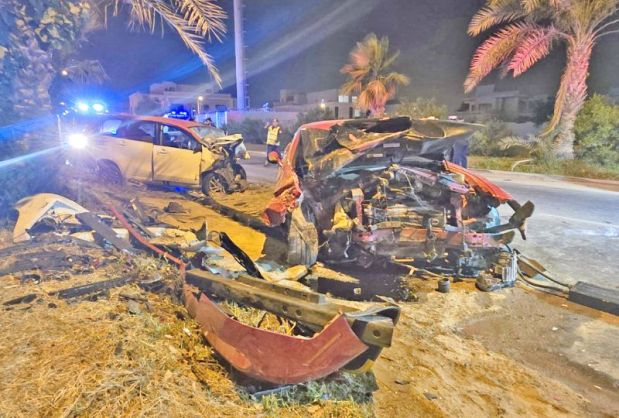
The lawyer of a man, accused of reckless driving that caused a car crash in which a couple and their child were killed, has denied his client was responsible for the fatal collision.
He claimed that the 29-year-old Bahraini defendant suffered from a seizure at the same time one of the tyres of his vehicle burst leading to the horrific accident.
The tragic crash occurred on May 30 in Saar when the accused suddenly veered into the opposite lane and collided head-on with an oncoming vehicle in which a man, his wife and three children were travelling.

Late father-of-three Mr Al Orrayedh
The 40-year-old father, Ahmed Al Orrayedh, and his wife Fatema Al Qaidoom, aged 36, died in hospital due to their critical injuries, while their young seven-year-old son Abdulaziz succumbed to his wounds two weeks later, on June 13.

The late Abdulaziz, left, with his surviving siblings Yousif, centre, and Aya, right.
The survivors, 12-year-old Aya and nine-year-old Yousif, have been left with severe injuries and disabled.
The accused was reportedly under the influence and driving over the legal speed limit in violation of traffic safety rules.
The defendant denied charges of criminal negligence at the Lower Criminal Court while his lawyer, Ahmed Touq, claimed that the children were not wearing a seatbelt in violation of traffic laws.
He added that since his client suffered from a malignant brain tumour he should be treated with mercy.
However, the Public Prosecution yesterday demanded that the judge grant no shred of leniency to him as ‘he tore a family apart’.
In a 12-page memo submitted to the court, Mr Touq claimed that the accident was fully out of his client’s control.
He said that the man was having an epileptic seizure at the same time as the front left wheel tyre of his vehicle burst, causing the vehicle to veer into the left lane and collide with the other car.
The defendant is on antiepileptic medication that make it appear on tests as if he is drunk since “they impair his kidney function”.
Mr Touq said that the anticonvulsant medication his client was on, carbamazepine, was prescribed to him since 2014 and could have resulted in false positive blood alcohol tests.
He also claimed that the suspect suffered bleeding in his brain and identified his condition as ‘cavernous hemangioma’, which is a type of malformation in the brain, though it is classified as benign in medical sources.
This brain growth allegedly affects the 29-year-old’s ability to control his movements, and means that he is not always in full possession of his faculties, Mr Touq stated.
Dismiss
The lawyer also tried to cast doubt on the autopsy and tried to dismiss a witness testimony, stating that the CCTV footage did not show the complete picture due to the camera’s angle.
He blamed Mr Al Orrayedh for negligence for not instructing his children to wear seatbelts.
“The victim is in the wrong, and there is no direct link between the defendant’s actions and the victims’ deaths,” the memo stated.
“In reality, the father is the true cause of the children’s injuries, since he did not make sure that they were wearing their seatbelts.
“The reason why the defendant was not injured while the victims were, is because he was following traffic rules while they were not.
“Because of the collision, the children in the back seats slammed towards the front seats, while one of the sons hit the gear stick.
“As for the youngest son, Abdulaziz, may he rest in peace, he was sitting in the front with his mother, which is against the law. He slammed into the dashboard, sustaining severe injuries.
“Had the driver and the passengers worn their seatbelts, they would have held them in place, and the airbags would have been triggered, and they would not have collided into what was in front of them.
“Meanwhile, Aya and Yousif were left without a seatbelt; their father did not heed how young and vulnerable they are. They would have been injured from any kind of collision or sudden stop.
“And Abdulaziz is too young to be sitting in the front seat, and that is a grave mistake on the victims’ part, which absolves the defendant of responsibility in their death since their mistakes were much greater.”
Mr Touq also claimed that the father’s autopsy states that he died of a heart attack, and not due to injuries he sustained in the accident.
Meanwhile, in a strongly-worded declaration before the court, the Public Prosecution described the defendant’s actions as ‘unforgivable’ and attributed the crash to his personal choice to consume drugs.
He called on the court to penalise the suspect to the fullest extent of the law.
“We stand before you today to hear a case which cannot be treated with any lenience or mercy,” a prosecutor told the court.
“Without consideration for the lives and safety of others, the defendant drove a vehicle under the influence of drugs, at outrageous speeds, against all that common sense and logic.
“He made the matter worse by committing a greater crime, entering the wrong lane with no regard to the danger he posed to innocent lives, and he collided head-on with a vehicle transporting a family.
“The result? The death of a man, a woman and their son, whose lives were taken away from them due to no fault of their own. The two other children are still receiving treatment.
“This is no regular traffic accident, but a crime complete with factors like gross negligence, extreme recklessness, disregard for laws and human lives.
“Your Honour, the defendant did not just commit a mistake, but chose to do wrong.
“He chose to consume drugs. He chose to drive a car despite not being in a condition to drive that day. He chose to drive in the opposite lane, with great speeds, with knowledge of the consequences and the dangers.”
The prosecutor declared that the evidence presented to the judge left no space for doubt that the defendant was the man who committed the crime.
The prosecutor further called on the judge to consider the effects of the verdict on the public’s trust in the law.
“A decisive ruling must be made, so society is assured that the law stands in the face of whoever is tempted to play with others’ lives.
“The verdict should not just be made for the sake of the surviving children, but for the people of Bahrain who showed their total sympathy for the tragedy that befell this family.
“This defendant destroyed an innocent family that was preparing for Eid Al Adha, to celebrate the happy and blessed occasion with their friends and family.
“Little did the family know that its fate was to be permanently fractured, because of this deranged defendant and his reckless, unjustifiable actions, which stemmed from his lack of care and sense of responsibility.
“These actions led to the death of parents, one of their children, leaving the other two alone and orphaned at such a young age, facing the challenges of life all on their own.”
Aya and Yousif, who suffer from long-term injuries, now live with their grandmother and uncle in Segaiya.
The Interior Ministry previously blamed the fatal accident on the accused’s “blatant disregard” of road rules.
“The collision was the result of extreme speeding, inattentiveness and gross neglect by the driver of a Dodge vehicle,” it said in a statement.
“As he attempted to overtake another vehicle, he veered into the opposite lane, collided face-to-face with a Toyota, killing its driver and his wife.”
The driver of the other vehicle was under the influence of drugs and alcohol, according to the Public Prosecution. He had also reportedly exceeded the legal speed limit on that particular road.
Request
At yesterday’s hearing, the judge did not grant the defence lawyer’s requests for the witness to be summoned before the court and for the CCTV footage to be provided to the defence.
Mr Touq’s request for the suspect to be evaluated by a medical commission to determine the extent of his illness and how it affected his ability to make his own choices was also rejected.
The judge announced that a verdict in the case will be issued on July 16.

The horrific crash spurred a wider discussion in Bahrain about reckless driving, with the GDN earlier reporting that legislators were working on new laws to impose harsher penalties on negligent motorists.
His Royal Highness Prince Salman bin Hamad Al Khalifa, Crown Prince and Prime Minister, directed the Interior Ministry to draft the necessary legislation to strengthen penalties for traffic violations and accidents that result in serious injuries or fatalities.
MPs have suggested updating the 2014 Traffic Law to introduce escalating penalties for repeat offenders, linking violations to key privileges such as licence renewal and insurance, introducing mandatory rehabilitation programmes for habitual offenders, carrying out awareness campaigns and more.
zainab@gdnmedia.bh