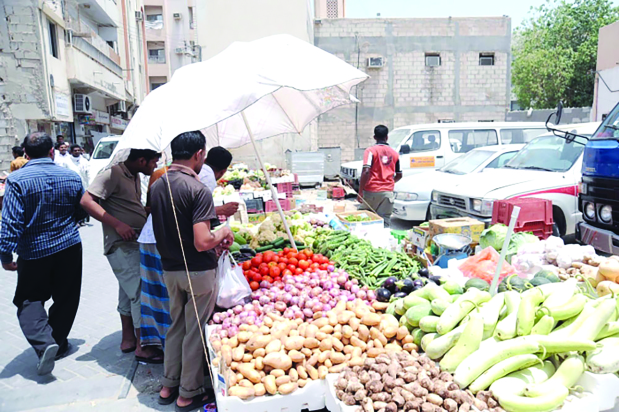
A call to ban unlicensed street stalls and mobile vendors – commonly known as ‘al-farshat’ – from operating in public squares and sidewalks across the Southern Governorate has been issued by a top councillor.
The request, by Southern Municipal Council chairman Abdulla Abdullatif, follows a wave of complaints from residents and local business owners.
The ban particularly targets street vendors selling fish and vegetables without proper permits, hygiene standards or storage facilities.
Mr Abdullatif stressed that such stalls were not only unsightly, but also posed real threats to public safety, urban movement and the economic sustainability of licensed retailers.
“The problem isn’t just about unregulated commerce, it’s about the safety of our residents, the health risks from contaminated food and the disruption to urban life,” he said.
“These stalls spring up in vital locations – near pharmacies, schools, health centres and service buildings. They block pedestrians, cause traffic jams and leave behind organic waste that attracts insects and tarnishes the image of our cities.”
Mr Abdullatif said that selling food, particularly perishable items like seafood and vegetables, in open-air, unsupervised conditions without proper storage, posed severe public health risks.
“Without refrigeration or sanitary safeguards, these products are vulnerable to bacterial contamination and spoilage,” he warned.
“We are putting the health of consumers at risk when we allow such activity to continue unchecked. We have seen cases of flies and vermin being attracted to leftover organic waste at these sites. This is not acceptable.”
He added that the issue was especially prevalent in high-traffic areas, where street vendors target consumers during rush hours, creating bottlenecks near traffic intersections and community facilities.

Mr Abdullatif
Mr Abdullatif revealed that the council had received multiple complaints from residents in neighbourhoods affected by the growing presence of these illegal vendors.
Citizens have called for the strict enforcement of Bahrain’s street vendors and public hygiene rules, which outline the regulations for operating as a mobile vendor and maintaining sanitation standards.
“People are not against vendors making a living, but they are against chaos and lawlessness.
“We have clear laws and licensing processes. What we need is enforcement and organisation, not a total ban. Vendors must be held to the same standards as shop owners who pay rent, taxes and fees.”
Mr Abdullatif also highlighted how licensed shopkeepers and retailers were bearing the brunt of the unregulated vending market. He said many local businesses are being pushed to the brink of closure due to unfair price competition from vendors who operate without paying rent, taxes or municipal fees.
“These unlicensed vendors can sell at lower prices because they don’t bear any of the overhead costs our local shops do,” he explained.
“This is not a fair market. It’s driving customer traffic away from legitimate businesses, some of which are now struggling to survive.”
Shop owners, he said, are required to comply with strict licensing and health regulations, undergo inspections, and often invest significantly in infrastructure to meet municipal requirements. Meanwhile, street vendors operate under no such obligations.
“The imbalance is stark,” Mr Abdullatif said. “How can a small grocery store or fishmonger compete when the vendor outside his door sells the same product at half the price with no oversight or responsibility?”
While advocating for a crackdown on illegal stalls, Mr Abdullatif made it clear that the goal is not to eliminate street vending altogether, but to bring it under control through regulation and formal licensing.
“Street vending has always existed in Bahrain, it’s part of the culture,” he said. “But unregulated vending cannot be allowed to override public health, safety and fair business practices. The solution is to create dedicated zones, set standards and issue permits that protect everyone’s rights.”
He called on relevant government bodies to launch joint inspection campaigns in collaboration with municipalities, particularly targeting unlicensed fish vendors, whose products often deteriorate rapidly without proper handling.
“We need joint enforcement efforts. Municipal teams, the police and public health inspectors must work together to uphold standards and remove violators,” he urged.
The Southern Municipal Council, according to Mr Abdullatif, is currently reviewing proposals to designate fixed market areas that would allow vendors to legally sell their goods in a controlled, hygienic and accessible environment. This would not only protect public health but also support small traders by offering them a lawful space to operate.
“We’re not trying to strip people of their livelihoods,” he said. “We want to build a framework where small vendors, businesses and the public can coexist in an organised, clean and lawful setting.”
The chairman renewed calls to the ministries of Municipalities Affairs and Agriculture, Health, Interior and Industry and Commerce to support municipal councils in implementing meaningful reforms that will protect urban order, support licensed businesses and offer regulated opportunities for informal traders.
Public sentiment is reportedly divided, with some defending the convenience and affordability offered by mobile vendors while others are backing the council’s push for cleaner, safer and fairer urban spaces.
The issue has been referred to Municipalities Affairs and Agriculture Minister Wael Al Mubarak, Bahrain’s two other municipal councils, and the Capital Trustees Board for review and action.
mohammed@gdnmedia.bh