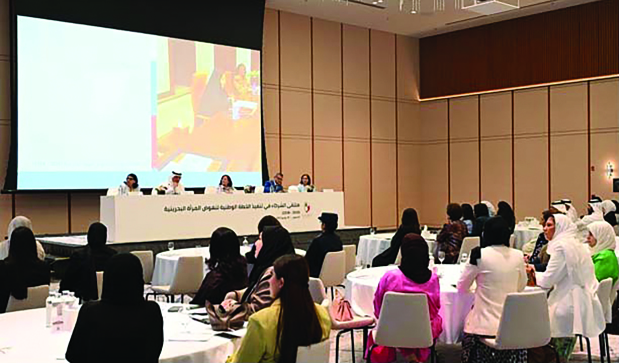
The Supreme Council for Women (SCW), chaired by Her Royal Highness Princess Sabeeka bint Ibrahim Al Khalifa, wife of His Majesty King Hamad, has launched the National Plan for the Advancement of Bahraini Women 2025-2026.
The National Plan for the Advancement of Bahraini Women 2025-2026 was developed based on solid foundations derived from national principles and frameworks, including the Royal Decree establishing the Supreme Council for Women, its direct affiliation to His Majesty, and its presidency by HRH Princess Sabeeka.
The plan is further grounded in the council’s mandate as outlined in Royal Decree (44) of 2001 and its amendments, the components of the National Strategy for the Advancement of Bahraini Women endorsed by His Majesty in 2005, as well as previous national plans for 2007-2012 and 2013-2022, and the evaluation report of the 2013-2022 plan.
The plan also draws inspiration from Bahrain Economic Vision 2030, the aspirations of Vision 2050, the Government Programme, and the National Gender Balance Model. It aligns with the concluding observations on Bahrain’s international mandatory and voluntary reports, including the Convention on the Elimination of All Forms of Discrimination Against Women.
In addition, the plan is informed by the 17 Sustainable Development Goals (SDGs) of the 2030 Agenda, with particular focus on goals that are directly relevant to women, namely Goal 5 on achieving gender equality and empowering all women and girls, and Goal 10 on reducing inequality within and among countries.
The National Plan for the Advancement of Bahraini Women 2025-2026 builds upon the significant progress made in empowering Bahraini women and their access to leadership and decision making roles across vital sectors. It serves as a strategic roadmap aimed at further advancing women’s leadership and reinforcing the sustainability of their contributions.
The plan seeks to enhance women’s participation in national development within an enabling legislative environment and through policies that support women’s advancement. It also focuses on continued efforts to invest in the development of women’s capacities, ensure gender balance, and promote equal opportunities across all fields.
The plan adopts a rigorous scientific methodology in analysing the current status of Bahraini women. Within each of its four focus areas, the plan includes a dedicated component for follow up and evaluation, centred on impact assessment.
This involves presenting detailed diagnostics based on the latest official data and statistics, alongside key performance indicators designed to measure progress toward the objectives of each area. These indicators evaluate the efficiency, impact, and effectiveness of the related initiatives.
The resulting assessments provide a clear picture of the current situation and a comprehensive evaluation of the implementation outcomes. This forms the basis for setting future goals and formulating the necessary plans to maintain progress.
An assessment of the current participation of Bahraini women reveals a notable increase in their presence across key sectors, disciplines, and fields.
Bahraini women have moved beyond the empowerment phase in political and public life, advancing toward leadership by assuming decision making roles. They have held ministerial posts in areas such as health, housing, tourism, youth, and sustainable development, in addition to executive positions across both the public and private sectors.
Bahraini women have established a strong presence in elected councils and made significant strides within the legislative authority, including holding leadership roles such as the presidency of Parliament. They have also taken on key roles in municipal councils, the judiciary, and the Public Prosecution.
In terms of political participation, women held eight seats in the Parliament in 2023, accounting for 20 per cent of its membership. In the Shura Council, 10 women served, representing 25pc. Women also held three seats in municipal councils, or 10pc, and four seats in the Capital Trustees Board, accounting for 40pc in 2023. Additionally, a Bahraini woman assumed the presidency of Parliament in 2018.
In specialised sectors, Bahraini women continued to demonstrate strong representation. As of 2024, there were 2,798 Bahraini female doctors, comprising 66pc of the total, and 3,657 Bahraini female nurses, accounting for 83pc. In higher education, the number of Bahraini female academics reached 536 in 2023, representing 55pc of the academic workforce. Additionally, there were 436 Bahraini female engineers in the public sector in 2024, making up 37pc.
The National Plan for the Advancement of Bahraini Women 2025-2026 focuses on continuing efforts to close existing gaps and implement outstanding priorities from previous plans to support women’s participation and achieve gender balance in sectors where women remain in the stages of empowerment or advancement.
It seeks to promote family stability for women by further developing the legislative framework, strengthening social protection policies, and raising legal and family awareness. The plan also underscores the importance of enhancing women’s role within the family and society, preserving national values and identity, and maintaining the presence of women in leadership positions and decision making roles across various sectors.
In addition, the plan’s directions include continued efforts to strengthen women’s status in private sector institutions, increase their participation on corporate boards and in civil society organisations, and enhance their economic position to ensure sustainable economic engagement in the labour market.
The plan places particular focus on emerging and promising fields, especially in technology sectors such as artificial intelligence, renewable energy, and digital transformation. It aims to achieve equal opportunities and provide legal safeguards that help women balance family responsibilities with their professional roles.
Further, it promotes awareness of healthy lifestyle practices and environmental wellbeing to enhance women’s quality of life, improve workplace safety services, and raise awareness of the impact of climate change on women’s health while empowering their contribution to environmental preservation.
The plan establishes a clear institutional framework for implementing initiatives across its four focus areas. This framework precisely defines the roles and responsibilities of all relevant stakeholders, emphasising effective co-ordination mechanisms between government institutions, the private sector, and civil society organisations.
The plan presents an ambitious vision that focuses on increasing women’s economic participation while diversifying employment opportunities available to them. It places particular emphasis on emerging and modern sectors such as technology and the digital economy, ensuring alignment with the future needs of the labour market.
This forward looking approach positions women’s empowerment as a key driver of economic development and emphasises their role as essential partners in shaping the future of the nation.
The inclusion of family stability as a core priority in the National Plan for the Advancement of Bahraini Women 2025-2026 reflects the Supreme Council for Women’s recognition of the vital role of women as active partners in building the nation, the family, and society. It underscores the importance of preserving national values and the authentic identity of the Bahraini family, and of ensuring a stable family environment that supports women’s empowerment and enables them to balance their multiple roles.
The Supreme Council for Women has consistently worked to safeguard the achievements that have enabled Bahraini women to attain decision making positions, particularly within the legislative and executive branches. The council continues to strive towards further strengthening women’s representation in other areas, with the aim of increasing their presence in the judiciary, on the boards of major corporations, and within civil society institutions.
To support this, the council is implementing initiatives that highlight women’s success stories and the impact of their leadership. It also seeks to unify national efforts in establishing a comprehensive programme to support and enable women’s access to the boards of public shareholding companies.
Within the domain of economic participation, the plan aims to continue efforts to review and enhance policies, regulations, and frameworks that support and strengthen the role of women in the economic sector. It seeks to ensure the sustainability of women’s active participation in the labour market and entrepreneurship, while promoting equal opportunities and gender balance.
The plan also focuses on highlighting exemplary female figures and their leadership in various economic fields. Special attention is given to emerging and promising areas, particularly within technological sectors such as artificial intelligence, digital content creation, digital transformation, information technology, financial technology, telecommunications, renewable energy, and modern sciences. The plan further emphasises the importance of providing legal protections to help women balance their family responsibilities with professional commitments.
The domain of quality of life includes the implementation of initiatives and awareness programmes aimed at promoting healthy, safe, and sustainable lifestyle practices for Bahraini women and their families. It also focuses on improving workplace safety services for women, supporting women’s sports, and providing the necessary facilities to help women achieve a balanced and fulfilling quality of life.
These efforts complement national initiatives in the area of wellbeing, where Bahrain has made significant progress in promoting women’s health and safety. The kingdom continues to advance in this area in line with efforts to ensure that Bahraini women have access to diverse and evolving options for improving their quality of life.
Based on the framework outlined in the plan, the forthcoming phase of the Supreme Council for Women’s work beyond 2026 will focus on marking a new stage in the advancement of Bahraini women. This stage will represent a shift from empowerment and progress to the pursuit of leadership.
The SCW aspires to support Bahraini women in reaching new heights of distinguished leadership across various domains. This strategic transformation builds on years of dedicated efforts in the area of women’s empowerment, in line with the SCW’s mandate, which has yielded tangible programmes and achievements at the local, regional, and international levels.