

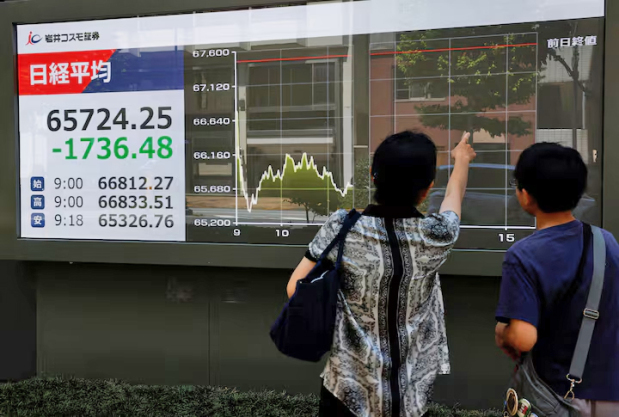
Global stocks slipped yesterday and oil prices eased as investors awaited details of threatened US sanctions on Iran, while the Canadian dollar dipped as a trade war loomed with its southern neighbour.
US Treasury Secretary Scott Bessent was due to hold a press conference later yesterday to outline sanctions on Iran, which Washington says must relinquish its control over the vital Strait of Hormuz.
Oil futures were down around 2 per cent ahead of the announcement as some oil traders took profits after big gains last week.
The tech sector was on edge for Nvidia’s results on Wednesday. Investors are aware how hard it will be for the chipmaker to meet sky-high expectations.
“The big news this week will be Nvidia earnings... The tone of that might drive sentiment into the Nasdaq (market),” said Nutshell Asset Management CIO Mark Ellis.
Analysts are generally looking for quarterly revenue to almost double to around $92 billion.
Market participants will also be hoping for some clarity on the outlook for US interest rates when Federal Reserve Chair Kevin Warsh speaks in Jackson Hole, Wyoming, on Friday, though his well-known aversion to forward guidance could lead to disappointment.
“There are several reasons to expect to be underwhelmed,” said Bruce Kasman, chief economist at JPMorgan, noting that past chairs have not wanted to front-run Fed decisions at the event.
“Warsh will rather likely focus on aspects of his ‘regime change’ agenda,” Kasman added. “As the Fed has already been moving toward shrinking the balance sheet, and the committee gave the balance sheet some attention in the July minutes, that might be the most likely topic for him to expound upon.”
Markets imply around a 40pc chance that the Fed will raise interest rates when it meets on September 16 and are fully priced for a move by December.
The odds could change depending on what US inflation figures show this week, with median forecasts for core inflation expected to hold at 3.3pc in July.
Warsh is sure to face questions about Treasury Secretary Scott Bessent’s surprise announcement last week of at least a doubling in bond buybacks, aimed at restraining a rise in yields that was tightening financial conditions in the economy.
His efforts have had little success so far, with 30-year yields at 5.2487pc, not far from the recent 19-year peak of 5.3371pc.
European stocks gained 0.1pc, following declines across Asia including tech-heavy South Korean shares. On Wall Street, S&P 500 futures fell 0.2pc and Nasdaq futures were down 0.6pc.
The Hong Kong-listed shares of Alibaba slid around 8.5pc after the Chinese e-commerce and cloud computing company launched a $10.2bn share offer and investors worried about returns from its massive AI spending.
Samsung Electronics fell more than 8pc after a record $79bn shareholder-return plan disappointed investors who had expected a larger share of AI-fuelled cash flows.
In currency markets, the dollar added 0.5pc against its Canadian counterpart to 1.3832 after Prime Minister Mark Carney said his country would respond to US tariffs with levies of its own as trade talks broke down.
Canada will impose tariffs on US steel, dairy, appliances, agricultural equipment, pulp and paper products, and electronics, along with some products that the US previously targeted in Canada.
The dollar index was up 0.2pc to 98.981. The euro dipped 0.1pc to $1.1665 after rising 0.9pc last week, while the dollar gained 0.1pc to 159.13 yen.
Gold firmed another 0.9pc to $4,643 an ounce, having climbed about 15pc for the month so far.
- Bahrain All Share Index has closed at 1,947.07 points marking an increase of 2.69 points above the previous closing.
This increase was due to a rise in the financials sector and the materials sector.
Bahrain Islamic Index has closed at 928.73 points, marking an increase of 6.70 points above the previous closing .
Results indicated that 104 equity transactions took place with a volume of 2,092,461 worth BD 694,346.
Investors traded mainly in the Financials Sector, representing 82.03pc of the total value of securities traded.
&uuid=(email))