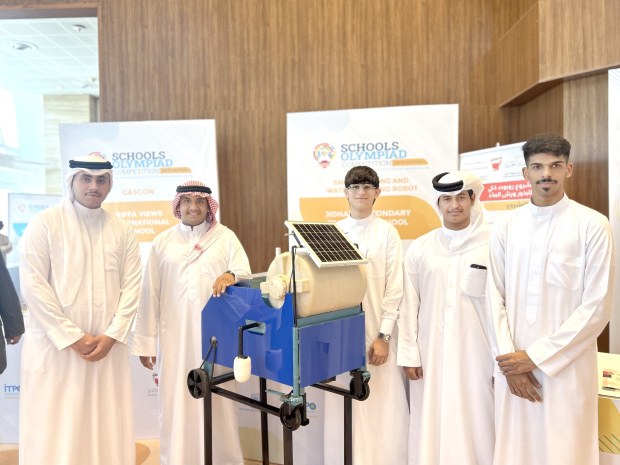
A solar-powered robot designed by a team of innovative Bahraini students has won a top prize at an UN olympiad.
The prototype, brought to life through artificial intelligence (AI), can perform integrated farming functions – including ploughing soil, planting seeds and irrigating lands even during peak summer – reducing the dependence on intensive manual labour and wastage of water and seeds.
The team of seven ambitious creatives from Jidhafs Secondary Technical School for Boys has made the kingdom proud by earning the second place in the United Nations Industrial Development Organisation’s (UNIDO) Entrepreneurship and Innovation Olympiad.
The teenagers are excited as they have also received a ‘very positive’ feedback about their project from Bahraini farmers, and are aiming to further improve the robot by enhancing its efficiency.
The robot’s external structure was created by 18-year-olds from the school’s welding department – Mohammed Amin, Bashar Ibrahim, Mahmoud Salman and Ali Hussein.
“We assembled the moving mechanical parts such as the wheels, seeding mechanism and water sprinklers that are connected to the upper tank,” Mr Amin told the GDN.
Sayed Hasan Ali and Mujtaba Mirza – 17-year-olds from the electronics department – put together the electrical connections.
“We were responsible for connecting the solar cells to the electric motors and an Arduino chip that enables us to control the robot remotely,” Mr Ali said.
“We also installed a camera that allows monitoring the planting process through an accompanying smartphone application,” Mr Mirza added.
Sayed Hasan Haydar, 18, from the information technology department was tasked with programming the Arduino chip to fully control the robot’s functions, such as moving its body, ploughing the soil and seeding in specific quantities depending on the type of crop.
“This project reflected a true spirit of co-operation among us, as the efforts of the various departments were integrated to produce a harmonious work that expressed a collective awareness, a shared understanding of the goals and a joint effort,” Mr Haydar expressed.
“The robot contributes to precise control over the amount of water used, helping to prevent waste and rationalise consumption.
“It also enables automated farming during the summer when manual labour is difficult by providing the ability to remotely monitor and control the farming process, reducing errors that could result from haphazard manual farming.”
According to Mr Haydar, one of the biggest challenges the team faced was determining the amount of water required for each type of seed.
“We had to do several practical experiments to ensure accuracy and effectiveness,” he added.
The students are currently working to further develop the project by improving its accuracy and enhancing production capabilities and are hoping to complete it by the beginning of the next academic year.
“Several farmers have expressed interest in owning the robot and have provided us with constructive feedback that we are using to improve the design and technologies used,” Mr Haydar said.
“We are aiming to launch more advanced versions that meet user needs and keep pace with technological advancements,” he added.
The Education Ministry had recently organised an event to honour students of government schools who won the sixth and seventh editions of the Olympiad competition, held under the theme ‘Entrepreneurship and Innovation: To Achieve the Sustainable Development Goals 2030’.
rima@gdnmedia.bh