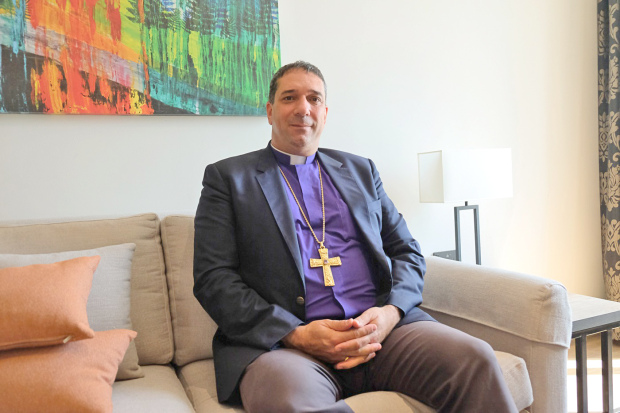
Gaza has endured one of its deadliest weeks in recent memory and the tears of its people are shared by the leading Christian clergyman living, preaching and serving his community in the warzone.
Israeli air strikes have reduced entire neighbourhoods to rubble, with the Mushtaha Tower and other high-rise buildings destroyed in recent days.
Aid agencies have been warning that the territory has reached the highest level of food insecurity, with famine deaths mounting daily.

For The Most Reverend Hosam Elias Naoum, the Archbishop of Jerusalem
For The Most Reverend Hosam Elias Naoum, Archbishop of Jerusalem, these developments only reinforce his description of life in Gaza as a deadly game for survival and in a previous interview with the GDN, he called it the ‘Hunger Games’.
“We are witnessing a lot of rising violence in the area between extremists, and violence is becoming the norm,” he said.
“The language of bloodshed is becoming the norm. I used the word ‘Hunger Games’ because I was thinking about people trying to get their daily bread, and they sometimes risk paying the price with their lives. No human heart or mind can condone this or agree with something like this.”
Humanitarian
Amid the war, Gaza’s small Christian community has played a large role in humanitarian efforts and the Archbishop is the leader of the Episcopal Diocese of Jerusalem, which also runs Al Ahli Arab Baptist Hospital in the city.
Originally founded in 1882, it is the only Christian hospital in the city and has managed to stay open throughout the conflict, despite a number of challenges, including an explosion which killed between 200 and 500 people, according to various sources.

Al Arab Baptist Hospital in the immediate aftermath of the first explosion in October 2023
In April this year, Israel bombed the hospital, taking out its emergency department and requiring the evacuation of its patients.
“Our hospital in Gaza has been attacked at least 10 times by rockets or missiles,” Archbishop Naoum added.
“One building totally collapsed. We’ve erected tents and even opened the church, using pews for injured and sick people. We continue to serve with the little resources we have.
“Because of the blockade, we don’t receive enough fuel, medical supplies, or food. We’re barely going. Our staff are heroes – they are preserving life and believe in the sanctity of life especially in the midst of war.”

Medical teams at the hospital
Archbishop Naoum emphasised that his community is not an external minority but an integral part of the Palestinian fabric.
“We as Christians feel part and parcel of the community,” he explained.
“We’re not expats or a congregation outside the fabric of society. We are Arab Christians.
“Arabic is my first language. Before 1948, Christians, Muslims, and Jews lived side by side for centuries.
“Today, we are divided by politics, but we have one destiny, one future.”

The hospital’s location
At the crossroads of the three religions lies Archbishop Naoum’s home city of Jerusalem, considered sacred by Christians, Muslims and Jews.
However, he warned that Jerusalem risks losing its sacred role unless this diversity is preserved.
“Diversity is something to be celebrated,” he added.
“The mosaic of the three religions in Jerusalem is precious. God chose Jerusalem to be one of the most sacred cities in the world.
“But honestly, none of us deserve Jerusalem unless we all appreciate what it stands for.”
He also expressed alarm at the erosion of the two-state solution from some agendas, warning that its absence paves the way for entrenched inequality.
“Having the two-state solution disappear totally from the political agenda is very dangerous,” he warned. “We risk ending up in an apartheid regime, no matter who is in charge.
“A one-state solution is a recipe for another disaster that will bring deepening discrimination, hatred and segregation.”
He argued that recognising Palestinian statehood is not a threat to Israel but a guarantee of its security.
“I know that to the Israelis, offering a Palestinian state might seem to endanger their security, but on the contrary, this will ensure their security,” he believes.
“There will be no reason why Palestinians would attack Israel if you end the occupation.
“We, as Palestinians, will stand with Israel against whoever tries to endanger this peace resolution.
“It’s easy to engage in war, but it’s very difficult to engage in peace building and reconciliation.
“People who want the war to continue do so because by keeping the war going, they become richer and more powerful.
“It’s not a conspiracy theory – it’s on the ground.
“If I were a politician, I would be working diligently to save lives.
“Today, people use this excuse to kill other people.”
Despite the devastation, Archbishop Naoum insisted that despair cannot have the final word. “No war continues forever,” he added.
“Those who have voices of peace will be remembered for times to come. We have to hold onto hope. When the war ends, we will need at least five to 10 years just to remove the rubble.
“I also envision building a new harbour in Gaza, creating a viable state that can trade and have access to the international community.
“With international support, in 20 years, we could transform Gaza into something beautiful – maybe even the ‘Riviera’ that was once imagined.”
The Archbishop emphasised that the religious traditions of the Holy Land must be harnessed as sources of reconciliation rather than division.
“We are trying to hang on to dialogue,” he added.
“We say that faiths, whether Islam, Judaism, or Christianity, are not part of the problem.
“They should be part of the solution. Religious communities must continue to hold onto humanitarian and divine values, showing how we can live together and coexist.”
In his view, the GCC provides a compelling example of this coexistence.
Bahrain’s interfaith initiatives, from joint prayer gatherings to dialogues hosted by the King Hamad Global Centre for Peaceful Coexistence, show how religious diversity can be an asset rather than a red line.
During last week’s high profile visit to the kingdom, His Majesty King Hamad received the Archbishop alongside Bishop Sean Semple, Bishop of Cyprus and the Gulf of the Episcopal Church in Jerusalem and the Middle East, at Safriya Palace. They were accompanied by Dr Richard Fermer, Dean of Saint Christopher’s Anglican Cathedral in Bahrain and UK Ambassador Alastair Long.
naman@gdnmedia.bh