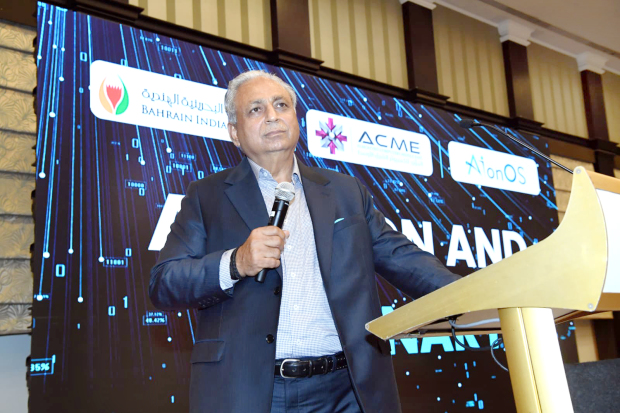
Bahrain has the technological foundation to become a global leader in artificial intelligence (AI) but must unify its fragmented efforts and articulate a bold, unifying vision to get there, a prominent Indian business leader has declared.
Delivering the keynote speech during a Bahrain India Society Business Networking Dinner at the InterContinental Regency, C P Gurnani, the former chief executive officer of Tech Mahindra, said the country is more technologically advanced than many people realise.
“In terms of technology, Bahrain is far more prepared than the world knows,” said Mr Gurnani, who is also co-founder and vice-chairman of AIonOS, an AI-first company. “The foundation is already here, and there’s a remarkable opportunity to build on it.”
Co-ordination
Mr Gurnani highlighted a key challenge facing the kingdom’s AI ambitions: a need to increase co-ordination among different government bodies.
“I have seen countless AI initiatives within different ministries – from Defence to Industry and Commerce – all seemingly working independently,” he noted. “This is a brilliant start, but to truly maximise the impact and effectiveness of AI, we need to unify these efforts.”
He called for a single, cohesive national strategy, similar to India’s Ministry of IT or Nasscom, to consolidate the kingdom’s resources and align goals. “The country needs to set a powerful goal, whether it’s becoming a ‘startup nation’ or a global leader in a specific AI domain, to guide all of the efforts and rally the people,” he added.
The need for a national AI strategy is also a matter of cultural preservation, according to Mr Gurnani. He stressed that a country must have its own large language model (LLM) to safeguard its heritage and history from being misinterpreted by foreign AI systems.
“For a country like Bahrain with a population of 1.5 million people, you might ask, ‘Why do I need my own LLM?’” he said. “The answer is simple: you have a 5,000-year history that can be misinterpreted by an outside source. Your culture and heritage, which are over a thousand years old, could be rewritten by someone else. That’s why it’s so important to put your own voice on the table.”
LLMs like Grok, GPT Series, Gemini, and DeepSeek are AI programmes trained on vast amounts of text data, enabling them to understand and generate human-like text.
Mr Gurnani also emphasised that the key to AI advancement lies in empowering the youth and the startup community. He argued that the barrier to entry in the field is lower than ever before and that young minds are the most fertile ground for innovation.
“Bahrain can leapfrog ahead in AI by giving them the tools and knowledge in neural intelligence, applications, infrastructure, and all the essential elements,” he said.
He added that future AI expertise goes beyond basic course completion and requires a combination of technical skills with creative and domain-specific knowledge. “The real value will come from our ability to integrate these diverse skill sets to create meaningful applications and solve complex problems,” he added.
For startups to thrive, said Mr Gurnani, there needs to be a complete ecosystem – a food chain of innovation and monetisation for investors.
“It’s like growing a plant; you need to prepare the soil, provide the seed, and add fertiliser and water. That’s what the kingdom needs to do for its startup ecosystem.”
According to him, India’s journey to becoming a top-tier startup hub is a great example. “Prime Minister Narendra Modi’s vision transformed us from the seventh to possibly the second or third largest ecosystem. They did this by giving grants to universities to incubate startups, creating government programmes to procure from startups, and making it easier for capital to flow in and out for venture funds. This last part was crucial because it made investing a two-way street, not a one-way trap for capital.”
He underlined tourism as ‘a huge opportunity for Bahrain’, with AI potentially acting as a key driver in making it even bigger.
“Bahrain needs to use AI to get a deeper understanding of its tourists – who they are, what they like, and what they’re willing to spend on. By leveraging these insights, the kingdom can create truly personalised experiences that will not only attract more visitors but also encourage them to spend more while they’re here. The future of tourism is all about creating unique, tailored journeys, and AI is the tool to help us do that.”
Mr Gurnani is renowned for his role in leading the acquisition and revival of Satyam Computer Services, a successful turnaround that has become a case study at Harvard Business School. At the event, he confirmed his partnership with Almoayyed Computers Middle East to advance AI solutions in Bahrain.
avinash@gdnmedia.bh