

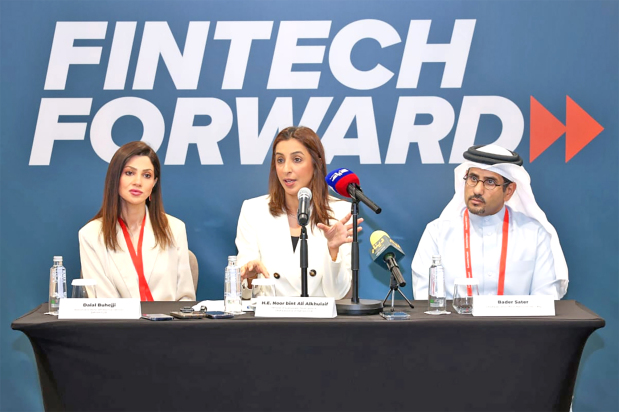
Bahrain’s position as a regional financial technology (fintech) and artificial intelligence (AI) leader was cemented this week as 38 agreements, deals and memoranda of understanding (MoUs) were signed during the two-day Fintech Forward 2025 event at Exhibition World Bahrain, which saw more than 2,000 delegates register.
Sustainable Development Minister and Bahrain Economic Development Board (EDB) chief executive officer Noor Al Khulaif revealed that the kingdom is aggressively leveraging its regulatory agility and skilled local talent to attract global partnerships, ensuring it maintains a competitive edge in the evolving digital landscape.
Ms Al Khulaif praised the Central Bank of Bahrain’s (CBB) proactive role in fostering innovation. “The CBB isn’t sitting on the sidelines; it’s actively engaging in discussions and partnerships. Our regulatory sandbox is the perfect example of that dialogue in action,” she said.
The sandbox is central to this strategy. “It allows fintech companies to test their technology and then directly discuss necessary regulatory changes with the CBB. That’s true agility.”
This mechanism ensures ongoing dialogue with international and local companies, helping the EDB identify the most effective regulations needed to create a supportive ecosystem conducive to job creation.
Recognising the disruptive growth of AI, the minister confirmed Bahrain is making strategic investments to become a regional hub.
“We fully recognise the disruptive growth of AI and are actively exploring its potential. Bahrain is uniquely positioned to leverage this shift,” Ms Al Khulaif added.
“We plan to build on our existing strengths – being a service centre and having skilled human capital – to lead the way in the AI landscape.”
This vision is supported by tangible infrastructure development.
“We are making serious investments in infrastructure, from data centres to partnerships, to create a thriving, collaborative AI ecosystem.”
The EDB is also actively seeking global partnerships for knowledge transfer, with a key focus on integrating AI into the education system from a young age.
The kingdom’s forward-looking approach to technology is founded on two decades of successful economic reform and diversification.
“Bahrain has been actively reforming its economy for over two decades,” Ms Al Khulaif said, highlighting the significant shift away from oil dependency. “In the last 20 years, the oil sector’s contribution has dropped dramatically, from over 40 per cent to less than 15pc of the economy.”
Furthermore, the minister noted that the economy has more than quadrupled in size, and crucially, no single non-oil sector exceeds 20pc of the total, which she called the “definition of successful diversification.”
With financial services being the largest non-oil economic contributor, Ms Al Khulaif outlined clear goals for the fintech sector. “Our aim is clear: to be a regional leader in both Islamic banking and asset management,” she said.
Anticipating AI’s growing role, the EDB expects new regulations to facilitate its use by fintech firms.
“Expect announcements, potentially extending into 2026, as we focus on supporting SMEs and improving access to finance.”
The EDB is developing “centres of excellence” – including digital banking, crypto assets, insurance, reinsurance and wealth management – and noted that global tech hubs like Citibank are already choosing Bahrain due to its available talent and strong government support.
“Bahrain possesses a significant advantage: local talent,” the minister said. “A large percentage of our workforce in finance is Bahraini, backed by a long history of investing in the infrastructure and human capital required to export financial services across the region.”
Dalal Buhejji, an executive director for business development in financial services at the EDB, and Bader Sater, the chief executive officer of the Bahrain FinTech Bay, were also present during the Press conference.
avinash@gdnmedia.bh
&uuid=(email))