MY husband Raymond Weaver was 28 years old when he arrived in Bahrain in 1956. He was an engineer and worked in the powerhouse. They were still expanding the township and so men, even if they were married, lived in bachelor accommodation for about two and half years, after which, a house would be allocated to them and they could move in and bring their families over.
My son Andrew, then five, and I, joined Ray (Raymond) two years later. I was 26 then. We flew aboard the Bristol Britannia, from London to Nice, to Rome, to Damascus, to Kuwait, and then, finally to Bahrain.
Helena, my second child, was made in Bahrain but because of potential anticipated complications for her birth, I was told by the Awali Hospital to go back to the UK for my delivery. We returned when she was just six weeks old ... the youngest age that one was allowed to fly back then.

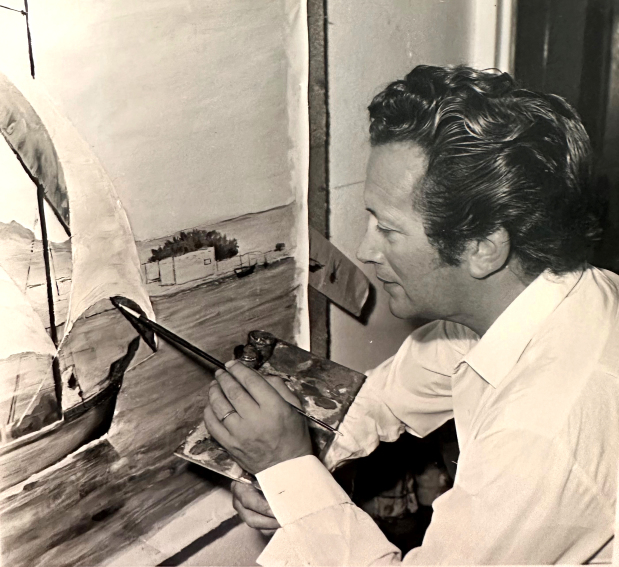
Mr Weaver with his completed artwork depicting a traditional Bahraini boat
We had to move many houses before we got a permanent one. At first, it was difficult, as we had to keep making new friends. However, we did forge some long-lasting relationships over time.
We bonded over sport and recreation. There was the Bapco Sailing Club at Zallaq. Ray was a founding member and while he never actually owned a boat, he loved sailing and was one of the people to get the club going.
There was the Awali Squash Club and we often travelled to Kuwait and Dubai for international matches. All of this brought us together as a community.

Mr and Mrs Weaver cooking at their home in the township
Back then, there were no tarmac roads in Bahrain, just the oiled sand roads. Coming from Manama, there was the Adhari Pool. Before you got there, on the left-hand side, coming from Awali, they had a sort of river where people did their washing and then spread it out on the sand to dry. My children called it the ‘wash wash’.
In Awali, there were masses and masses of palm trees through which you could see the burial mounds – the tumuli – that came right down to the main road.

Mr Weaver with a copy of the GDN carrying a story on the reunion in Bahrain in October 2019
Most of the locals’ houses were made of palm fronds and called barastis. There was an encampment just outside of Awali for the longest time. Our garages were also barastis. There was nothing around our houses. Just sand. So we started planting hedges and grass. Bahraini gardeners used to come and water them.
Around the time, I also joined the Bahrain Garden Club and I hear they are still going strong. There used to be a hedge at the premises (that was removed for security reasons and replaced with a wall more than 15 years ago), which was planted by my friend Mary Bowler in the 1970s.

The duo with their youngest Helena during Christmas time
When it came to food as well, we did not have much variety and supplies were limited. Supplies mostly came in tins that we bought from the commissary at the township. The meat was frozen and came from either Australia or New Zealand. It was much later that Ashrafs started a supermarket that sold fresh meat. You could not get fresh milk either and we had to reconstitute our own milk powder with water. In later years, the Bahrain Danish Dairy (now Awal Dairy Company) formed in Budaiya and reconstituted the powder on an industrial scale.
We did not have much fresh produce until we discovered the covered bazaar that lead up to Manama Suq. Later, we had the experimental farm in Budaiya; Ray did some posters for them about fruit and vegetables to educate the workers there – he was an artist.

Mr Weaver, second from left, in character for a play
An interesting memory about his art is when we asked the potters at A’ali to produce a moneybox for a fundraising event for the church in Awali. I spoke to the artisans to create a vessel with a slit in it where the money could be inserted. Ray drew a picture that they could understand and the moneyboxes were made. I believe they are produced to this day. We had a copy of the original sketch but it is long gone.
Every week, we went to the Manama market on a green and white bus to do our shopping or if we had to make a call back home – we had to book one with Cable and Wireless. There was a street where you could find beautiful materials if you wanted to stitch clothes. The tailors came to our house and we could show them a photo of what we liked and they would make it for us.

At the Bapco refinery with colleague Brendan Thomas Beckett, right. Mr Beckett used to sign everything ‘BTB’ and so earned the nickname ‘BeeTeeBee’
When Jashanmal and Yateem opened, we had more options. They were some of the first supermarkets in Bahrain. Later, there used to be one on the edge of Isa Town. One year they had fresh-cut Christmas trees for BD60 per piece!
Christmas time was lively and we had many Bahraini friends who, even though they did not celebrate, enjoyed the spirit of the season. It was so informal, so friendly and everyone respected each other. So many of our children who grew up there still call Bahrain their ‘home’.

Mr Weaver, left, at the Zallaq Sailing club
In fact, a Bahraini, who lived in one of the barastis outside the township, once helped me find my lost car. I would keep my children’s clothes in boxes when they outgrew them and the families were happy to use them.
Another fond memory that speaks of the locals’ endearing nature is when Ray and I returned to Bahrain in 1997 for a reunion event of the Bahrain Society in London. We got into a taxi outside the Gulf Hotel Convention and Spa. The driver and I started talking and my husband was sitting in the back seat with our daughter Helena. At one point, my husband said he used to work for Bapco Energies and the driver responded that he used to work there too but was now retired. He went on to talk about a ‘wonderful boss’ he had. We asked him what his boss’ name was and nothing could have prepared us for what he said: ‘Mr Weaver’. It was quite emotional.
Back at the township, children did not start school until they were seven so one of the residents, Elsie Cox, decided to start a nursery. She rented a hall near the (Riffa) Golf Club and all of us parents who put our children there had to help – my daughter attended too.
The original moneypot that Mr Weaver designed owned by his daughter
The children engaged in activities like building sand castles and playing with each other. The nursery then moved to the township premises – two houses were allocated – and we continued to help with running it. We would watch the children while they were playing, and teach them things like how to say ‘please’ and ‘thank you’.
In the summer, we conducted summer camps for the children. As local leaves came by only after every two-and-a-half-years, they needed something to do when the schools were closed. The mums conducted activities like making papier-mâché sculptures.
One of the nice things about life at the township, especially for our children, was that it was safe. The biggest crime back in the day was somebody’s laundry taken off the line! Our children went out and played with their friends and we did not need to chaperone them everywhere. That is how safe the island was.

Mr Weaver playing badminton on a Friday afternoon at the Bapco Club. Bapco used to set up the ballroom with the courts and nets so that they could play. This is where he taught numerous Awali children to play
Ray and I left Bahrain in 1982. I am now retired and live in the West Country in the UK, a small town called Clevedon. My husband passed away on June 28, 2022, in a nursing home three miles from where we live and is interred in Clevedon – he was five days shy of his 95th birthday. I will always carry the many fond memories of our life on the island – a place we called home for so many years.
melissa@gdnmedia.bh