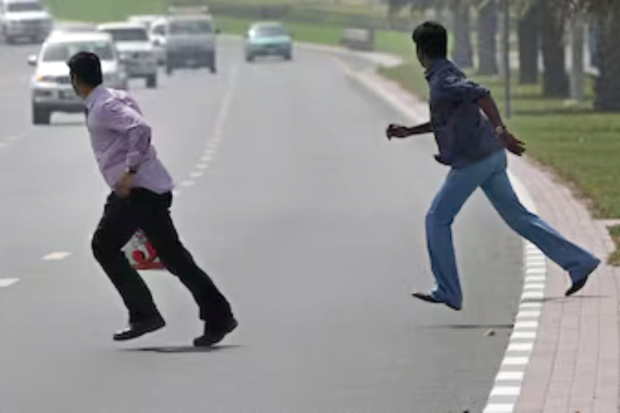
Bahrain is considering introducing penalties for jaywalking, under a new parliamentary proposal that aims to ‘enhance road safety’ and align the kingdom’s pedestrian laws with several other nations.
Jaywalking is when someone illegally crosses a street and will likely face a fine. Generally, pedestrians must use designated crossings and abide by walk signals that indicate when they may or may not cross.
The term originated in the US, referring to an ignorant or reckless person (a ‘jay’) who walked in a dangerous way.
The initiative in Bahrain is being spearheaded by the Strategic Thinking Bloc, a group of five MPs committed to long-term policy reform.
The proposal is led by Bloc president and chairman of Parliament’s financial and economic affairs committee, MP Ahmed Al Salloom, and has already attracted support from outside the bloc, including independent MPs such as MP Muneer Suroor.
“Jaywalking not only endangers lives, but also disrupts traffic and causes unnecessary accidents,” said Mr Al Salloom. “This proposal is about fostering a culture of responsibility and awareness.”
If passed, the legislation would impose fines on individuals who cross streets illegally, outside designated pedestrian crossings or against traffic signals.
The move would bring Bahrain in line with neighbouring UAE, where jaywalking can lead to a fine of up to Dh10,000 according to a new traffic law, as well as the US, Germany, Switzerland, South Korea and Iran, where it is also a fineable offence. It is not the case in the UK, although pedestrians are banned on motorways.
According to Mr Al Salloom, the proposed law is not about punishing pedestrians, but protecting them.
“Our streets are becoming increasingly busy, and we must ensure the safety of all users – drivers and pedestrians alike,” Mr Al Salloom said.
He added that Bahrain has made significant progress in road infrastructure and traffic control systems, but that the human factor – specifically pedestrian behaviour – remains challenging at times.
“In many countries, penalties for jaywalking are standard, and they have proven effective in reducing road casualties. This is a step towards safer, smarter urban mobility,” said Mr Al Salloom.
The Strategic Thinking Bloc believes the new law would not only cut traffic accidents and the burden on emergency services but also improve traffic flow.
The move has found support beyond five MP-members from the bloc, with several MPs from across the political spectrum backing the proposal.
Mr Suroor said the idea resonates with growing concerns about pedestrian safety in urban and suburban areas.
“We’ve all seen people dart across roads, even highways, endangering themselves and others. It’s reckless, and it’s time we address it with clear legislation,” he said.
“This isn’t about issuing tickets – it’s about saving lives.”
Mr Suroor highlighted that public awareness campaigns would need to accompany the legislation to educate citizens and expatriates about the dangers of jaywalking and encourage safer alternatives.
“The aim is not to punish but to change behaviour. Education, signage and proper pedestrian infrastructure must go hand-in-hand with enforcement measures,” he added.
“As Bahrain continues to modernise its transport systems and urban planning, the initiative reflects a growing recognition of the need for comprehensive, enforceable laws that protect all road users.”
While the proposed penalties have yet to be specified, sources suggest the fines could be nominal at first, with harsher penalties for repeat offenders or cases involving accidents.
The Interior Ministry and the General Directorate of Traffic are expected to be consulted in the drafting and enforcement phases. If approved, the law would be the first of its kind in Bahrain targeting pedestrian violations.
Public opinion remains divided. While many residents welcome measures that promote safety, others argue that more pedestrian bridges, zebra crossings and signalised crossings must be built first to offer safer alternatives to jaywalking.
In response, MPs behind the bill have pledged to push for improvements in pedestrian infrastructure as part of a broader traffic reform strategy following the vast tough amendments to the 2014 Traffic Law introduced last month.
The proposal will be reviewed by the foreign affairs, defence and national security committee before potentially being forwarded to the Cabinet for consideration.
If endorsed, it could be enacted as early as 2026.
mohammed@gdnmedia.bh