

Bahrain’s drive towards a digital economy has gained significant momentum, with point-of-sale (POS) transactions jumping by more than 22 per cent in the first eight months of the year, driven overwhelmingly by contactless payments, new Central Bank of Bahrain (CBB) data reveals.
The surge in digital transactions and broader stability in the financial sector were among the key indicators reviewed yesterday by the CBB board of directors during their fourth meeting for 2025, chaired by Hassan Al Jalahma.
The figures, presented during the board’s review of key monetary and banking indicators up to August 2025, highlight a sharp rise in the adoption of modern payment methods across the kingdom.

Mr Al Jalahma
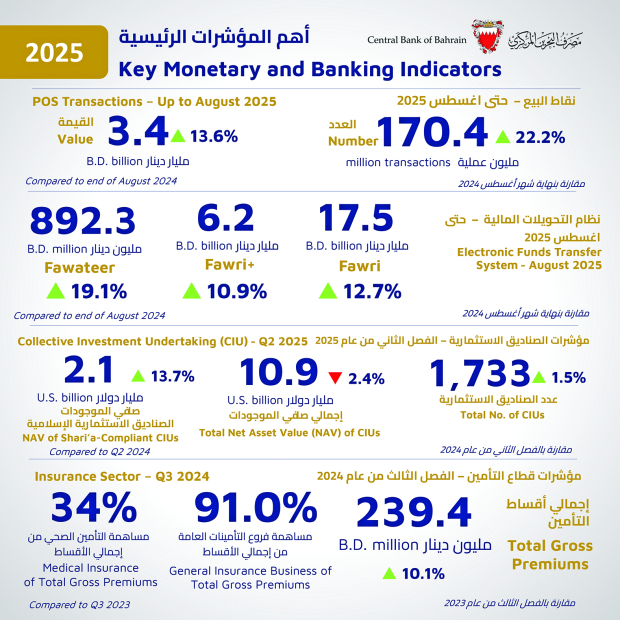
Between January and August 2025, the total number of POS transactions reached a massive 170.4 million, marking a robust increase of 22.2pc compared to the same period in 2024.
Crucially, contactless transactions accounted for 77.6pc of this volume.
In terms of value, the total of POS transactions hit BD3.4 billion, a growth of 13.6pc year-on-year, with contactless payments making up 51.7pc of the total value.
The CBB also reported continued expansion in lending to resident economic sectors.
The outstanding balance of total loans and credit facilities climbed to BD12.6bn by the end of August 2025, an increase of 4pc from August 2024.
The personal sector remains the largest borrower, accounting for 48.8pc of total loans, while the business sector holds a significant 40.9pc share.
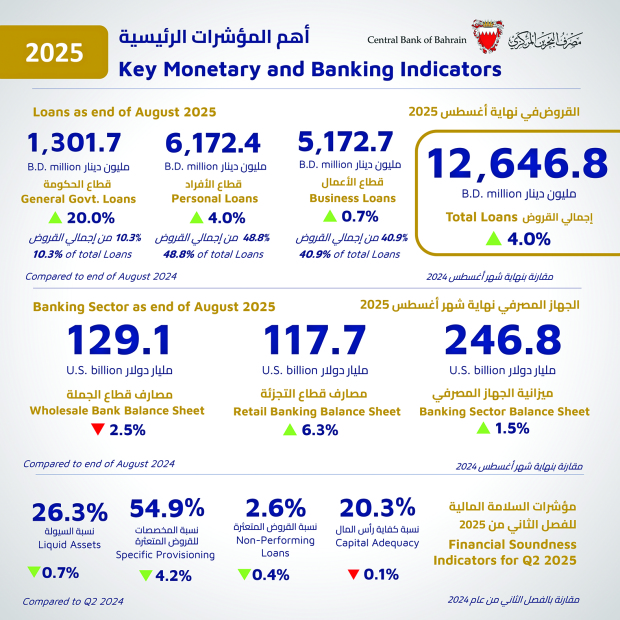
The overall balance sheet of the banking system, encompassing both retail and wholesale banks, expanded to $246.8bn at the end of August 2025, reflecting a 1.5pc growth compared to the previous year.
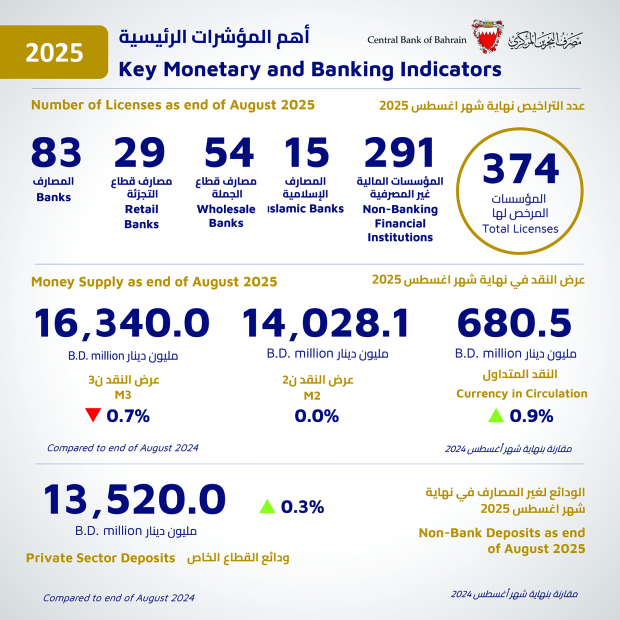
Private deposits in retail banks saw a modest increase, reaching BD13.5bn, up by 0.3pc compared to the end of August 2024.
However, the CBB also noted a slight dip in money supply, which decreased by BD0.1bn to stand at BD16.3bn at the end of August 2025, compared to the same period in 2024.
The sector maintained strong capital buffers, with the overall banking sector capital adequacy ratio at 20.3pc in the second quarter of 2025, a marginal dip from 20.4pc in Q2 2024.
Islamic retail banks showed a high capital adequacy ratio of 23.8pc, while conventional retail banks stood even higher at 29.7pc.
In the collective investment sphere, the net asset value (NAV) of collective investment undertakings (CIUs) saw a slight overall decline of 2.35pc in Q2 2025 year-on-year, dropping to $10.915bn.
Despite this, Sharia-compliant CIUs bucked the trend, recording a healthy surge of 13.69pc in their NAV, increasing from $1.812bn to $2.060bn.
The total number of registered CIUs also grew, reaching 1,733 in June 2025, up from 1,707 a year prior.
The board also reviewed progress on supervisory initiatives, the payment system upgrade, CBB’s financial performance as of September, and highlighted the importance of the GP15 Graduate Development Programme.
avinash@gdnmedia.bh
&uuid=(email))