

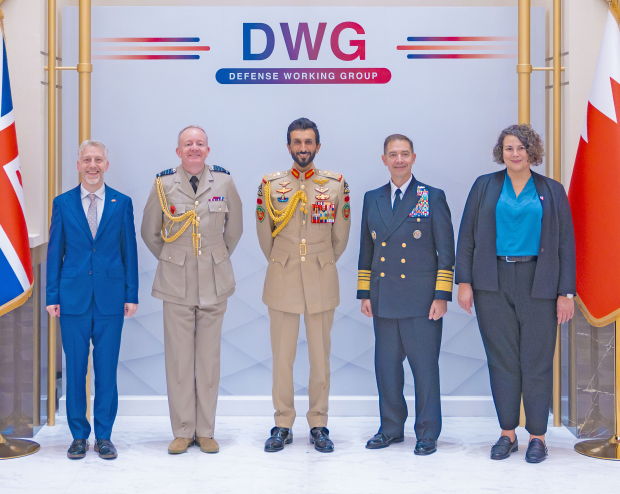
Bahrain, US and UK national security representatives met yesterday for the first meeting of the Defence Working Group (DWG), operating under the umbrella of the Comprehensive Security Integration and Prosperity Agreement (C-SIPA).
DWG members welcomed the UK’s accession to C-SIPA, noting that the UK’s expertise and long-standing commitment to regional and global stability significantly reinforce the strategic objectives of the agreement.
The meeting was attended by National Security Adviser and Supreme Defence Council Secretary General Lieutenant General Shaikh Nasser bin Hamad Al Khalifa, UK Chief of the Defence Staff Air Chief Marshal Sir Richard Knighton and US Central Command commander Admiral Brad Cooper.
The group spotlighted Article II of C-SIPA, which treats ‘any external aggression against the sovereignty, independence and territorial integrity of any of the Parties as a matter of grave concern’.
“The Defence Working Group is a group emanating from C-SIPA,” Deputy National Security Adviser and Supreme Defence Council Deputy Secretary General Colonel Shaikh Khalid bin Ali bin Jaber Al Khalifa told reporters, during a Press meet at the Supreme Defence Council offices in Sakhir.
“This group is the main platform for all joint security and defence issues among the member states.
“Today is considered a historic day for the agreement, as it is the first day that the third state, the UK, meets within this agreement.”
Col Shaikh Khalid added that C-SIPA had already added to Bahrain’s defence capabilities and improved their potential as a deterrent for regional instability, noting that the coming year would lead to more integration between the three member states.
His Royal Highness Prince Salman bin Hamad Al Khalifa, Crown Prince and Prime Minister, signed C-SIPA in September 2023 with then-Secretary of State Antony Blinken.
One of the key points that C-SIPA delivers is enhancing deterrence, including through expanded defence and security co-operation, interoperability, and mutual intelligence capacity building.
In his opening keynote on Friday at the International Institute of Strategic Studies (IISS) Manama Dialogue, Lt Gen Shaikh Nasser announced that he is leading the DWG, working on the defence aspect of the agreement.
British Ambassador Alastair Long reiterated after yesterday’s first meeting that C-SIPA ‘has three pillars in it: closer defence and security collaboration; closer collaboration on things that drive mutual prosperity for the wider region and world; and the embrace of technological progress.’
“We’ve started today in the DWG with the first pillar, but we were discussing on the margins that we have good thoughts on the other two pillars.”
Mr Long noted that with the DWG established, the three countries might consider working groups for the other two pillars as well, but this would require ‘a bit of thinking’.
The UK was invited to join the C-SIPA agreement at the IISS Manama Dialogue last year, and officially joined the agreement in July this year.
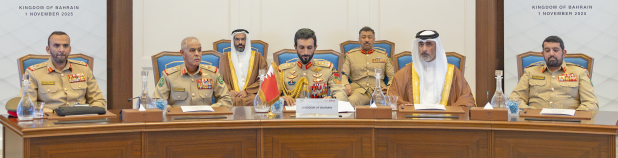
Lt Gen Shaikh Nasser attends the DWG meeting in the presence of Col Shaikh Khalid and other officials
“The idea of security that is interdependent with prosperity is something we firmly believe in,” Mr Long added.
“It is an agreement that understands that the basis of security for this region is recognition of the State of Israel and for it to exist securely, and also the creation of a Palestinian State.
“And then there are important other aspects to the agreement around the adoption of technology and seeking to progress together on that pathway, and working together in all manner of fields related to mutual prosperity as well.
“This was the first meeting trilaterally, and I think we hoped to show that this is real, we have real purpose together, and that it is open to others.”
When speaking with reporters after the meeting, US Central Command public affairs director Captain Tim Hawkins added that the defence aspect of the agreement calls on member states ‘to work together on taking threats seriously’, both from state and non-state actors.
“All threats have our collective attention,” Capt Hawkins added.
“We still see destabilising activity from Iran, which has our attention.
“In general as well, we are looking to work together.
“We are stronger when there are more partners working together, and it is the collective strength that enables us to promote a more stable and prosperous region.”
naman@gdnmedia.bh
&uuid=(email))